
Ga onbeperkt met Magzter GOLD
Krijg onbeperkte toegang tot meer dan 9000 tijdschriften, kranten en Premium-verhalen voor slechts
Poging GOUD - Vrij
Image a fisheye Milky Way
BBC Sky at Night Magazine
|August 2023
Ultra-wide-angle lenses capture our Galaxy crossing the whole sky. Here's what to consider
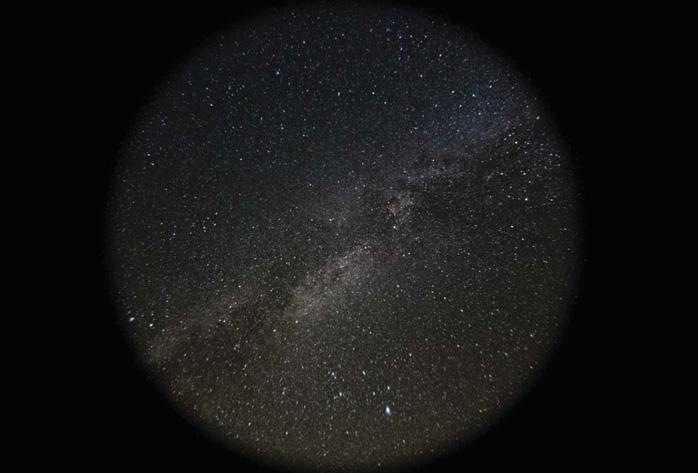
The night sky can be breathtaking, especially when it contains bright views of the Milky Way from a darksky location. But what's the best way to capture the entire stretch of the night sky? There are several methods, but as ever compromises have to be made.
A camera with an interchangeable lens system such as a DSLR or mirrorless camera gives you the best of all worlds, allowing you to go wide-angle or mid-angle. A wide-angle lens has a focal length of 17mm or less, a mid-angle is 18-40mm. Anything over this is getting in too close to the subject to be considered all-encompassing.
If you choose a mid-angle focal length, you'll be able to cover a decent portion of the Milky Way, but you'll need to consider mosaicking shots together to cover all of it. However, seemingly perfect shots can then reveal issues such as lens distortion and edge vignetting, so be prepared to put significant time into a Milky Way mosaic in order to get something that looks natural.
An alternative is to use a wide-angle lens, essentially capturing most of the visible part of the Milky Way in one fell swoop. It seems an obvious choice to reduce workload, but wide-angle lenses have drawbacks of their own.
As with meteor photography, using a wide-angle lens may seem the ideal route - catching a trail is down to luck, but the narrower the field of view, the less chance of success. So it seems a no-brainer to choose a lens that covers the entire sky in one go.

Dit verhaal komt uit de August 2023-editie van BBC Sky at Night Magazine.
Abonneer u op Magzter GOLD voor toegang tot duizenden zorgvuldig samengestelde premiumverhalen en meer dan 9000 tijdschriften en kranten.
Bent u al abonnee? Aanmelden
MEER VERHALEN VAN BBC Sky at Night Magazine

BBC Sky at Night Magazine
New moons found around Jupiter and Saturn
And we think we know why Jupiter has more big moons than its neighbour

1 min
June 2026

BBC Sky at Night Magazine
Q&A WITH A STAR DIMMING EXPERT
Extraordinary flickering in a distant star has led astronomers to the wreckage of two planets colliding. We meet one of the team behind the rare discovery
3 mins
June 2026
BBC Sky at Night Magazine
Don't let stars overpower your images
How to use Siril freeware to turn down the stars and turn up delicate details
3 mins
June 2026

BBC Sky at Night Magazine
Chasing UFOs on the web
Robert Pateman investigates how the internet has changed the way we view and report on UFO sightings
6 mins
June 2026

BBC Sky at Night Magazine
Under southern SKIES Stargazing in Australia's Warrumbungles
Ten years after Australia gained its first International Dark Sky Park, Yvette Cook finds out exactly why Warrumbungle National Park is a world-class astrotourism destination
7 mins
June 2026

BBC Sky at Night Magazine
Pick the perfect eyepiece
How to choose the right match for your target, telescope and sky conditions
3 mins
June 2026
BBC Sky at Night Magazine
What's really at the heart of our GALAXY?
Colin Stuart investigates the radical claim that our Milky Way's central supermassive black hole may not exist after all
7 mins
June 2026

BBC Sky at Night Magazine
A new way to find advanced alien life
Model could find patterns across multiple planets that reveal life - whatever form it takes
1 mins
June 2026

BBC Sky at Night Magazine
Star-forming region captured in amazing clarity
Piercing the dust clouds allows astronomers to see little-known, youthful massive stars
1 min
June 2026
BBC Sky at Night Magazine
RVO Horizon 102 tabletop Dobsonian
An affordable, easy, carry-anywhere telescope that makes learning the sky a pleasure
4 mins
June 2026
Translate
Change font size