
Ga onbeperkt met Magzter GOLD
Krijg onbeperkte toegang tot meer dan 9000 tijdschriften, kranten en Premium-verhalen voor slechts
Poging GOUD - Vrij
TOT-AN IMPERATIVE FOR SUBMARINE MANUFACTURING
Geopolitics
|December 2024
India's transition from offset strategies to fostering self-reliance through technology transfer (TOT) and local assembly highlights the significance of global collaborations like thyssenkrupp Marine Systems in shaping a robust, indigenised defence ecosystem, a perspective shared by KHALIL RAHMAN, CEO, thyssenkrupp Marine Systems India.

India has seen a major shift in its defence import strategy over the years. It has moved from the “offsetting” strategy, where foreign partners were mandated to reinvest a proportion of the contract in India, to a more sustainable transfer of technology (ToT) and local assembling of imported components. This transition has meant a tectonic shift towards creating and strengthening a self-reliant, indigenously developed defence-industrial complex along with the armed forces and ensuring the successful implementation of the "Make in India" strategy.
As the word suggests, ToT involves the transfer of knowledge, expertise, and intellectual property rights from foreign entities to the Indian partner, typically through licensing agreements, joint ventures, or technology transfer programmes. The local assembly or domestic manufacturing is about products that are manufactured from imported components, parts or semi-finished products, with final assembly taking place at home.
A great example of the local assembly is the import of knock-down kits in the car industry to be assembled in India. thyssenkrupp Marine Systems (tkMS), the German-based providers of naval vessels, surface ships and submarines, has not only built a global reputation and illustrious track record for its performance in the maritime industry, but has also been admired for its unrivalled commitment to the development of international industrial co-operation through strategic partnerships. The German major has promoted exchange of knowledge and resources globally to effectively transfer innovative technologies and solutions for various international companies and governments. A very early example of this is the highly successful 209 class submarine programme with Mazagon Dockyard Ltd in India.
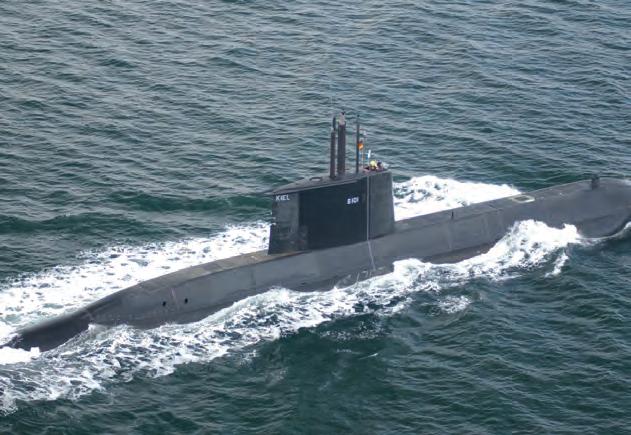 Creating synergies for advanced submarines

Dit verhaal komt uit de December 2024-editie van Geopolitics.
Abonneer u op Magzter GOLD voor toegang tot duizenden zorgvuldig samengestelde premiumverhalen en meer dan 9000 tijdschriften en kranten.
Bent u al abonnee? Aanmelden
MEER VERHALEN VAN Geopolitics

Geopolitics
Navy Advances Amphibious Carrier Evaluation
The Indian Navy has begun technical evaluations for its proposed Landing Helicopter Dock warship programme, widely viewed as a step toward developing a compact, drone-enabled aircraft-carrier capability.

1 min
May 2026

Geopolitics
Indigenous Engine Materials Near Completion
MIDHANI has reportedly completed nearly half of the specialised alloy development work required for India's proposed 120kN engine intended for the Advanced Medium Combat Aircraft programme, with around 80 per cent of the materials already certified.
1 mins
May 2026

Geopolitics
Sheshnag Swarms Transform Battlefield Dynamics
Bengaluru-based NewSpace Ben Hechnologies is preparing to Research Sheshnag-20 swarming loitering munition system for trials with the Indian Army following successful developmental testing.
1 min
May 2026
Geopolitics
MPATGM Nears Production Clearance Milestone
India's indigenous Man-Portable Anti-Tank Guided Missile programme has moved closer to final production approval following successful moving-target trials.
1 min
May 2026
Geopolitics
India Accelerates Future Combat Drones
India is accelerating the development of multiple manned-unmanned teaming programmes under the Combat Air Teaming System initiative as the country prepares for the next generation of network-centric aerial warfare.
1 min
May 2026
Geopolitics
THE IRON RENAISSANCE
India is committing ₹57,000 crore to overhaul its ageing Soviet-era tank fleet into a digital warfighting force. The transformation comes as China's Type 15 tanks loom on Himalayan ridgelines and Ukraine's battlefield lessons echo worldwide. The country's engineers are reimagining the very concept of the tank for a new era of combat. A Special Report
8 mins
May 2026

Geopolitics
THE ALGORITHMIC BATTLEFIELD IS THE FUTURE
As India is confronted with a critical strategic question of whether to prioritise indigenous development or to rely on foreign Artificial Intelligence technologies to guarantee sovereignty and security, JOSEPH P CHACKO analyses indigenous capabilities and the dependence versus self-reliance debate, as well as Al implementations in surveillance, threat detection, and decision support systems within the Indian defence framework.
14 mins
May 2026

Geopolitics
Rafale Partnership Structure Faces Overhaul
India is reportedly examining a major restructuring of the Dassault Reliance Aerospace Limited (DRAL) venture, with discussions underway regarding the induction of a new private-sector partner to strengthen Rafale-related manufacturing and maintenance operations in the country.
1 mins
May 2026

Geopolitics
INDIA'S DEFENCE VISION-2047: CLARITY BEFORE CAPABILITY
While the outlined roadmap for the Indian defence forces to emerge as the best in the world by the time the country celebrates 100 years of independence is timely, argues that one should not rush into creating theatre commands before becoming self-reliant in defence manufacturing.
6 mins
May 2026

Geopolitics
Indigenous Blast Capabilities Expand Rapidly
Sagar Defence Engineering has secured an explosives manufacturing licence, marking a major milestone in the company's expansion into indigenous defence production and reinforcing India's broader push towards strategic self-reliance in military technologies.
1 min
May 2026
Listen
Translate
Change font size