
Ga onbeperkt met Magzter GOLD
Krijg onbeperkte toegang tot meer dan 9000 tijdschriften, kranten en Premium-verhalen voor slechts
Poging GOUD - Vrij
Shishupala to Vishkanya: Changing Nature of India's Coercive Doctrine with Pakistan
The Sunday Guardian
|May 11, 2025
After nearly eight decades of enduring the strategy of 'a thousand cuts', India must respond with its own strategy of poisoning the sources of power of the Pakistani Army.

Ever since the Pakistan Army sent its soldiers disguised as "tribesmen" to attack India in Jammu and Kashmir soon after the creation of Pakistan in 1947, the question of establishing deterrence against an ideological enemy has worried India.
This question has been further muddied by subsequent wars which led to Pakistani defeats, in 1965, 1971, and in Kargil, and yet it is impossible to deny that the Pakistani military state has sought to effectively alter the narrative and project a victory.
The only place the Pakistani establishment could not do this was the actual breaking up of Pakistan after the Bangladesh independence war in 1971. Even in 2019, when India defied hitherto established red lines of crossing into Pakistani territory to hit terror camps after the attack in Pulwama in Kashmir by the terrorist group Jaish-e-Mohammed headquartered in Pakistan, the Pakistani air retaliation, which also involved the capture (and subsequent return) of an Indian pilot, gave Pakistan a face saver.
For many in India, the fact that India had crossed what had been considered a "red line"—going inside Pakistani territory to attack—would signal to Pakistan about its determination to fight terrorism at all costs. And this would convince Pakistan to move away from its strategy of harboring and using Islamist terrorist groups and using them to further the proxy war against India.
The abrogation of Article 370 and the complete constitutional integration of Jammu and Kashmir with the Indian state gave an irreversible sense of closure to many in India.
In the years that followed, a semblance of normalcy dawned on the Jammu and Kashmir region with tourist arrivals of up to 1.6 million in summer 2024. In areas of downtown Srinagar where dusk meant eerie emptiness, and the Indian flag could never be seen, countless tourists and coffee shops opened under the sway of giant Indian Tricolours.
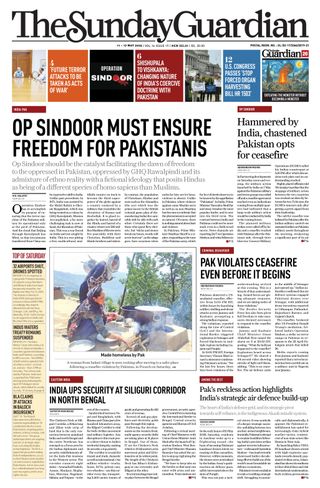

Dit verhaal komt uit de May 11, 2025-editie van The Sunday Guardian.
Abonneer u op Magzter GOLD voor toegang tot duizenden zorgvuldig samengestelde premiumverhalen en meer dan 9000 tijdschriften en kranten.
Bent u al abonnee? Aanmelden
MEER VERHALEN VAN The Sunday Guardian
The Sunday Guardian
SUVENDU ADHIKARI SIGNALS END OF BENGAL'S ERA OF IMPUNITY
The walls of Nabanna, West Bengal's state secretariat on the banks of the Hooghly, have witnessed much political theatre over the years.

5 mins
May 17, 2026
The Sunday Guardian
THE THUCYDIDES TRAP: HOW TRUMP FELL FOR XI'S BLUFF
The body language of US delegation members was evidence of their unease at the patronizing manner that Xi had while speaking to the US President. Each meeting was laden with the symbolism of the superiority of Chinese Communist culture over its US counterpart.
5 mins
May 17, 2026
The Sunday Guardian
EXAMINATION SYSTEM FACES CREDIBILITY CRISIS AFTER NEET-UG CANCELLATION
India’s central examination system is facing its deepest credibility crisis in years after the nationwide cancellation of the National Eligibility cum Entrance Test Undergraduate (NEET-UG) 2026, despite sweeping reforms, arrests, agency probes and a stringent anti-paper leak law introduced after the controversies of 2024.
8 mins
May 17, 2026
The Sunday Guardian
Measles epidemic sweeping through Bangladesh, India at risk
Hundreds of children are believed to have died after the erstwhile Yunus government ended the practice of procuring vaccines through UNICEF.
5 mins
May 17, 2026
The Sunday Guardian
Congress had a tough time choosing Satheesan over Venugopal as Keralam CM
Even as Congress named V.D. Satheesan as Keralam Chief Minister, knocking out from the race contenders such as K.C. Venugopal and Ramesh Chennithala, party insiders said that it was not an easy decision to make.
2 mins
May 17, 2026

The Sunday Guardian
A chastened Trump returns from Beijing
Jury is still out on what the US gained from the summit and whether it was at all needed.
6 mins
May 17, 2026
The Sunday Guardian
DMK, AIADMK RETHINK STRATEGY AS TVK RISES
Vijay’s TVK disrupts Tamil Nadu’s traditional two-party Dravidian equilibrium.
3 mins
May 17, 2026

The Sunday Guardian
India's Bangladesh Conundrum: demographic pressures and geopolitical risks
India’s ‘Bangladesh Conundrum’ is surely a border management problem, but now it intersects with regime change in Dhaka, political shift in West Bengal and Pakistan’s constant attempts to exploit the situation for asymmetric leverage against India.
5 mins
May 17, 2026

The Sunday Guardian
Taiwan is the permanent fault line in US-China relations
Xi’s phrase ‘extremely dangerous situation’ is not mere rhetoric. Missteps could trigger escalation.
2 mins
May 17, 2026

The Sunday Guardian
XI-TRUMP AND THE BALANCE OF POWER
CHINESE DOMINANCE
4 mins
May 17, 2026
Listen
Translate
Change font size