
Ga onbeperkt met Magzter GOLD
Krijg onbeperkte toegang tot meer dan 9000 tijdschriften, kranten en Premium-verhalen voor slechts
Poging GOUD - Vrij
Why young Europeans are turning towards the far right
The Guardian Weekly
|December 08, 2023
Housing, health and economic fears, not cultural factors, are pushing many younger voters towards political extremes
Lunching on a sandwich in the central market of Volendam, a port north of Amsterdam, Gerald, 24, was lucid about his choice in last month's Dutch election.
"I voted for Wilders, and many of my friends did too," he said. "I don't want to live with my parents forever. I want my own home, and to be able to provide for my family later on. Wilders wants to figure out the housing crisis and make our healthcare better. Those are the most important topics for me."
If everyone who voted in the election were aged under 35, Geert Wilders, the far-right populist whose Party for Freedom (PVV) shocked Europe by winning the most parliamentary seats, would have won even more.
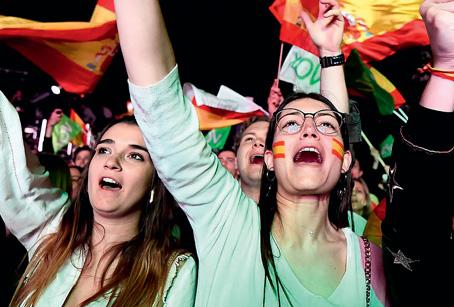
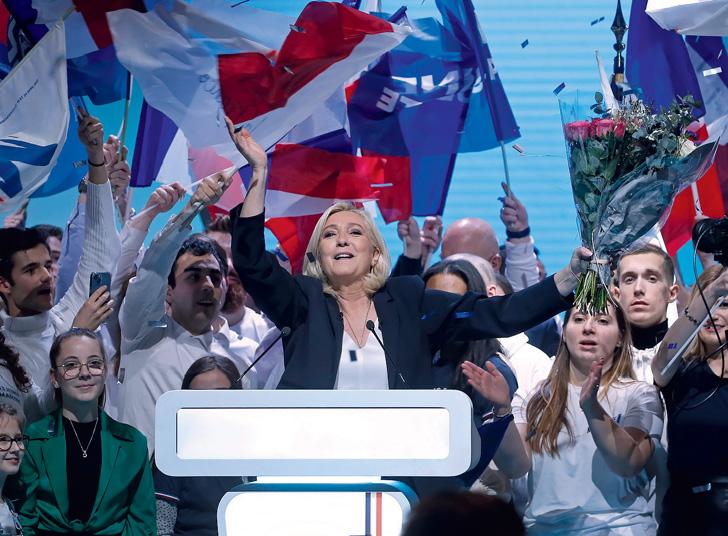
In last year's French presidential runoff, Marine Le Pen won 39% of votes from people aged 18-24 and 49% of those aged 25-34. Before Italy's election in September last year, Giorgia Meloni's Brothers of Italy was the largest party among under-35s, on 22%.
Across Europe, the image of the radical-right voter - typically white, male, non-graduate, and old - is changing, and studies suggest that in several countries, support for the far right is growing fastest among younger voters.
Several factors may explain the phenomenon, analysts say. "We really should be careful about assuming a cultural or ideological alignment between young voters and the far right," said Catherine de Vries, a political scientist at Italy's Bocconi University.

Dit verhaal komt uit de December 08, 2023-editie van The Guardian Weekly.
Abonneer u op Magzter GOLD voor toegang tot duizenden zorgvuldig samengestelde premiumverhalen en meer dan 9000 tijdschriften en kranten.
Bent u al abonnee? Aanmelden
MEER VERHALEN VAN The Guardian Weekly
The Guardian Weekly
A bold attempt to convince sceptics that neuroscience has proved Freud was right
Vladimir Nabokov notoriously dismissed the \"vulgar, shabby, and fundamentally medieval world\" of the ideas of Sigmund Freud, whom he called.

3 mins
January 23, 2026
The Guardian Weekly
A fascinating and wideranging account of the good-and the bad-of the new obesity drugs
Few aspects of being human have generated judgment, scorn and conmore demnation than a person's size, shape and weight - particularly if you are female.
1 mins
January 23, 2026

The Guardian Weekly
Can Cuba survive?
Disillusioned with the revolution after 68 years of US sanctions and a shattered economy, one in four Cubans have left the country in the past four years. Now it seems the Trump administration has the regime in its sights and its future is unclear
11 mins
January 23, 2026

The Guardian Weekly
Are our bodies really full of microplastics?
Doubts over whether plastic particles have infiltrated human tissue have grown, with one high-profile study called a 'joke'
5 mins
January 23, 2026

The Guardian Weekly
The team reinventing abortion advice for TikTok age
What do a purple cartoon cat and abortion have in common? Nothing - and that is the point, say the women behind Jacarandas, a Colombian abortion helpline.
3 mins
January 23, 2026

The Guardian Weekly
Talk of The town
Michael Sheen on building a new Welsh National Theatre company, as its first show reimagines an American classic in his homeland
7 mins
January 23, 2026

The Guardian Weekly
Parallel lives
Piet Mondrian found fame with his grid-like paintings. But a reappraisal of little-known British artist Marlow Moss repositions her influence on his work
4 mins
January 23, 2026

The Guardian Weekly
Melting ice brings geopolitical jostling for Arctic assets
Lying between the US and Russia, Greenland has become a critical frontline as global heating opens up the Arctic.
2 mins
January 23, 2026

The Guardian Weekly
Every cent you take?
Sting and his former bandmates have been in court over a royalties dispute-the latest chapter in the song's fractious story
3 mins
January 23, 2026

The Guardian Weekly
Shah's son stakes his claim to lead the country
Reza Pahlavi, the son of Iran’s former pro-western monarch, has predicted the country’s Islamic regime will fall and claimed he is “uniquely” placed to head a successor government.
2 mins
January 23, 2026
Translate
Change font size