Poging GOUD - Vrij
Conversations with whales
The Guardian Weekly
|June 06, 2025
As we race to translate animal languages, will we listen to what nature has to say?
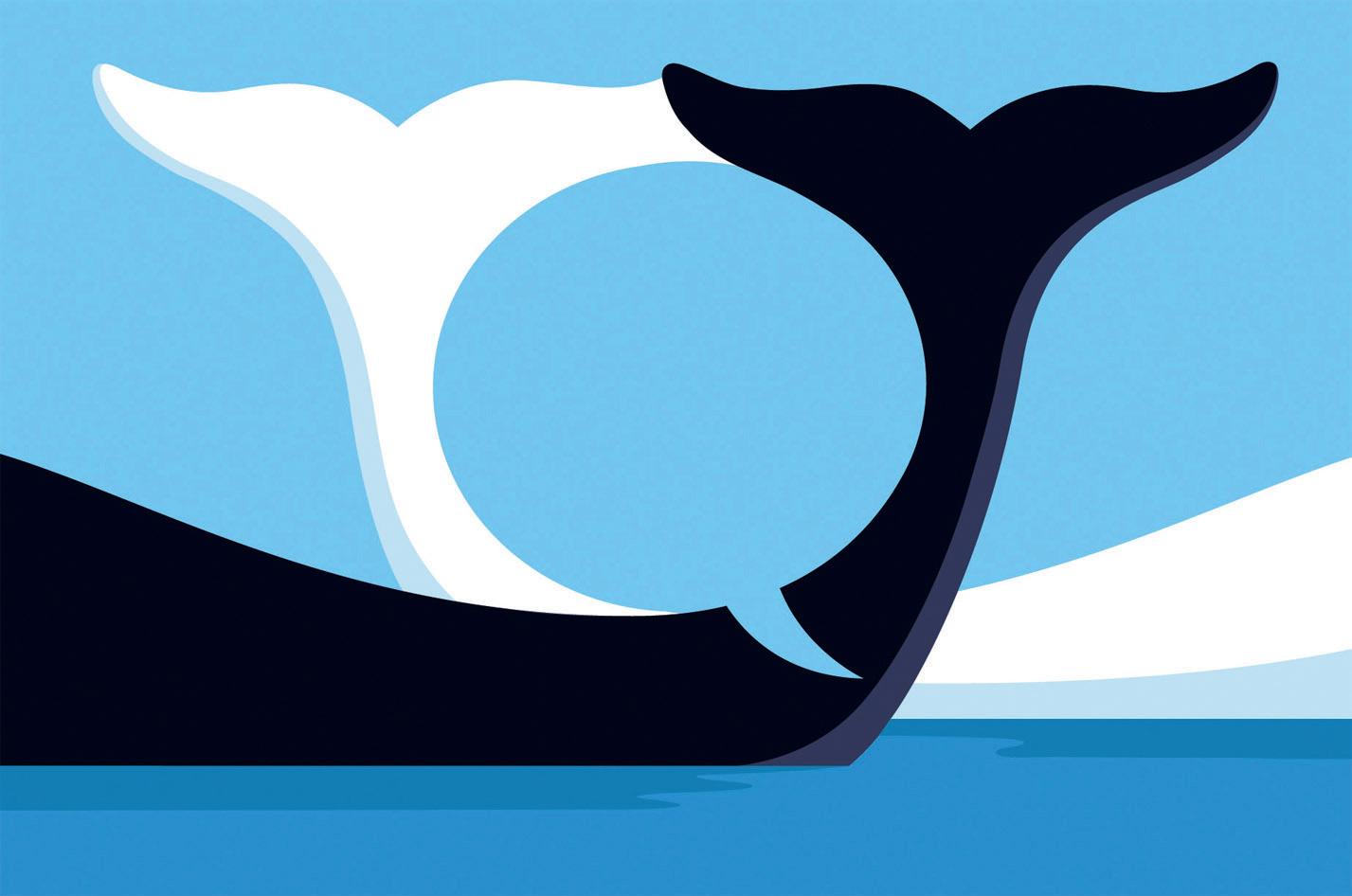
Charles Darwin suggested that humans learned to speak by mimicking birdsong: our ancestors' first words may have been a kind of interspecies exchange. Perhaps it won't be long before we join the conversation once again.
The race to translate what animals are saying is heating up, with riches as well as a place in history at stake. The Jeremy Coller Foundation has promised $10m to whichever researchers can crack the code. This is a race fuelled by generative AI; large language models can sort through millions of recorded animal vocalisations to find their hidden grammars. Most projects focus on cetaceans because, like us, they learn through vocal imitation and, also like us, they communicate via complex arrangements of sound that appear to have structure and hierarchy.
Sperm whales communicate in codas - rapid sequences of clicks, each as brief as 1,000th of a second. Project Ceti (the Cetacean Translation Initiative) is using AI to analyse codas to reveal the mysteries of sperm whale speech. There is evidence the animals take turns, use specific clicks to refer to one another, and even have distinct dialects. Ceti hopes to speak whaleish as soon as 2026.
The linguistic barrier between species is already looking porous. In April, Google released DolphinGemma, an AI program to translate dolphins, trained on 40 years of data.

Dit verhaal komt uit de June 06, 2025-editie van The Guardian Weekly.
Abonneer u op Magzter GOLD voor toegang tot duizenden zorgvuldig samengestelde premiumverhalen en meer dan 9000 tijdschriften en kranten.
Bent u al abonnee? Aanmelden
MEER VERHALEN VAN The Guardian Weekly

The Guardian Weekly
Trump has shown there aren't any rules. We'll all regret that
I never thought it possible that you could look back on the Iraq war and feel some measure of nostalgia.

4 mins
January 09, 2026

The Guardian Weekly
The new world order 'according to Trump
With the audacious snatch and grab raid that extracted Nicolás Maduro to face trial in the United States, Washington sent a clear message to its allies and adversaries:
3 mins
January 09, 2026
The Guardian Weekly
The phone is ringing, but is it a scam? I'll ask my assistant
I am staring at my computer when my phone rings.
3 mins
January 09, 2026

The Guardian Weekly
The unlikely genius of Getdown Services
Scatological lyrics, social conscience, a commitment to fun and a shoutout from Walton Goggins - 2026 is going to be the laptop garage band's year
3 mins
January 09, 2026
The Guardian Weekly
Behind the race to get Americans back on the moon
With astronauts set to fly around the moon for the first time in more than half a century when Artemis 2 makes its ascent sometime this spring, 2026 was already destined to become a standout year in space.
3 mins
January 09, 2026
The Guardian Weekly
Striking it rich The US plan for involvement in Venezuela's 'bust' oil sector
The Venezuelan oil industry has been “a total bust” for a long time, according to Donald Trump.
2 mins
January 09, 2026

The Guardian Weekly
Life after extinction Science or science fiction?
A startup's plans for resurrecting lost creatures have caught the public's imagination but many researchers doubt that such a feat is possible
5 mins
January 09, 2026

The Guardian Weekly
It's a ridiculous time to be a man'
A group of male comedians is at the forefront of a new genre of social media comedy poking fun at our ever-shifting notions of modern masculinity
4 mins
January 09, 2026

The Guardian Weekly
Charting the global economy in 2026
With inflation predicted to cool, rising unemployment, weak growth and trade tensions pose fresh risks, while high debt and AI add to uncertainty in the year ahead
4 mins
January 09, 2026
The Guardian Weekly
High stakes for Mamdani as he must now deliver on his promises to New York
The multiple firsts achieved by New York’s new mayor, Zohran Mamdani, have been well chronicled: he is the first Muslim to occupy that role, the first south Asian and the first to be born in Africa.
2 mins
January 09, 2026
Listen
Translate
Change font size