
Ga onbeperkt met Magzter GOLD
Krijg onbeperkte toegang tot meer dan 9000 tijdschriften, kranten en Premium-verhalen voor slechts
Now, for GST 3.0
Business Standard
|September 18, 2025
The latest reforms promise relief, but some issues remain unresolved
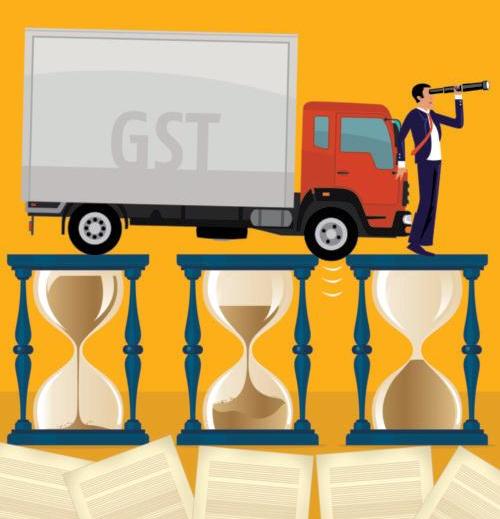
Excise duty, service tax, value-added tax (VAT), central sales tax, purchase tax, entertainment tax, octroi.... Before the goods and services tax (GST) came into force, on July 1, 2017, people grappled with a maze of taxes, complicated further by multiple rates across the Centre and states. All in all, there were 17 large taxes and 13 cesses.
The GST regime consolidated these into four main slabs: 5, 12, 18, and 28 per cent. It also eased business operations. Companies no longer needed to maintain warehouses in every state, and the removal of border checkposts brought down the time and cost of logistics. Problems, though, persisted, with commodities and services split into sections and subsections, which invited different rates.
This, too, has now been simplified. On August 15, Prime Minister Narendra Modi announced that the system would be overhauled and made friendlier. From four slabs, GST is now down to a two-tier rate structure — § and 18 per cent — along with a peak rate of 40 per cent for demerit goods and a few super-luxury cars. The 12 and 28 per cent slabs have been done away with altogether.
The aim is to make common-use items cheaper and resolve classification disputes. The GST Council has also addressed the issue of inverted duty structure in sectors like textiles, fertilisers, and leather goods.
The reforms, being called GST 2.0, will kick in on September 22.
Despite these changes, experts are of the view that a number of issues remain unresolved and need to be tackled in the next round of reforms to make GST more suitable for businesses.
Multiplicity of rates
One of the biggest unfinished tasks under GST 2.0 is the continued multiplicity of rates. In mature economies, the trend is towards simpler GST/VAT structures — either asingle uniform rate or a standard rate, with one or two reduced rates.


Dit verhaal komt uit de September 18, 2025-editie van Business Standard.
Abonneer u op Magzter GOLD voor toegang tot duizenden zorgvuldig samengestelde premiumverhalen en meer dan 9000 tijdschriften en kranten.
Bent u al abonnee? Aanmelden
MEER VERHALEN VAN Business Standard
Business Standard
PE-VC investments at $33 bn in '25
Mega deals slide slightly; IT and BFSI lead sector investments

1 mins
January 01, 2026
Business Standard
RBI red-flags bank-NBFC interlink risks
Banks acquiring 80% assets through a limited number of NBFCs
2 mins
January 01, 2026
Business Standard
Precious metals outshine stocks in 2025 amid global volatility
Nearly 60% of the top 1,000 listed stocks delivered negative returns
1 mins
January 01, 2026
Business Standard
Weakness in ₹, broader equity market shrinks India's billionaire club in 2025
Top IPO promoters
3 mins
January 01, 2026
Business Standard
EV Policy 2.0: Delhi govt to meet five auto firms, Siam
Meeting scheduled on Jan 2 as capital remains in a smog of pollution
2 mins
January 01, 2026
Business Standard
Year of hope
India must aim to sustain the growth momentum
2 mins
January 01, 2026
Business Standard
Eight more cos to get incentives under auto PLI
Three vehicle makers, five auto part makers to get benefits from FY27
2 mins
January 01, 2026
Business Standard
Centre notifies revised draft rules for labour codes, seeks stakeholders' responses
The Ministry of Labour and Employment on Wednesday notified the revised draft rules for the four new Labour Codes, providing clarity on certain provisions such as gratuity payments and retrenchment of workers.
1 mins
January 01, 2026
Business Standard
Oyo parent files for ₹6,650 cr IPO via confidential route
Oyo’s parent firm Prism has filed confidential draft red herring prospectus (DRHP) papers with the markets regulator to raise up to %6,650 crore through an initial public offering (IPO), which would be the third attempt by the global travel technology company at public listing.
2 mins
January 01, 2026
Business Standard
External uncertainties may trigger outflows, Fx rate volatility: RBI
The Reserve Bank of India (RBI) has cautioned that the country's economy faces near-term risks largely from external uncertainties, including the possibility of a sharp correction in US equities that could trigger foreign portfolio outflows, heighten exchange rate volatility and tighten domestic financial conditions.
2 mins
January 01, 2026
Listen
Translate
Change font size