
Ga onbeperkt met Magzter GOLD
Krijg onbeperkte toegang tot meer dan 9000 tijdschriften, kranten en Premium-verhalen voor slechts
Poging GOUD - Vrij
The digital labor revolution
TIME Magazine
|January 27, 2025
OVER THE PAST TWO YEARS, WE'VE WITNESSED advances in AI that have captured our imaginations with unprecedented capabilities in language and ingenuity. And yet, as impressive as these developments have been, they're only the opening act. We are now entering a new era of autonomous AI agents that take action on their own and augment the work of humans. This isn't just an evolution of technology. It's a revolution that will fundamentally redefine how humans work, live, and connect with one another from this point forward.
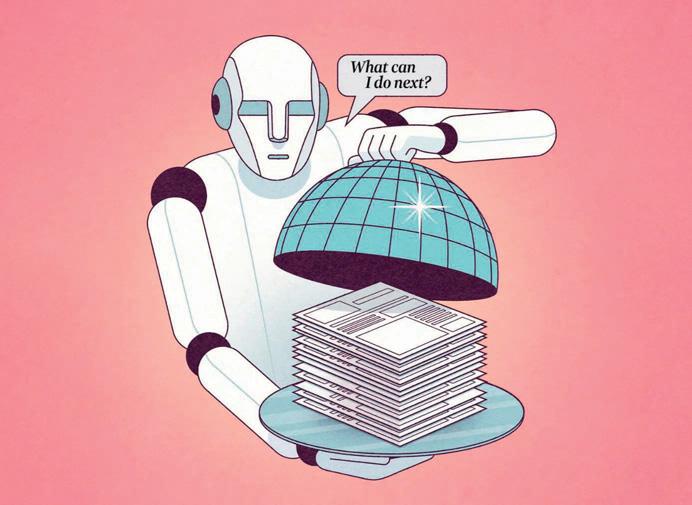
Today, we're already used to “predictive AI”—which analyzes data to provide recommendations, forecasts, and insights—and “generative AI,” which learns from data and uses patterns to seamlessly generate text, images, music, and code. Agents are software components that go far beyond this. They can perform tasks independently, make decisions, and even negotiate with other agents on our behalf. And unlike the traditional tech transformations of the past, which required years of costly infrastructure buildout, these new AI agents are easy to build and deploy, unlocking massive capacity.
This is a new horizon with radical implications. For the first time, technology isn't just offering tools for humans to do work. It's providing intelligent, scalable digital labor that performs tasks autonomously. Instead of waiting for human input, agents can analyze information, make decisions, and take action independently, adapting and learning as they go.
Take, for example, a large retailer during the holiday season. Traditionally, human workers or preprogrammed software might handle customer inquiries or inventory updates. But now, intelligent digital agents can respond to customer questions in real time, monitor stock levels, reorder inventory, and even coordinate with shipping providers—all without human intervention. These agents are enabling an entirely new scale of operations that was previously not possible.
This shift to intelligent digital labor is already unlocking capacity across industries. It's no longer constrained by human availability or physical limits, allowing businesses to scale their operations while driving down costs and improving responsiveness, or by geographical limits—opening opportunities previously limited by location.


Dit verhaal komt uit de January 27, 2025-editie van TIME Magazine.
Abonneer u op Magzter GOLD voor toegang tot duizenden zorgvuldig samengestelde premiumverhalen en meer dan 9000 tijdschriften en kranten.
Bent u al abonnee? Aanmelden
Listen
Translate
Change font size