Poging GOUD - Vrij
Annihilation of Dignity
Outlook
|August 21, 2025
From Varanasi's funeral pyres to Delhi's sewers, India's caste system creates hazardous working conditions for the country's most marginalised communities, leaving them with psychological and physical scars
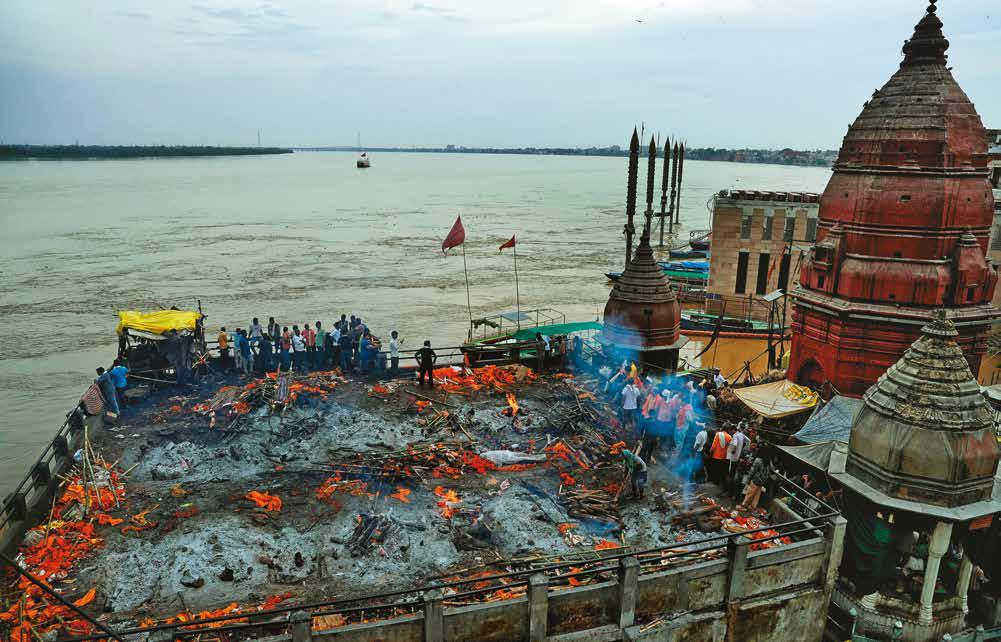
A human corpse burns at 1,000 degrees Celsius. A living human exposed to such heat can watch their sweat vanish before it can drip, their skin singe, and their hair curl and sear at the edges. Burnt to a deep brown, with hairless arms and chest, Shalok Chaudhry lights funeral pyres for about “30 to 100 bodies a day” on a slow day. Visible burn marks stain his fingertips.
Chaudhry laughed at the sores on his hands. “I get burnt here and there because I have to move through the pyres and arrange the wood to make sure all the bodies are burning properly. It happens,” he said, scoffing at his injuries.
One of roughly 200 Dom workers who stoke the Hindu funeral pyres at the Manikarnika Ghat in Varanasi, Chaudhry works under Dom Raja Om Chaudhry and his nephew Shalu Chaudhry. The 32-year-old once used to work as a government clerk. “I knew I had to come back eventually and do this work. I would think about it often, and I think people sensed it too, so I gave it all up and moved back to fulfil our caste’s duty. Every one of us has to do this, no matter what else we do,” he said.
As the sun sank into the Ganges, Manikarnika Ghat was awash with activity and desperate people. It is the day’s final hour in which a Hindu funeral pyre can be lit. Bodies wrapped in saffron cloth are laid out on bamboo rafters. At any given moment, five or six bodies crackle in the fire, consigned to flames that rage as hot as between 5,000 and 6,000 degrees Celsius.

Dit verhaal komt uit de August 21, 2025-editie van Outlook.
Abonneer u op Magzter GOLD voor toegang tot duizenden zorgvuldig samengestelde premiumverhalen en meer dan 9000 tijdschriften en kranten.
Bent u al abonnee? Aanmelden
MEER VERHALEN VAN Outlook
Outlook
'Why GDP Growth Doesn't Always Translate Into Votes'
The recent election results have once again shown that economic growth alone does not guarantee electoral victory.

3 mins
June 06, 2026

Outlook
Lights, Camera, Othering
The establishment of Israel has been accompanied by a national cinema devoted to negating and erasing the Palestinian Other
5 mins
June 06, 2026

Outlook
Goodbye to All That
Booker-winning British author Julian Barnes' Departure(s) is a unique hybrid work: playful, philosophical, whimsical
4 mins
June 06, 2026

Outlook
Collapse of Trust
As the NEET-UG 2026 paper leak forced the cancellation of India’s biggest medical entrance exam, more than 22 lakh aspirants find themselves trapped in uncertainty
11 mins
June 06, 2026

Outlook
NO LONGER A TWELFTH MAN
Bihar cricket, which has languished in the shadows for long, is all set to improve its strike rate, thanks to Vaibhav Sooryavanshi, the new Bihari kid on the block
5 mins
June 06, 2026

Outlook
BLAZE OF GLORY
The challenges of being a celebrity cricketer at a young age can be tough to handle
5 mins
June 06, 2026

Outlook
THE SWASHBUCKLERS
A new generation of fearless stars is emerging and finding its feet at the very top of an extremely competitive cricketing environment
5 mins
June 06, 2026

Outlook
THE TEEN TORNAD
At the age of 15, Vaibhav Sooryavanshi is already a cricketing legend
10 mins
June 06, 2026

Outlook
A Journey to Remember
The prerecorded message crackled over the din in the compartment: ‘Welcome to the Shatabdi Express.
4 mins
June 06, 2026

Outlook
Crossing Borders
Ruth Martin is the translator of German-Iranian author Shida Bazyar’s novel The Nights are Quiet in Tehran (originally written in German), which has been shortlisted for the 2026 International Booker Prize.
4 mins
June 06, 2026
Listen
Translate
Change font size