Poging GOUD - Vrij
An Unequal Heat
Outlook
|July 21, 2024
Dalit women working as farm labourers bear the extreme brunt of the climate crisis and escalating temperatures. This visual project documents their stories, which are a powerful testament to the fact that there can be no climate justice without social justice

IN the relentless march of headlines detailing heat wave fatalities-"100 People Die in Heatwave" or "Extreme Heat Kills Hundreds"-the profound human narratives often fade into statistical obscurity. Who are these individuals succumbing to the sweltering temperatures in the Global South, in our cities, and across our villages? What stories do they carry, and what societal injustices push them to the forefront of this climate crisis?
The unsettling truth emerges: the victims predominantly hail from marginalised communities, bearing the intersectional weight of caste, gender, and economic disparity. The impact of heat waves is far from equitable.
The Heat is not Equal to All of Us
Consider someone sitting in an air-conditioned room and compare their experience to that of a Dalit woman toiling in the sun, working someone's field for a daily wage. The difference is stark. In these fields, even access to water is unequal. In the realm of environmental discourse, water is often romanticised as the nectar of life, a symbol of purity, and a source of natural beauty. However, for Dalits in India, water carries a burden far heavier than its lifenurturing properties-it is a stark reminder of caste-based discrimination and exclusion.
Imagine fetching water not as a routine chore but as a journey fraught with the fear of facing discrimination and violence. For Dalits, accessing water sources reserved for upper castes can result in ostracisation, verbal abuse, or even physical assault. The simple act of quenching one's thirst becomes a daily struggle.
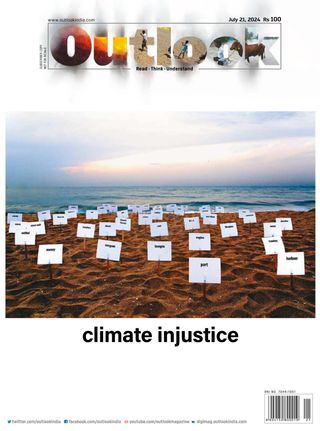

Dit verhaal komt uit de July 21, 2024-editie van Outlook.
Abonneer u op Magzter GOLD voor toegang tot duizenden zorgvuldig samengestelde premiumverhalen en meer dan 9000 tijdschriften en kranten.
Bent u al abonnee? Aanmelden
MEER VERHALEN VAN Outlook
Outlook
'Why GDP Growth Doesn't Always Translate Into Votes'
The recent election results have once again shown that economic growth alone does not guarantee electoral victory.

3 mins
June 06, 2026

Outlook
Lights, Camera, Othering
The establishment of Israel has been accompanied by a national cinema devoted to negating and erasing the Palestinian Other
5 mins
June 06, 2026

Outlook
Goodbye to All That
Booker-winning British author Julian Barnes' Departure(s) is a unique hybrid work: playful, philosophical, whimsical
4 mins
June 06, 2026
Outlook
Collapse of Trust
As the NEET-UG 2026 paper leak forced the cancellation of India’s biggest medical entrance exam, more than 22 lakh aspirants find themselves trapped in uncertainty
11 mins
June 06, 2026

Outlook
NO LONGER A TWELFTH MAN
Bihar cricket, which has languished in the shadows for long, is all set to improve its strike rate, thanks to Vaibhav Sooryavanshi, the new Bihari kid on the block
5 mins
June 06, 2026

Outlook
BLAZE OF GLORY
The challenges of being a celebrity cricketer at a young age can be tough to handle
5 mins
June 06, 2026

Outlook
THE SWASHBUCKLERS
A new generation of fearless stars is emerging and finding its feet at the very top of an extremely competitive cricketing environment
5 mins
June 06, 2026

Outlook
THE TEEN TORNAD
At the age of 15, Vaibhav Sooryavanshi is already a cricketing legend
10 mins
June 06, 2026

Outlook
A Journey to Remember
The prerecorded message crackled over the din in the compartment: ‘Welcome to the Shatabdi Express.
4 mins
June 06, 2026

Outlook
Crossing Borders
Ruth Martin is the translator of German-Iranian author Shida Bazyar’s novel The Nights are Quiet in Tehran (originally written in German), which has been shortlisted for the 2026 International Booker Prize.
4 mins
June 06, 2026
Listen
Translate
Change font size