Poging GOUD - Vrij
The Funnel of Righteousness
Philosophy Now
|October/November 2024
Peter Worley tells us how to be right, righter, rightest.

We enjoy being right. There are many ways to delight in this pleasure, some more noble than others. We might feel good when we’ve made a good argument, drawing on good evidence, cogently structured. Or we might only care about others believing us, no matter how that’s achieved. But there are few who derive no pleasure at all from being right, or being thought to be right. Indeed, the sense of being right really matters to us. You had an argument with a friend or family member and it has been playing through your mind ever since: Were you right to have said that? Did they understand the points you were making? Or you may feel that you were seen as wrong in a board meeting because of some group-think rather than because you hadn’t made a good case. And so on.
Here I’ll identify different aspects of being right. This is designed more as a life-guide than a piece of theoretical philosophy. It’s to help us assess what’s going on next time we relax into a sense of self-righteousness. Are we right to? When, if ever, is it right to feel righteous?
Consider this: A teacher asks a class, “What’s 2 + 2?” Alison says, “22”. Belinda says, “4”. Who’s right?
Now imagine that Alison’s reason for her answer is “Because if you add the digit ‘2’ to another digit ‘2’, you get ‘22’”, while Belinda’s reason is, “Because 4 is my favourite number.” How does this affect your assessment of who’s right? There are some who would say that Belinda is right, even though her reasoning is wrong. One thing I want to do in this article is to explain how Alison and Belinda are both right and wrong.
First I want to describe and distinguish between a whole series of weaker and stronger senses of ‘being right’. It’s a weaker sense if there’s a greater probability of being wrong; it’s a stronger sense when the probability of being wrong is less. Being right and wrong are, on this understanding, by
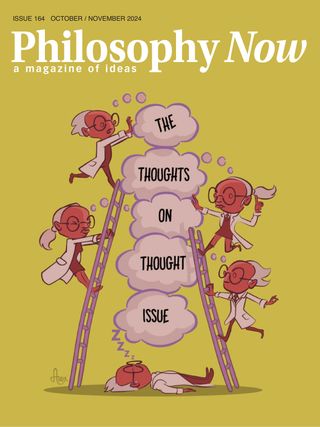

Dit verhaal komt uit de October/November 2024-editie van Philosophy Now.
Abonneer u op Magzter GOLD voor toegang tot duizenden zorgvuldig samengestelde premiumverhalen en meer dan 9000 tijdschriften en kranten.
Bent u al abonnee? Aanmelden
MEER VERHALEN VAN Philosophy Now

Philosophy Now
The Possibility- Bearing Animal
Raymond Tallis explores a twilight zone.

7 mins
February/March 2026

Philosophy Now
Amazing Times at the Pub Agora
John Douglas Mullen is a philosophical bar fly on the wall.
8 mins
February/March 2026

Philosophy Now
Friedrich Nietzsche (1844-1900)
Hilarius Bogbinder considers the all too human life of the notorious iconoclast.
11 mins
February/March 2026

Philosophy Now
Heisenberg's Philosophy of Quantum Mechanics
Kanan Purkayastha explains how Werner Heisenberg's 1925 paper turned the quantum theory of the early 1900s into the quantum mechanics of today.
10 mins
February/March 2026

Philosophy Now
Cicero & the Ideal of Virtue
Abdullah Shaikh explores Cicero's ideas about the core Roman principle of virtus.
13 mins
February/March 2026

Philosophy Now
ROPE
Les Jones has a Nietzschean take on a Hitchcock thriller.
6 mins
February/March 2026
Philosophy Now
What Have the Romans Ever Done For Us?
Salve! This issue's theme is Roman Philosophy. But as the rebels in Monty Python's Life of Brian asked, what have the Romans ever done for us? The question seems relevant here; we are philosophers, not archaeologists.
2 mins
February/March 2026

Philosophy Now
Paul Guyer
Paul Guyer is an American philosopher and a leading scholar of both Immanuel Kant and aesthetics. AmirAli Maleki interviews him about Kant's political and moral vision.
9 mins
February/March 2026
Philosophy Now
Identity in the Age of Connectivity
Sara Asran explores the dynamics of identity online.
6 mins
February/March 2026

Philosophy Now
A Very Short History of Critical Thinking
Luc de Brabandere summarises a long history through key figures of thought.
7 mins
February/March 2026
Listen
Translate
Change font size