Poging GOUD - Vrij
Smart Strategies for Paying Your Child an Allowance
Kiplinger's Personal Finance
|November 2025
By giving your kids money to spend and save, you'll help them sharpen their financial skills at an early age.

THE practice of parents paying their kids an allowance is still going strong. A recent Wells Fargo survey found that 71% of parents who have children between the ages of 5 and 17 give them an allowance, averaging $37 a week. However, about half of parents who responded to the survey struggle to discuss money in a way their children will understand.
Offering your kids an allowance can be a great way to teach them financial responsibility and introduce conversations about spending and saving money. If you have kids at home, consider these ideas to set an allowance strategy.
Establish guidelines for earning it. A key decision is whether you will link your child's allowance to household chores or other tasks, which can help kids understand the relationship between money and work. Some parents feel that everyday chores, such as making the bed or washing the dishes, are part of a child’s responsibilities as a family member and shouldn't come with a financial reward. Alternatively, you could pay your child for performing tasks that go beyond daily expectations.
Kate Hamilton, entrepreneur and author of The Imperfect Parent, suggests that starting at the age of 5, your children could take on extra weekly tasks, such as raking leaves in the yard. To help kids learn about how they would be compensated in the workplace, she says that you could offer them a fixed rate for performing tasks—say, $10 an hour for two hours of doing laundry and washing your car.
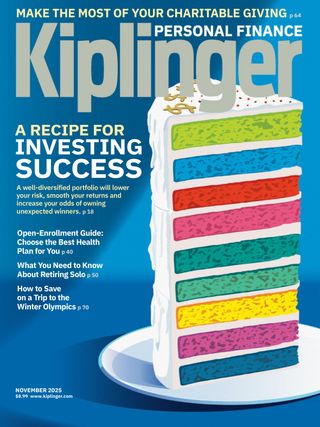

Dit verhaal komt uit de November 2025-editie van Kiplinger's Personal Finance.
Abonneer u op Magzter GOLD voor toegang tot duizenden zorgvuldig samengestelde premiumverhalen en meer dan 9000 tijdschriften en kranten.
Bent u al abonnee? Aanmelden
MEER VERHALEN VAN Kiplinger's Personal Finance

Kiplinger's Personal Finance
Same Story, Different Year
WHAT does the Federal Reserve's rate-reduction initiative mean in the short run for your fixed-income holdings? You'll recall that one year ago, the Fed cut three times, starting by hacking its benchmark overnight funds rate by 0.50 percentage point in September. The year ended with bond markets and fund returns in retreat. It's wishful thinking that cheaper short-term credit and falling money market yields will spark a general bond-buying binge and propel your 2025 total returns toward 10% by year-end.

2 mins
December 2025

Kiplinger's Personal Finance
WHEN HELPING MOM AND DAD HURTS YOUR WALLET
New research shows how assisting an aging parent with expenses can strain your own finances.
3 mins
December 2025

Kiplinger's Personal Finance
WHAT'S AHEAD FOR SOCIAL SECURITY
Bipartisan collaboration on a mix of reforms will likely be needed to keep the system solvent and benefits intact.
3 mins
December 2025

Kiplinger's Personal Finance
WHAT TO MAKE OF A HOT IPO MARKET
This year's crop of initial public offerings could be even dicier than usual because of a skew toward tech and crypto.
5 mins
December 2025

Kiplinger's Personal Finance
Grab a Deal on a Winter Getaway
In the early months of the year, travel demand dips-and so do prices.
5 mins
December 2025

Kiplinger's Personal Finance
8 DIVIDEND FUNDS TO CONSIDER NOW
Our picks deliver a diversified portfolio of dividend stocks.
6 mins
December 2025
Kiplinger's Personal Finance
A NEW WAVE OF ETFS IS ON THE WAY
A long-expected decision from the Securities and Exchange Commission is close to being official, and it could mean more exchange-traded fund options for investors.
1 mins
December 2025

Kiplinger's Personal Finance
CHECKING IN ON THE KIPLINGER DIVIDEND 15
Our favorite dividend payers have had a good year on average, beating the market and yielding twice as much.
14 mins
December 2025
Kiplinger's Personal Finance
THIS FUND FERRETS OUT HIGH-QUALITY STOCKS
THE U.S. stock market has been notching new highs, which tends to kick up the likelihood of a market pullback (defined as a drop of 5% to 10%) or even a correction (a 10% to 20% selloff). That's where JPMorgan U.S. Quality Factor comes in.
1 mins
December 2025

Kiplinger's Personal Finance
New Ways to Use 529 Funds
Tax-free withdrawals from these plans could help you sharpen your job skills.
2 mins
December 2025
Listen
Translate
Change font size