Poging GOUD - Vrij
The Post-Moore Era
Circuit Cellar
|August 2025
Could Molecular Electronics Keep the Pace?
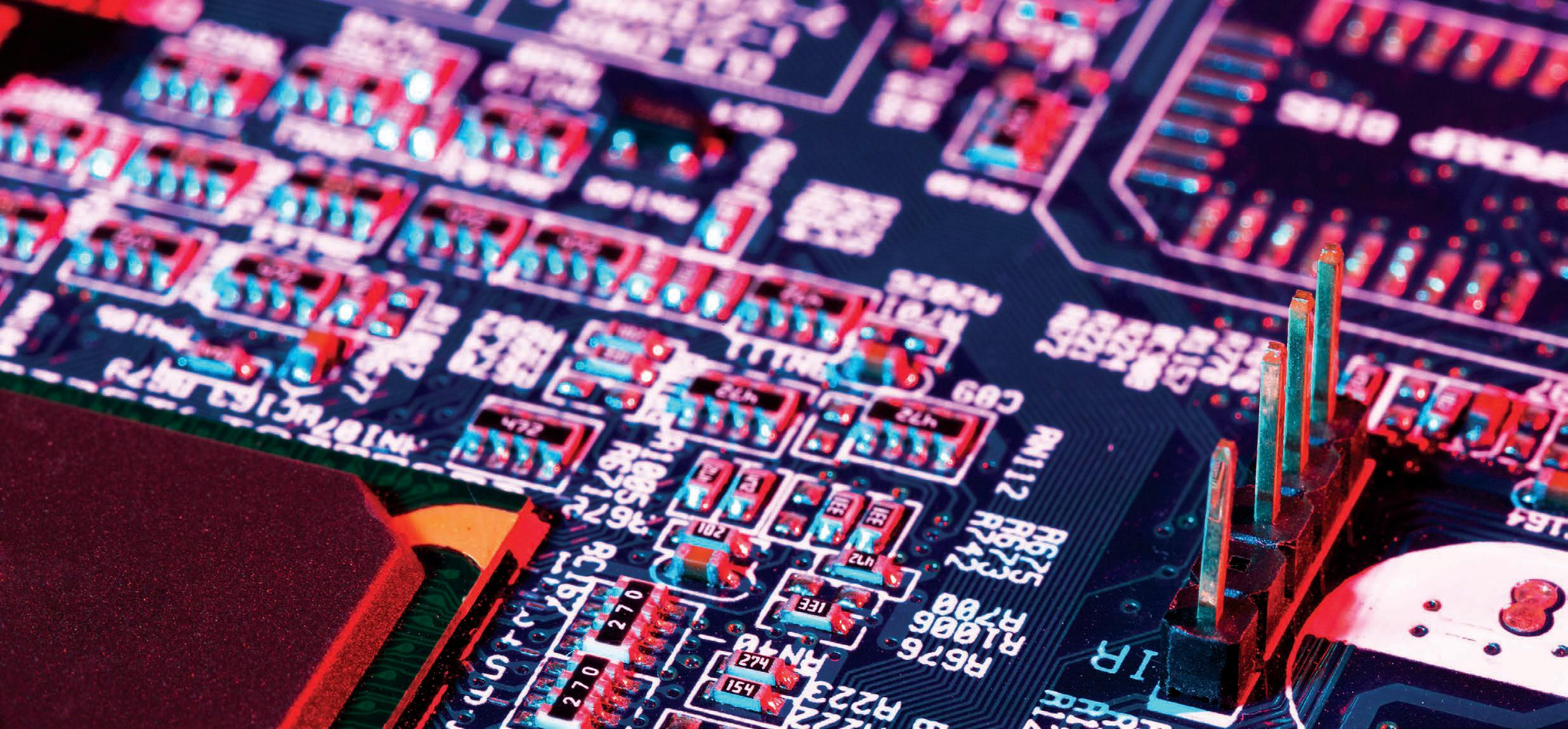
Molecular electronics could continue semiconductor advances in a post-Moore era. Here we break down how molecular diodes, wires, and logic gates work, examine recent commercial breakthroughs, and look at the feasibility of integrating molecular components into existing semiconductor workflows. Can molecules really take us beyond the limits of lithography, or is this just another lab-bound dream?
Moore's Law is a theory that came from one of Intel's co-founders, Gordon Moore, back in 1965. He observed that the number of transistors that could be placed on an integrated circuit was doubling roughly every two years.
This theory was never meant to last forever. In fact, Moore himself predicted that it would only continue for around 10 years (up to 1975). In reality, Moore's law has continued to hold true right up into the 21st century and has been a driving force for development within the semiconductor industry, with Apple's 2025 ARM-based M3 Ultra SoC containing a staggering 184 billion transistors.
Despite this, we're now starting to see signs that we're fast approaching a post-Moore era. Silicon-based transistors can only get so small before the laws of physics start to get in the way. We're already measuring transistors on the atomic scale, with the smallest commercially available transistor measuring at 3 nanometers (only slightly wider than a strand of human DNA, which is roughly 2.5 nanometers wide). There's still some room to go smaller, and IBM recently announced their 2 nanometer chip, but progress is slow and understandably expensive. [1]

Dit verhaal komt uit de August 2025-editie van Circuit Cellar.
Abonneer u op Magzter GOLD voor toegang tot duizenden zorgvuldig samengestelde premiumverhalen en meer dan 9000 tijdschriften en kranten.
Bent u al abonnee? Aanmelden
MEER VERHALEN VAN Circuit Cellar
Circuit Cellar
Vishay Intertechnology Automotive-Grade Optocouplers Deliver High Isolation Voltage Ratings and Distance for EVs and Solar Inverters
Vishay Intertechnology, Inc. introduced two new Automotive-Grade optocouplers with phototransistor output in a widebody package featuring a comparative tracking index (CTI) of 600.

1 min
July 2026

Circuit Cellar
WWVB Timecode Generator A Tool for Testing Radio-Controlled Clocks
In this article, Robert describes how he built a timecode generator that provides simulated code from WWVB, a radio station operated by the National Institute of Standards and Technology, which is used to synchronize millions of radio-controlled clocks.
16 mins
July 2026

Circuit Cellar
MCUs at the Heart of the Edge Modern MCUs Go Beyond Simple Process Control
Microcontroller Units (MCUs) are the power at the heart of modern embedded systems.
2 mins
July 2026

Circuit Cellar
650V ICeGaN Device for Automotive Applications from CGD Helps Increase EV Range
Cambridge GaN Devices (CGD) has developed a 650V GaN IC for automotive applications that addresses automakers' desires to improve inverter efficiency.
1 min
July 2026

Circuit Cellar
Blues Latest IoT Modules Notecard for Skylo and Notecarrier CX
Satellite comms for IoT projects may seem the domain of enterprise customers, but new modules from Blues can bring satellites within reach even for small professional and research projects.
22 mins
July 2026

Circuit Cellar
Rust: An Embedded Lightning Rod Nothing Is Quite as It Seems
Linus Torvald’s release of Linux 7.0 announced the finalization of Rust-related projects in the kernel: From now on, the programming language is to be considered a first-class member of Linux.
10 mins
July 2026
Circuit Cellar
PLS' Debug and Trace Tool UDE Supports ST's Stellar P3E Automotive Microcontroller
The debug, trace, and test tool UDE Universal Debug Engine from PLS Programmierbare Logik & Systeme, has expanded its support to encompass the Stellar P3E.
2 mins
July 2026

Circuit Cellar
The Tireless Intern: LLM Coding Agents for Embedded Work Using AI Speeds Security Tooling
This article discusses a case study of using a large language model (LLM) to develop a tool for embedded security, that would have otherwise taken several weeks (or months) of effort in a few days.
10 mins
July 2026

Circuit Cellar
IoT Infrastructure: On-Premises Deployment or Cloud Solution?
Designing an IoT system is not only about sensors and dashboards.
5 mins
July 2026

Circuit Cellar
Signal-to-Noise Ratio for Voice Activity Detection Devices
Users needs to be able to give AI glasses voice commands and be sure the device is only picking up their speech, not other sounds.
4 mins
July 2026
Listen
Translate
Change font size