
Ga onbeperkt met Magzter GOLD
Krijg onbeperkte toegang tot meer dan 9000 tijdschriften, kranten en Premium-verhalen voor slechts
The Future of Embedded Chip Design Navigating the Chip Creation Space
Circuit Cellar
|December 2024
Custom Silicon at Lower Cost, Reduced Development Time

Empowering a new generation of developers to create more specialized, efficient and innovative chips opens paths for smaller enterprises to take on the challenges of machine learning, IoT, artificial intelligence and automation.
The proliferation of embedded systems has reshaped industries by providing intelligence to products, thereby improving ease of use, functionality and life cycle cost. Historically, embedded systems providers could meet most customers' requirements using standard, off-the-shelf components, providing differentiation through software. In certain cases, the embedded systems had particularly demanding performance, cost, or power requirements (or some combination of all three) and required tailored hardware in the form of customizable silicon solutions, most notably FPGAs or custom silicon such as ASICS.
We are now moving to the next generation of embedded systems, one powered by machine learning (ML). These new ML-enabled systems are expanding the applications served and the value that microelectronics provide in traditional embedded markets.
Importantly, they also bring the power of embedded intelligence to a wide array of existing and new consumer markets. In this new world, the benefit of tailored hardware becomes more broadly relevant, often making the difference between products that serve a market's needs and those that do not.
As such, enabling simple, fast and affordable customizing of chips has emerged as a critical differentiator among OEM's, software and service providers. Once again, FPGAs are one choice. They are relatively easy to implement by non-chip experts but are not energy efficient and do not integrate the extensive analog functionality necessary for cost-sensitive or sensor driven applications.
Alternatively, ASICS give engineers a wide
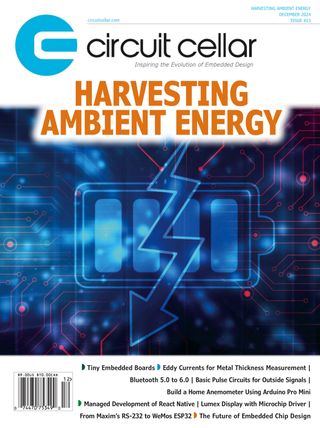

Dit verhaal komt uit de December 2024-editie van Circuit Cellar.
Abonneer u op Magzter GOLD voor toegang tot duizenden zorgvuldig samengestelde premiumverhalen en meer dan 9000 tijdschriften en kranten.
Bent u al abonnee? Aanmelden
MEER VERHALEN VAN Circuit Cellar
Circuit Cellar
The Future of Sensors in Safety Systems Sensing the Stop
How Magnetic Sensors Are Enabling the Next Generation of Braking Systems

5 mins
December 2025

Circuit Cellar
Alif Semiconductor Elevates Generative AI at the Edge with New Support for ExecuTorch Runtime in Its Ensemble MCUs
Alif Semiconductor, the leading global supplier of secure, connected, power efficient Artificial Intelligence and Machine Learning (AI/ML) microcontrollers (MCUs) and fusion processors, announced that developers can now use the ExecuTorch Runtime, a quantization extension of the popular PyTorch ML framework, for AI applications built to run on its Ensemble E4/E6/E8 series of MCUs and fusion processors.
1 min
December 2025

Circuit Cellar
Encrypted MQTT Protocol for Critical Sectors
Mechanisms, Challenges, and Best Practices
3 mins
December 2025

Circuit Cellar
Datasheet: Small Size, Big Power
Smaller Microcontrollers Bring New Possibilities
9 mins
December 2025

Circuit Cellar
Analog Devices Launches ADI Power Studio and New Web-Based Tools
Analog Devices, Inc. (ADI), a global semiconductor leader, announced the launch of ADI Power Studio, a comprehensive family of products that offers advanced modeling, component recommendations, and efficiency analysis with simulation.
1 mins
December 2025
Circuit Cellar
Compact IBR300 2.5" SBC Powered by NXP i.MX 93 from IBASE
IBASE Technology, Inc., a leading provider of rugged embedded computing platforms, announced the release of the IBR300, a 2.5\" RISC-based single board computer (SBC) powered by the NXP i.MX 93 processor with dualcore ARM Cortex-A55 (up to 1.7GHz) and a Cortex-M33 MCU.
1 min
December 2025
Circuit Cellar
Sensors in the Spotlight
The Next Decade of Embedded Sensor Systems
12 mins
December 2025

Circuit Cellar
Bob's Wrap Up
In Bob's last article with Circuit Cellar, he attempts to wrap up a career of more than 50 years as an embedded systems engineer and 14 years with Circuit Cellar. He looks at each of his 58 articles by category and provides some recommendations for his fellow engineers.
7 mins
December 2025

Circuit Cellar
Designing Embedded Software Architectures That Last
I've reviewed hundreds of firmware projects over the years, and one thing always stands out: the most successful projects have a clear, deliberate architecture.
10 mins
December 2025

Circuit Cellar
Broadcom Introduces Industry's First Wi-Fi 8 Silicon Ecosystem Powering the AI Era
Broadcom, Inc. unveiled the first Wi-Fi 8 silicon solutions for broadband wireless, targeting residential gateways, enterprise access points, and smart mobile clients.
1 mins
December 2025
Listen
Translate
Change font size