Poging GOUD - Vrij
THE BEST OF THEM
The New Yorker
|January 13, 2025
His was a genius for the ages. Will Gottfried Leibniz ever get his due?

Gottfried Leibniz was not the first philosopher to think that we live in the best of all possible worlds. He may have been the unluckiest, suffering the posthumous fate of being skewered in the best of all possible parodies, Voltaire’s “Candide” (1759). When Voltaire was writing, four decades after Leibniz’s death, the German polymath was renowned for his work in several sciences, philosophy, history, law, and, especially, mathematics—he and Newton had, independently, invented calculus, but it’s Leibniz’s notation that’s still used today. Over the years, Leibniz’s reputation continued to grow as more unpublished work came to light, some of which would make him the godfather of the digital age. But he will never quite live down Voltaire’s ridicule.
No subject—math, physics, religion, law, history—eluded the scholar’s mastery.
Leibniz was too logical about God. Like some ancient Stoics, he reasoned that, if God is omnipotent and good, ours has to be the best of all possible worlds, because if a better world had been feasible God would have made that one instead. All our sufferings must therefore be lesser evils that somehow serve to bring about a greater good. This solves the age-old puzzle of why God lets bad things happen. “I cannot show you this in detail,” Leibniz conceded, because no finite mind can see all the connections between events. But God had surely done all the relevant sums. So, Leibniz insisted, we may rest assured that any imagined world that might seem happier than our own would actually have been worse over all.
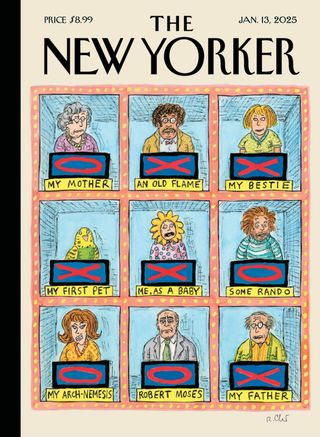

Dit verhaal komt uit de January 13, 2025-editie van The New Yorker.
Abonneer u op Magzter GOLD voor toegang tot duizenden zorgvuldig samengestelde premiumverhalen en meer dan 9000 tijdschriften en kranten.
Bent u al abonnee? Aanmelden
MEER VERHALEN VAN The New Yorker
The New Yorker
CONTRIBUTORS
Eliza Griswold (\"Young Americans,\" p. 12) is a contributing writer.

1 mins
June 29, 2026

The New Yorker
THE READERS
Early in my treatment, we decided that you wouldn't read my work.
24 mins
June 29, 2026

The New Yorker
URBAN LEGEND
Closing out a crime trilogy about a changing New York, Colson Whitehead excavates his own foundations.
33 mins
June 29, 2026
The New Yorker
ABOUT TOWN
POST-ROCK | Last year, the Chicago instrumental post-rock band Tortoise returned with \"Touch,\" its first album in nearly a decade, the further explorations of an inquisitive nature.
3 mins
June 29, 2026
The New Yorker
GOINGS ON JUNE 24-30, 2026
What we're watching, listening to, and doing this week.
1 min
June 29, 2026
The New Yorker
LONGING FOR ITHACA
There’s a reason Homer’s homecoming epic has long defeated the directors.
16 mins
June 29, 2026

The New Yorker
HOT PURSUIT
The repo man coming for your ride.
35 mins
June 29, 2026
The New Yorker
WILD THINGS
Why do animals have sex, anyway?
14 mins
June 29, 2026
The New Yorker
PRICKLY PAIRS - “The Invite.”
“The Invite” begins with an aphorism: “One should always be in love.
6 mins
June 29, 2026
The New Yorker
BRAVE NEW WORLD DEPT.INSTANCING
Wednesday evenings at Hex&Co., board-game café and bar in Morningside Heights, are dedicated to \"RPG Encounters,\" in which fans of role-playing games gather to create collaborative stories over espresso drinks.
3 mins
June 29, 2026
Listen
Translate
Change font size