
Ga onbeperkt met Magzter GOLD
Krijg onbeperkte toegang tot meer dan 9000 tijdschriften, kranten en Premium-verhalen voor slechts
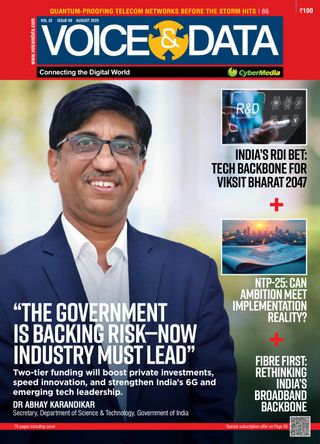
India's RDI bet: Tech backbone for Viksit Bharat 2047
Voice and Data
|August 2025
The Scheme aims to boost private sector R&D with long-term funding, accelerating innovation in emerging tech like semiconductors, AI, telecom, and quantum.

In July 2025, the Union Cabinet approved a Rs 1 lakh crore Research, Development and Innovation (RDI) Scheme aimed at strengthening India's innovation ecosystem. The primary objective is to provide long-term, low-interest financing that can catalyse private sector investment in R&D, especially in strategic and emerging technology areas. This policy move comes at a time when India's Gross Expenditure on R&D (GERD) remains low at around 0.64% of GDP, far behind countries like the US and China, where R&D investment ranges between 2.5% and 3.5% of GDP. Compounding this gap is the limited share of private industry in R&D, which accounts for just about 36% of total R&D expenditure, far below global benchmarks.
The RDI Scheme seeks to reverse this trend by providing patient capital at scale, specifically to support high Technology Readiness Level (TRL) projects and strategic technology development. Through a 50-year, interest-free loan extended to the Anusandhan National Research Foundation (ANRF), the scheme intends to address the "valley of death" in innovation, where promising research often fails to progress from prototypes to market because of limited risk capital and insufficient industry co-funding.
CATALYSING AN ATMANIRBHAR TECH ECOSYSTEM
If deployed effectively, the RDI Scheme could raise India's Gross Expenditure on R&D (GERD) significantly over the next two decades. Based on India's current GERD of roughly Rs 1.3 lakh crore annually, the RDI corpus deployed over 5–10 years equates to an annual addition of Rs 10,000–20,000 crore. This scale of funding, when combined with expected private co-investment and crowd-in effects, could raise overall R&D expenditure by an estimated 15–25%. The increase reflects not just the direct public outlay but also the catalytic effect on industry, academia, and venture capital participation.

Dit verhaal komt uit de August 2025-editie van Voice and Data.
Abonneer u op Magzter GOLD voor toegang tot duizenden zorgvuldig samengestelde premiumverhalen en meer dan 9000 tijdschriften en kranten.
Bent u al abonnee? Aanmelden
MEER VERHALEN VAN Voice and Data

Voice and Data
Shaping India's near-future digital playbook
As India enters 2026, these ten technologies will advance network design, strengthen digital infrastructure, and unlock new layers of enterprise value.

11 mins
December 2025

Voice and Data
Securing the nation in an age of silent cyber conflict
India's expanding digital ecosystem now sits at the centre of global cyber conflict, demanding resilience, sovereign control, and Al-driven defence at scale.
4 mins
December 2025

Voice and Data
INDIA'S NEXT NETWORK FRONTIER
Ten deep-tech shifts will redefine how India connects, secures, and scales its digital future in 2026 and beyond—reshaping networks, infrastructure, and innovation.
8 mins
December 2025

Voice and Data
DPDP Act sets new guardrails for India's Al ecosystem
India's data law reshapes the foundations of Al by enforcing trust, clarity, and responsible innovation across every layer of its evolving digital ecosystem.
3 mins
December 2025

Voice and Data
"We are building a Rapido, not a bus, for space"
Immanuel Louis, Co-founder and COO of Astrophel Aerospace, is attempting to rewire how India thinks about satellite launches-from large-ride dependency to faster, indigenous access to orbit. Alongside his co-founder, Louis is building a vertically integrated space-tech startup focused on Made-in-India rocket components, reusable engines, and sub-systems optimised for small and CubeSat missions.
6 mins
December 2025

Voice and Data
Driving speed, stability, and next-gen wireless efficiency
Built on multi-link architecture, expanded spectrum, and higher-order modulation, Wi-Fi 7 lays the foundation for the next phase of immersive and connected living.
4 mins
December 2025

Voice and Data
UNSHACKLING SATCOM: THE POLICY RESET INDIA NEEDS FOR VIKSIT BHARAT
India's connectivity gap demands a regulatory shift that can enable satellite networks to reach regions where terrestrial infrastructure cannot viably operate.
6 mins
December 2025

Voice and Data
Telcos to Techcos: The long climb to a new success story
As operators climb out of the commodity-connectivity trap, they are rebuilding networks, services, and platforms to script a sustainable growth story.
3 mins
December 2025

Voice and Data
When automation turned against the world wide web
A routine Cloudflare update triggered a global outage, exposing the security and stability risks of centralised cloud and why resilience must be re-engineered.
7 mins
December 2025

Voice and Data
6G to need 2-3 GHz more mid-band spectrum by 2040
GSMA forecasts 2-3 GHz more mid-band spectrum needed by 2040 to avoid urban congestion and enable global 6G readiness.
1 min
December 2025
Listen
Translate
Change font size