Poging GOUD - Vrij
CUT COSTS, NOT YIELD
Successful Farming
|December 2023
When soil health improves, fewer inputs may be needed.
FARM SCHOOL
An educational series for farmers who want to take their skills to the next level.
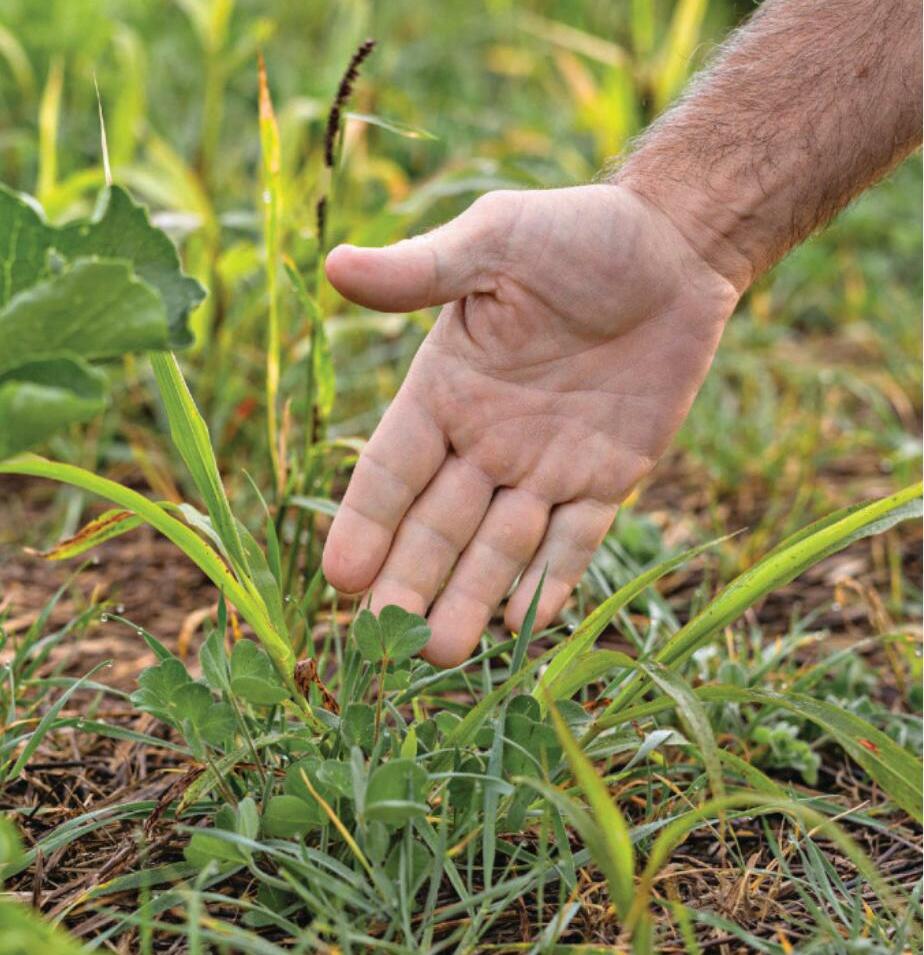
Profitability can increase when inputs are reduced and yields can be maintained. The key is to first increase soil health.
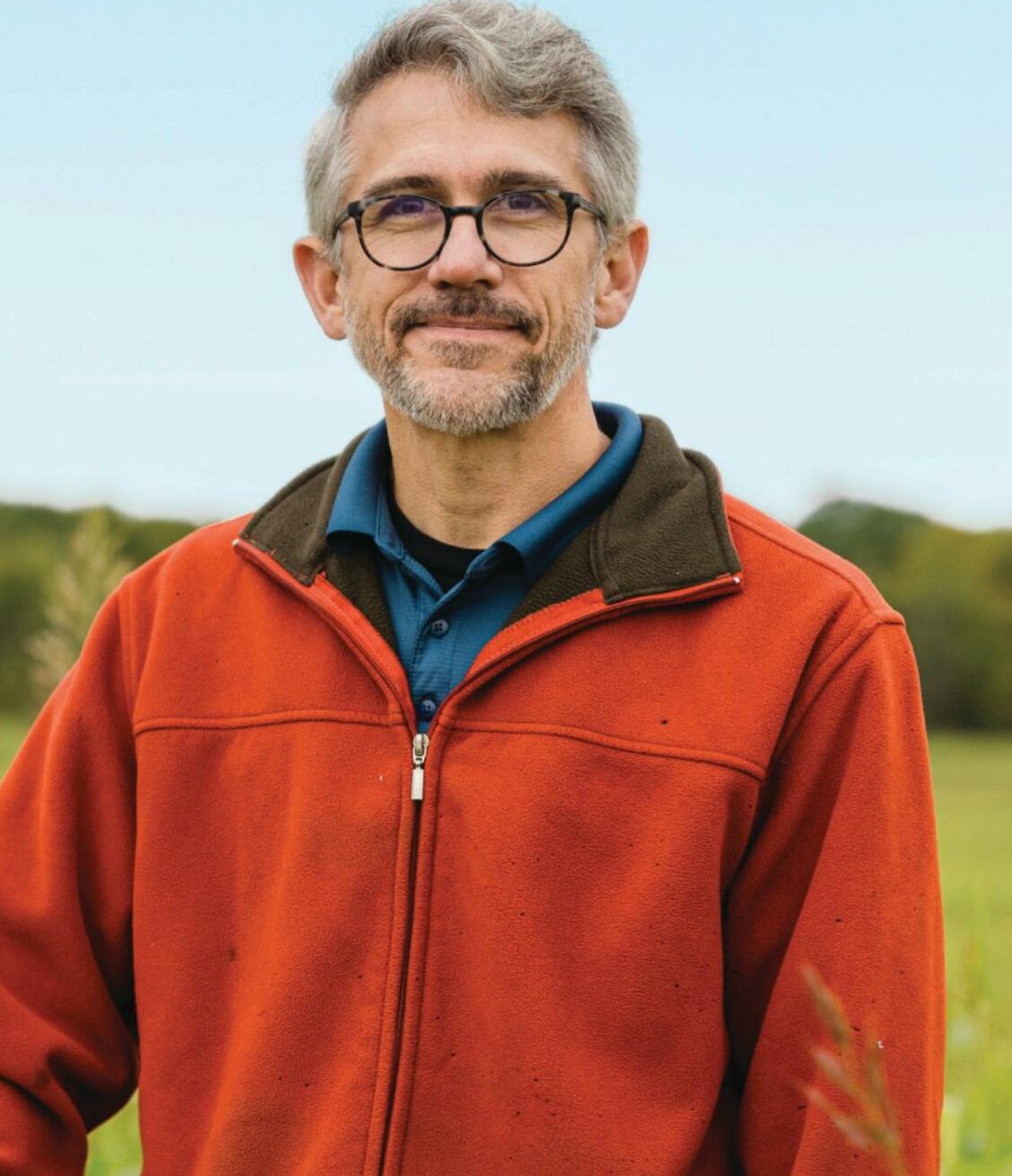
Near Carroll, Ohio, Jay Brandt continues a legacy built by his late father, David Brandt, an iconic farmer who started no-tilling and growing cover crops in the 1970s. Today, on the farm's 1,000 acres of corn, soybeans, and wheat, Jay Brandt uses 50% of the synthetic nitrogen fertilizer used by conventionally farming neighbors, he says, and 60% to 70% of the herbicide.
Despite these reductions in inputs, yields and profit hold strong. "We're in the yield average for our area," says Brandt, "and profitability is good because of the crop rotation and because our cost of production is very low due to our reduced use of inputs."
No-till farmer and cover crop grower Sonny Price has experienced similar results on his 6,600-acre farm near Dillon, South Carolina, where he grows corn, beans, soybeans, cotton, winter wheat, and cover crops. In 2016 and 2017, Price stopped applying phosphorus, potash, and lime despite general assumptions that yields couldn't be sustained in his region without those inputs.
But yields have maintained and even increased, while the reduction in inputs brings significant savings. "In 2017, Price was saving $50 an acre just by not applying lime, a savings that easily paid the cost of his cover crop seed," says University of South Carolina researcher Robin (Buz) Kloot. At 2017's prices, the savings from not applying phosphorus and potassium amounted to another $50 to $70 an acre, adds Kloot, generating a total savings of $120 an acre.
Cut Costs 101: No-Till, Cover Crop Combo


Dit verhaal komt uit de December 2023-editie van Successful Farming.
Abonneer u op Magzter GOLD voor toegang tot duizenden zorgvuldig samengestelde premiumverhalen en meer dan 9000 tijdschriften en kranten.
Bent u al abonnee? Aanmelden
MEER VERHALEN VAN Successful Farming
Successful Farming
Roger Wenning
Taking the long view on soil health has allowed this Indiana farmer to drastically transform his land and yields.

3 mins
December 2025
Successful Farming
A Systems Overhaul
These farmers jump-started soil lite to provide health and fertility for crops.
5 mins
December 2025

Successful Farming
Do You Trust Your Land?
A trust may help you and your family with farm succession and retirement.
4 mins
December 2025

Successful Farming
Make Your Own Handy Tools
Craft your own wire splicers for fencing repairs, and a sprayer tip-cap remover to save your fingers.
1 min
December 2025
Successful Farming
Do 100 THINGS 1% Better
Yield contest champions confirm big yields come from small, consistent improvements.
7 mins
December 2025

Successful Farming
Rural Route Ramble
Holiday shoppers are descending on northwest Iowa communities, getting a glimpse of the beauty of small-town life and offering a much-needed boost to businesses.
4 mins
December 2025
Successful Farming
A Fresh Start
Up-and-coming farmers find peace, purpose, and a path to independence in Iowa.
1 mins
December 2025

Successful Farming
Sean Lehmann
The Braunvieh beef breed has become a favorite of this Kansas cattleman and his family.
4 mins
December 2025
Successful Farming
A SLOW UNWINDING
While some data shows farmland values are up, one expert sees farmland values declining due to market dynamics.
5 mins
December 2025

Successful Farming
Who Can Own American Farmland?
What does the National Farm Security Action Plan mean for foreign-owned businesses such as Syngenta?
3 mins
December 2025
Translate
Change font size