Poging GOUD - Vrij
Is the 'second bite' really so bad?
Stockfarm
|November 2025
One of the most common misconceptions among grazing managers is that allowing animals to graze grass regrowth is harmful, says Richard Fynn, professor of Rangeland Science at the Okavango Research Institute, University of Botswana.
This approach suggests that animals should take only a single bite from each blade of grass before moving on. The belief is that a second bite will damage the grass and ultimately lead to veld degradation. Based on this view, animals should only return to a specific tuft after a long rest period.
Differences in grassland types
Speaking at the 2025 congress of the Grassland Society of Southern Africa, Prof Fynn said this perspective fails to account for differences in grassland types. “In arid regions, where grasses grow slowly and mature grasses retain much of their nutritional value, restricting animals from grazing regrowth has a limited impact on animal production. However, in mesic areas with annual rainfall exceeding 600mm, grasses grow more rapidly, and quality declines significantly as they mature. Forcing animals to feed only on long-rested, mature grass in these areas can harm production,” he explained.
Ultrahigh-density grazing
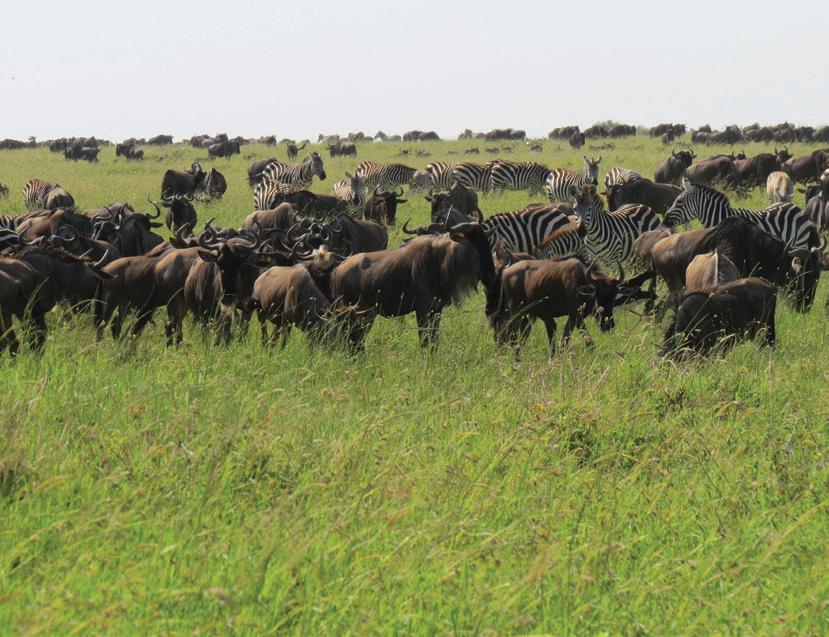
Linked to this misconception is the commonly held belief that ultrahigh-density (UHD) grazing – with very short grazing periods and extremely long rest periods – accurately mimics the natural behaviour of large wildlife herds. “In reality, herds move into areas with young, green grass, such as recently burnt patches, a few weeks after good rains. They graze the area down and move on, returning after several weeks when the grass has regrown to provide fresh, highly nutritious regrowth.”
Extensive evidence from studies (e.g. in the Serengeti and elsewhere in Southern Africa) shows that herds frequently return to the same area throughout the wet season. Research on buffalo in the Kruger National Park indicates that they revisit specific sites approximately every ten days. This differs from the holistic approach.

Dit verhaal komt uit de November 2025-editie van Stockfarm.
Abonneer u op Magzter GOLD voor toegang tot duizenden zorgvuldig samengestelde premiumverhalen en meer dan 9000 tijdschriften en kranten.
Bent u al abonnee? Aanmelden
MEER VERHALEN VAN Stockfarm
Stockfarm
Building a conservation economy: WRSA turns 20
Wildlife Ranching South Africa (WRSA) recently celebrated its 20th birthday at Wolwespruit in Pretoria.

1 min
Mei 2026
Stockfarm
Zero tariffs drive growth in Zim's agri exports
Zimbabwe is expanding its exports following the introduction of zero tariffs for African suppliers by China.
1 min
Mei 2026
Stockfarm
Cloned sheep goes on display at museum
A cloned animal that helped pave the way for the creation of Dolly the sheep has gone on permanent display at a Scottish museum.
1 min
Mei 2026
Stockfarm
Influence of prolonged elevated testes temperatures on the fertilising capacity of ram spermatozoa
The phenomena associated with the predicted increase in ambient temperatures, i.e. variable climate, drought and degradation of land, are expected to happen concurrent with an increased demand for animal protein.
4 mins
Mei 2026
Stockfarm
Fuel impacts on beef production
The fuel access and price crisis driven by the Iran conflict is taking a heavy toll on red meat supply chains.
1 min
Mei 2026
Stockfarm
Sheep scab: Tiny mites, huge impact
Sheep scab is not limited to a single flock or farm.
3 mins
Mei 2026
Stockfarm
Mosdene Borans make their mark
When the bid closed on R2 million for the Boran bull Odysseus (E18-138), it took mere minutes for the Mosdene Boran Stud's very first production auction to make headlines.
4 mins
Mei 2026
Stockfarm
Feedlot finishing phases and tips
Fattening cattle is an important way for producers to add value to their calf crop. However, before deciding to finish cattle, producers should carefully evaluate market conditions and feed costs, as these factors influence the profitability of the operation. This is particularly important for producers who consider this a seasonal activity rather than a permanent component of the farming operation.
3 mins
Mei 2026
Stockfarm
Deductions from employees' compensation
Good intentions can easily lead to costly disputes when deductions are incorrectly made from employees' compensation. This is one of the most common violations identified by inspectors from the Department of Employment and Labour during farm visits. Such mistakes can cost employers in terms of money, time, and working relationships.
2 mins
Mei 2026
Stockfarm
The dynamic dairy goats of Modderaskolk
Farming may appear simple from the outside, but behind the scenes it is not always as romantic and idyllic as one might think. Sometimes a farm must be built from the ground up. Whatever the situation, there is a way if you set your mind to it.
4 mins
Mei 2026
Listen
Translate
Change font size