Poging GOUD - Vrij
Make Smarter Investments in Resilient Supply Chains
MIT Sloan Management Review
|Fall 2024
Many companies invest in resilience only after a disruption. Applying the concept of real options can help decision makers fortify supply chain capabilities no matter the crisis.

MORE THAN EVER, COMPANIES need supply chains that are resilient to disruptions, whether the cause is a natural disaster, an infrastructure failure, labor actions, or a global pandemic. Yet the conventional approach to resilience is seriously flawed. Many companies follow a boom-and-bust pattern, making big investments in resilience after a supply chain disruption and then paying little attention to the issue until the next crisis.
This reactive way of protecting supply chains is based on the approach of mitigating the risk that a disruptive event will occur. But that is not enough for creating true resilience, which is the ability to bounce back as quickly as possible after a disruption.¹ A more effective approach focuses not on risks but on outcomes - that is, on the value of maintaining operations when adversity strikes rather than on the cost of a supply chain disruption. The goal is a robust supply chain that can sustain value creation under any plausible risk scenario.²
Developing such an approach is difficult. It requires companies to determine in advance how much to invest in resilience and how to implement those investments across different parts of the organization. These challenges have long frustrated efforts to make supply chains more resilient.
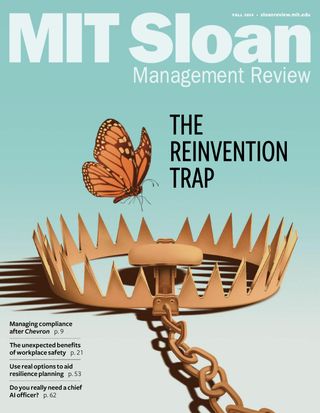

Dit verhaal komt uit de Fall 2024-editie van MIT Sloan Management Review.
Abonneer u op Magzter GOLD voor toegang tot duizenden zorgvuldig samengestelde premiumverhalen en meer dan 9000 tijdschriften en kranten.
Bent u al abonnee? Aanmelden
MEER VERHALEN VAN MIT Sloan Management Review

MIT Sloan Management Review
A Smarter Approach to Measuring Customer Experience
Many companies collect more customer experience data points than they need or can use effectively. Here's how to focus on the metrics that matter.

10 mins
Spring 2026

MIT Sloan Management Review
Why Digital Dexterity Is Key to Transformation
To make headway with digital transformation, executives are redefining the challenge: Build a workforce to take advantage of new technologies.
17 mins
Spring 2026

MIT Sloan Management Review
Ask Sanyin: What Makes a 'Listening Tour' Meaningful?
I've just stepped into a new leadership role and was advised to embark on a \"listening tour.\"
2 mins
Spring 2026

MIT Sloan Management Review
Build Business Advantage With Real-Time Decision-Making
Stop running your business on yesterday's data. Real-time data, empowered employees, and agile systems can lead to higher margins.
11 mins
Spring 2026

MIT Sloan Management Review
Balancing Innovation and Risk in the Age of AI
Monica Caldas is executive vice president and global CIO of Liberty Mutual Insurance.
2 mins
Spring 2026

MIT Sloan Management Review
Turn Customer Complaints Into Innovation Blueprints
You can reframe client grievances as an opportunity instead of a burden. At one Swiss hospital, complaints have become a pipeline for improvements to the customer experience.
6 mins
Spring 2026

MIT Sloan Management Review
The Eight Core Principles of Strategic Innovation
A company's future depends on the new directions it explores and develops today — and that requires different structures and capabilities from incremental innovation.
14 mins
Spring 2026

MIT Sloan Management Review
What AI Can Teach Us About Designing Better KPIs
Machine learning research offers four proven strategies to prevent people from gaming measures of organizational performance.
12 mins
Spring 2026

MIT Sloan Management Review
THREE THINGS TO KNOW ABOUT Learning by Hiring
LEADERS WHO RECOGNIZE THAT OUT-siders can be major drivers of innovation often seek to bring new knowledge into their organizations by making external hires.
2 mins
Spring 2026

MIT Sloan Management Review
Validating LLM Output? Prepare to Be ‘Persuasion Bombed’
Research demonstrates how generative AI ramps up the rhetorical pressure on users who question the AI's output.
8 mins
Spring 2026
Listen
Translate
Change font size