Poging GOUD - Vrij
Strategies to prevent water contamination of food
Farmer's Weekly
|August 01-08, 2025
Decades of South African research reveal key blueprints to reduce water contamination in fruit and vegetables. Loandi Richter-Mouton and Lise Korsten of the University of Pretoria share some of their counter-measures.
-

Water is essential at all stages of food production, from irrigation to food processing, to washing fruit and vegetables before we eat them.
Crops and livestock need it to grow, but water can also be contaminated by pathogens (any organism that causes disease), heavy metals, and chemicals.
These can be considered a potential food safety hazard when they enter the food chain. For example, contaminated irrigation water can transfer pathogens like E. coli to fruit and vegetables. Eating these raw and without washing them properly can lead to severe stomach cramps, diarrhoea, nausea and fever.
We are a team of researchers from the University of Pretoria and the Water Research Commission in South Africa, who have investigated bacterial pathogens in water sources for the past 20 years. We've developed ways to help determine whether water is of good quality when used before, and after, harvesting fresh produce.
With about 40 years of combined experience, we are also identifying potential hotspot environments for contamination. We're currently tracking multi-drug resistant bacteria in South Africa's water and assessing the implications for food safety.
We have also analysed the complete supply chains of fresh produce using microbiological methods to investigate what contaminants might be circulating in vegetable production and contaminated irrigation water.
Our research is focused on ensuring that the food reaching consumers' tables does not pose hidden health risks. Over the years, we've learnt these key lessons:
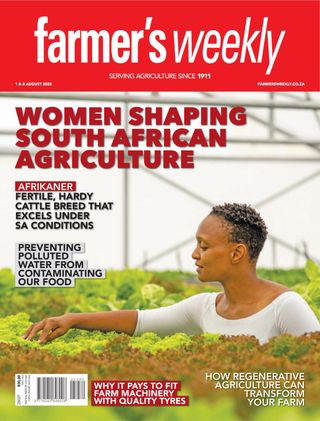

Dit verhaal komt uit de August 01-08, 2025-editie van Farmer's Weekly.
Abonneer u op Magzter GOLD voor toegang tot duizenden zorgvuldig samengestelde premiumverhalen en meer dan 9000 tijdschriften en kranten.
Bent u al abonnee? Aanmelden
MEER VERHALEN VAN Farmer's Weekly
Farmer's Weekly
Cash flow budgets: keeping farmers in control of liquidity, risk, and their survival
Profit doesn't guarantee a farm's survival - cash does. Cobus du Plessis explains why cash flow budgets are one of the most important yet underused financial tools on South African farms.

5 mins
February 27 - March 06, 2026

Farmer's Weekly
The toast of the Navy
The incredible story of the World War II-era Great Dane dog Nuisance being enlisted in the Royal Navy is well documented. Graham Jooste shared some entertaining anecdotes involving the canine shipmate.
6 mins
February 27 - March 06, 2026
Farmer's Weekly
Healthier soils deter destructive locusts
Locust swarms remain a serious global threat, capable of devastating crops, livelihoods and local economies across vast regions.
1 min
February 27 - March 06, 2026
Farmer's Weekly
Wheat crisis dominates Grain SA regional meetings
As the ongoing wheat crisis continues to erode producers' margins, emotions ran high at Grain SA's regional meeting in Moorreesburg in the Western Cape.
2 mins
February 27 - March 06, 2026

Farmer's Weekly
A FARMER'S EXPERIENCE
Street Wallet has been a game-changer for Mario Athanasopoulos, hydroponic production consultant and owner of Green City Farms.
1 mins
February 27 - March 06, 2026
Farmer's Weekly
Kesieberg Merino Stud Production Sale
The Kesieberg Merino Stud Production Sale was held on the farm Leeuwfontein on 4 February on behalf of Willie and Herman Henning.
1 min
February 27 - March 06, 2026
Farmer's Weekly
Not cheaper, just different: what you should know about farming in Mozambique
Although Mozambique is often viewed as a cheaper, easier farming location than South Africa, cost comparisons tell a more complex story. But while cross-border production presents real challenges, it also offers opportunities for complementary trade, diversification and regional food security, particularly when it comes to subtropical crops such as bananas.
10 mins
February 27 - March 06, 2026
Farmer's Weekly
The all-rounder anchoring South Africa's beef value chain
Louis Steyl, CEO of the Bonsmara Cattle Breeders' Society of South Africa, spoke to Octavia Avesca Spandiel about how the versatile Bonsmara breed anchors the country's beef value chain, delivering balanced performance, reproductive and feed efficiency, and carcass traits across extensive and intensive systems.
6 mins
February 27 - March 06, 2026

Farmer's Weekly
THE HITCHING POST
I'm a 60-year-old white woman who loves camping, animals, the outdoors, and watching sport.
2 mins
February 27 - March 06, 2026
Farmer's Weekly
Foot-and-mouth disease in pigs
Recently, the radio news mentioned an outbreak of foot-and-mouth disease (FMD) in pigs in South Africa.
2 mins
February 27 - March 06, 2026
Listen
Translate
Change font size