Poging GOUD - Vrij
Assertive men — strong! Assertive women — aggressive!
DataQuest
|June 2025
We're often expected to ‘carry the culture’ while also driving business results. Men are often assessed on both their current performance and their potential, whereas women are evaluated primarily on their output. Labels, sisterhood, succession planning, broken rungs—there’s so much that women should boldly address. Kavita Mehra, General Manager of Dell Technologies’ India Centre of Excellence, unravels all these nuanced constraints and biases that women leaders have been facing, but are now bravely conquering. And she urges women leaders to be unapologetic because they have earned their seats, and to raise their voice, sometimes literally.

Is it fun, easy, tough, or tricky being a woman leader?
Being a woman leader can be all those things: fun, tough, inspiring, and sometimes, tricky. Each day is different. Some days, you feel invincible, capable of conquering anything. Other days, the weight of expectations or a mismatch with your values presents challenges. On good days, the support systems in place make it all flow seamlessly. On others, even with visibility, you may still feel the need to prove your worth.
The journey can be tricky as it requires navigating nuances and building your playbook along the way. If you'd asked me this 20 years ago, I might have pointed to a promotion or a major launch as a proud moment. Today, what I hold close is the resilience I've built, especially while managing personal loss and showing up at work, with empathy and strength. That journey is deeply human, and I know many women leaders share it.
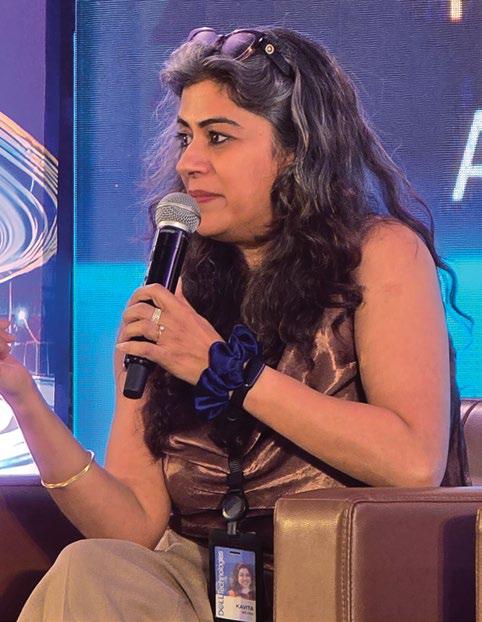 KAVITA MEHRA General Manager, Dell Technologies' India Centre of Excellence
A 2024 KPMG report notes that nine per cent of organisations still have no women in Leadership roles, and 17 per cent have seen no change or a decrease in the number of women leaders. However, women's drop-out rates have marginally declined in 36 per cent of organisations over the past five years and significantly decreased in 13 per cent. How do you interpret these trends in the context of your own experience and what you observe among your peers?
There’s clearly some momentum building, but the pace and consistency of progress vary widely. At Dell Technologies, we've made significant strides, not just in representation but in creating a more level playing field when it comes to development, pay equity, and internal mobility. But that’s not the norm everywhere.

Dit verhaal komt uit de June 2025-editie van DataQuest.
Abonneer u op Magzter GOLD voor toegang tot duizenden zorgvuldig samengestelde premiumverhalen en meer dan 9000 tijdschriften en kranten.
Bent u al abonnee? Aanmelden
MEER VERHALEN VAN DataQuest

DataQuest
Engineering India's Al-First Data Centres at Hyperscale
Rohan Sheth explains how AI and HPC are reshaping India's data centres, from density and cooling to power economics, sustainability, and hyperscale decision criteria.

4 mins
February 2026

DataQuest
From copilots to colleagues: Why agentic AI is forcing enterprises to rethink control, trust, and culture
As AI agents shift from assisting to acting, enterprises must redesign governance, data controls, and security guardrails so autonomy stays auditable, reversible, and trusted.
2 mins
February 2026

DataQuest
Reclaiming Control in the AI Era: A Conversation with Kalyan Kumar, CPO, HCLSoftware
Enterprises are reassessing cloud-first strategies as AI becomes core to operations. HCLSoftware's Kalyan Kumar explains why sovereignty, choice and control now shape decisions.
5 mins
February 2026

DataQuest
When infrastructure learns: The rise of the Al-native core
AI-native infrastructure is moving from concept to operational reality, reshaping how organisations build, govern, and scale intelligence across their digital core.
6 mins
February 2026

DataQuest
Bridging the gap between connectivity and compute at scale
As AI scales in India, data centres are evolving into high-density, low-latency platforms that unify connectivity, compute, and sustainability at national scale.
4 mins
February 2026

DataQuest
PUE is not a grapefruit metric, anymore
So what are the new high-hanging fruits for data centre strategists today? And are players going after them?
4 mins
February 2026

DataQuest
Even if Al demand fades, India need not worry - about data centres
For every megawatt (MW) of installed colocation capacity, users here generate approximately 13.2 PB of data monthly- compared to 0.3 PB for Australia and just 0.01 PB for Singapore. India's data centre growth is not dependent on one tech lever. Plus, it is phased and modular and not kneejerk. Manoj Paul explains these contours in detail.
7 mins
February 2026

DataQuest
AI infrastructure and systemic risk
What has been the biggest change in data centre industry-specially after AI workloads? Is Al-bubble a big risk for data centre infra- how much will it affect data centres if something cracks?
1 min
February 2026

DataQuest
Inside the Shift to High-Density, Al-Ready Data Centres
CtrlS' Vipin Jain discusses what it truly takes to build AI-ready data centres in India, balancing high density, liquid-ready cooling, resilience, and ESG accountability.
4 mins
February 2026

DataQuest
Sustainability is now the headline, not a footnote
Sanjay Agrawal, Head Presales and CTO at Hitachi Vantara India and SAARC opines that the conversation is moving beyond headline metrics like PUE toward a broader view of how data lifecycle management and infrastructure efficiency reduce the overall environmental footprint. Let's see why and how- while also touching upon adjacent (or not-so-adjacent) factors like redundancies, availability and AI-readiness
3 mins
February 2026
Listen
Translate
Change font size