
Ga onbeperkt met Magzter GOLD
Krijg onbeperkte toegang tot meer dan 9000 tijdschriften, kranten en Premium-verhalen voor slechts
Poging GOUD - Vrij
Why AI-Enabled ‘Dirty Drugs’ are Future for Longevity Medicine
BioSpectrum Asia
|BioSpectrum Asia July 2025
Ageing is not a result of a single malfunction; it’s a gradual, systemic breakdown that touches everything. Researchers have long understood this and have mapped the tangled web of genes, pathways, enzymes, and signalling molecules involved. For decades, the pharmaceutical industry tried to simplify its way through the complexity of ageing. But now, with AI and polypharmacology, we finally have the tools to meet that complexity on its terms.
What if a key part of the solution to Asia's looming demographic crisis lies in embracing something we in the pharmaceutical industry have long avoided, complex, multi-target, so-called 'dirty' drugs? Across the region, a slow-burning emergency is unfolding. Birth rates are plunging, life expectancy is climbing, and the population pyramid is inverting. In countries like Japan, South Korea, China, and Singapore, this is already translating into overburdened health systems, lonely older populations, frustrated youth, and stifled economic growth. The conventional tools of medicine, clean, single-target therapies, are falling short in the face of the complexity underlying chronic diseases and the ageing process itself.
Tackling them effectively demands therapies that engage multiple biological 'levers' at once, without triggering chaos. Until recently, the complexity and risk involved in designing drugs of this kind were, for all intents and purposes, unmanageable. But that is now changingemerging artificial intelligence (AI) models, particularly graph neural networks, allow us to navigate ageing's complexity and design effective, multi-target compounds with exceptional precision and efficacy.
Ageing Is a Systems Problem
Ageing is not a result of a single malfunction; it's a gradual, systemic breakdown that touches everything. Metabolic regulation slips. Immune signals misfire. Neuroendocrine rhythms falter. Regeneration slows. These aren't isolated failures; they're deeply interconnected.
Ageing researchers have long understood this. We've mapped the tangled web of genes, pathways, enzymes, and signalling molecules involved. But understanding that complexity exists is not the same as being able to address it. As with other aspects of medical research, most drug discovery efforts in longevity biotech have focused on single levers: one gene, one protein, one pathway at a time.
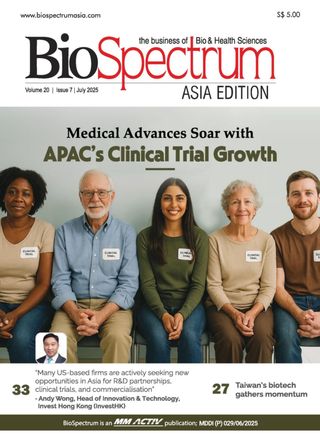

Dit verhaal komt uit de BioSpectrum Asia July 2025-editie van BioSpectrum Asia.
Abonneer u op Magzter GOLD voor toegang tot duizenden zorgvuldig samengestelde premiumverhalen en meer dan 9000 tijdschriften en kranten.
Bent u al abonnee? Aanmelden
MEER VERHALEN VAN BioSpectrum Asia
BioSpectrum Asia
India–EU FTA Paves Way for Expanded Healthcare Trade
On January 27, 2026, after years of negotiations, India and the European Union announced a landmark Free Trade Agreement.

4 mins
BioSpectrum Asia March 2026
BioSpectrum Asia
PreferCo and Glatt to open CoE for precision fermentation bioprocess scale-up in India
In a major boost to Government of India's BioE3 push, German major Glatt and India-based startup PreferCo have announced the launch of \"PreferCo-Glatt Centre of Excellence (CoE) for Bioprocess Scale-Up\" in Hyderabad's Genome Valley.
1 min
BioSpectrum Asia March 2026

BioSpectrum Asia
Women's Health Surge in APAC
The rising burden of diseases such as ovarian cancer, breast cancer, cervical cancer, infertility, etc. is emerging as the key driver of the women's healthcare market across the globe. While North America led the women healthcare market in 2025, Asia Pacific (APAC) is expected to witness the fastest growth this year onwards. As a result, governments across the APAC region, are recognising the importance of women's health and are launching initiatives, particularly under female leaders, to improve access to healthcare services. Moreover, a number of women-led startups are now developing new solutions to address this growing burden of women-associated diseases in the APAC region. Let's take a closer look.
6 mins
BioSpectrum Asia March 2026

BioSpectrum Asia
Hanchor Bio receives US FDA Orphan Drug Designation for HCB101 in gastric cancer
Taiwan-based biotech startup HanchorBio, Inc. has announced that the US Food and Drug Administration (FDA) has granted Orphan Drug Designation (ODD) to HCB101 for the treatment of gastric cancer.
1 min
BioSpectrum Asia March 2026

BioSpectrum Asia
Daiichi Sankyo names Dr John Tsai as Global Head of R&D
Japan-based Daiichi Sankyo Company has appointed Dr John Tsai to succeed Dr Ken Takeshita, who is stepping down as Global Head of R&D, effective April 1, 2026.
1 min
BioSpectrum Asia March 2026

BioSpectrum Asia
"The global trend is moving beyond centralised hubs toward distributed networks and domestic capability"
King Faisal Specialist Hospital & Research Centre (KFSHRC) and US-based Germfree Laboratories have announced a strategic partnership to develop Saudi Arabia's first fully integrated, modular Advanced Therapy Medicinal Product (ATMP) Manufacturing Campus.
4 mins
BioSpectrum Asia March 2026

BioSpectrum Asia
SEOUL'S RISKY DRUG PRICING RESET
Drug pricing has once again moved to the centre of policy debate in South Korea, with the government recently stepping back from its proposed generic drug pricing reform.
2 mins
BioSpectrum Asia March 2026

BioSpectrum Asia
Takeda and Iambic sign $1.7 B deal to advance AI driven design of small molecules
Iambic, a US-based clinical-stage life science and technology company developing novel medicines using its artificial intelligence (AI)-driven discovery and development platform, has announced a multi-year technology and discovery collaboration agreement with Japan-based Takeda Pharma that will use Iambic's industry leading AI drug discovery models to advance a select set of high-priority small molecule programmes, initially in Takeda's Oncology and Gastrointestinal and Inflammation therapeutic areas.
1 min
BioSpectrum Asia March 2026

BioSpectrum Asia
S.Biomedics announces partnership with Catalent to develop and manufacture TED-A9
US-based Catalent and South Korea-based S.Biomedics have announced a strategic partnership to support the development and manufacturing of TED-A9, S.Biomedics' allogeneic pluripotent stem-cell-derived ventral midbrain-specific dopaminergic precursor cell therapy being developed for the treatment of Parkinson's disease.
1 min
BioSpectrum Asia March 2026
BioSpectrum Asia
China revises drug administration regulations to spur innovation
China has revised regulations concerning drug administration in a bid to promote drug innovation, strengthen management of online sales of medicines and reinforce drug safety supervision.
1 min
BioSpectrum Asia March 2026
Listen
Translate
Change font size