Poging GOUD - Vrij
Explaining the Bluff and the Bite
The Country Smallholder
|October 2025
Paul Donovan delves into the world of Threat Posturing in chickens, why they do it, how it looks and when and how we should take action
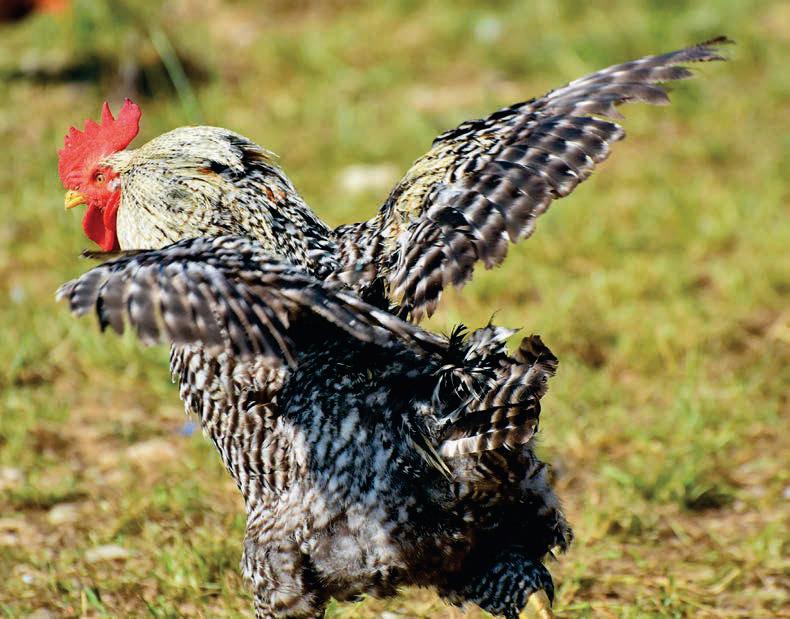
Threat posturing is a fascinating and complex behaviour in chickens, serving as a vital communication tool in their social hierarchy. Chickens use a range of visual and auditory cues to convey aggression, dominance, or submission, influencing the dynamics of their flock. While threat posturing may appear intimidating, it is often a substitute for actual violence, allowing chickens to resolve conflicts without physical harm. By deciphering these behaviours, we can better manage our birds, reduce stress, and promote harmony
WHAT IS THREAT POSTURING?
Threat posturing encompasses a range of behaviours designed to imitate, deter, or influence others. These displays involve visual, auditory, and posture cues that signal aggression, dominance, or submission. Common threat posturing behaviours include:
- Puffing out feathers to appear larger, making the bird’s profile more formidable.
- Raising hackles, or feathers on the back of the neck, to convey agitation or hostility.
- Spreading wings, either to block access, or prepare for an attack.
- Loud, high-pitched vocalisations, such as squawking or screeching, to alert others or express alarm.
- Aggressive displays, like charging, lunging, or flapping wings. These behaviours may be directed towards other chickens, humans, or even perceived threats, like predators or unfamiliar objects. Threat posturing serves as a vital communication tool, allowing chickens to establish dominance hierarchies, defend resources, and maintain social order.
ELEMENTS TO THREAT POSTURING
Effective threat posturing involves a combination of posturing, feather positions, and facial expressions. These can be accompanied by loud, distinctive calls that convey emotions, and intentions, while making rapid, deliberate movements that signal aggression.
CAUSES OF THREAT POSTURING

Dit verhaal komt uit de October 2025-editie van The Country Smallholder.
Abonneer u op Magzter GOLD voor toegang tot duizenden zorgvuldig samengestelde premiumverhalen en meer dan 9000 tijdschriften en kranten.
Bent u al abonnee? Aanmelden
MEER VERHALEN VAN The Country Smallholder
The Country Smallholder
Making sure you put enough nutrition into your dairy goat to support her milk production
Sarah Day, nutritionist for Small Holder Feed offers feeding advice for your dairy goats to help them be happy, healthy and milky animals.

6 mins
March 2026
The Country Smallholder
Welcoming the very start of the spring season
Henrietta Balcon makes the most of the new crop rhubarb
2 mins
March 2026
The Country Smallholder
Starting with Pigs - before you start
Linda Aldous outlines what you need to do before anything porcine arrives on your smallholding
3 mins
March 2026
The Country Smallholder
Insurance to protect livestock - and your peace of mind
Looking ahead to a busy 2026 for Pedigree Sales, farmers and breeders will be preparing their livestock for the upcoming markets
2 mins
March 2026

The Country Smallholder
Getting Your Electric Fence Spring-Ready: Expert Q&A
As Spring arrives, it’s the perfect time to give your electric fence some attention. Based on questions we discuss regularly here at www.electricfencing.co.uk, here’s a list of the checks you should be carrying out now, and why they matter.
2 mins
March 2026

The Country Smallholder
Check your kit for the busy seasons ahead
Agricultural journalist, and machinery writer Jane Brooks, joins us for her regular look at the world.
4 mins
March 2026
The Country Smallholder
Flock together: is now the right time to add more hens?
Andy Hill explains how to integrate birds into a flock without feathers flying
4 mins
March 2026
The Country Smallholder
The secrets behind maximising incubator hatch rates
Buying quality point of lay hens can be an expensive proposition these days (even if you can find a local source of the breed that you want). Incubating fertilised eggs can save a great deal of money and make many more breeds accessible. If you already keep poultry that includes a cockerel, an incubator means that you can hatch their eggs either to increase your flock or to sell. Hugh & Fiona Osborne have been using incubators for many years and have learned that getting a good hatch means attention to detail.
7 mins
March 2026
The Country Smallholder
Making choices for your chicks
Victoria Roberts BVSc MRCVS says Natural and Artifical Incubation are not an either/or choice
5 mins
March 2026

The Country Smallholder
An appetite for asparagus
Our Experts answer your questions
1 mins
March 2026
Listen
Translate
Change font size