Poging GOUD - Vrij
Rearing chickens, ducks and geese to eat
The Country Smallholder
|May 2023
Experienced smallholder Lorraine Turnbull discusses how to get the best return from your meat birds.
-

Having bred poultry now for quite some time, I’ve never shied away from preparing our own birds for eating, either as joints or a whole roast. You know how they’ve been fed, raised and humanely processed. Of course you have to decide which species of bird; chickens, ducks or geese.
CHOOSING CHICKENS
Starting with chickens, obviously you’ll get more meat from a large fowl rather than a bantam, and there are specific meat birds you may wish to purpose. Here in France they are Bresse; large white meaty birds, whilst in the UK Cobb or Ross meat birds are commercially available. You’ll of course get more meat from a meat bird, but you can always create your own meat birds from crossing Light Sussex, Marans or Orpingtons with a Cornish game bird, for example. A typical commercial laying hen will be a poor reward for the cost of feeding it up, so concentrate on the larger, heavier breeds.
Timing is crucial, of course. Before four months old, there will be lots of growing, and not a lot of putting on flesh or weight. Waiting after six months means any male birds are sexually active and all that chasing females will result in strong (often tough) leg meat and not a lot on the breastbone. Personally, with my own birds, I aim to prepare them at five months old, although Cobb or Ross birds will be ready to eat much sooner. Keeping birds in a secure and lit shed with constant access to food will also develop a heavier bird quicker - after all, what else have they to do but eat?
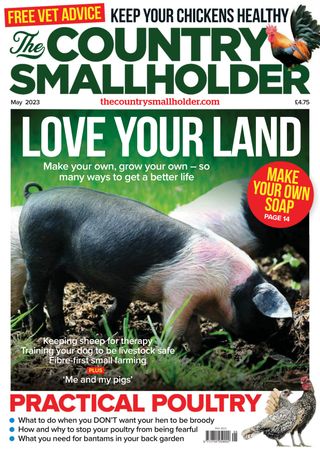

Dit verhaal komt uit de May 2023-editie van The Country Smallholder.
Abonneer u op Magzter GOLD voor toegang tot duizenden zorgvuldig samengestelde premiumverhalen en meer dan 9000 tijdschriften en kranten.
Bent u al abonnee? Aanmelden
MEER VERHALEN VAN The Country Smallholder
The Country Smallholder
Making sure you put enough nutrition into your dairy goat to support her milk production
Sarah Day, nutritionist for Small Holder Feed offers feeding advice for your dairy goats to help them be happy, healthy and milky animals.

6 mins
March 2026

The Country Smallholder
Welcoming the very start of the spring season
Henrietta Balcon makes the most of the new crop rhubarb
2 mins
March 2026
The Country Smallholder
Starting with Pigs - before you start
Linda Aldous outlines what you need to do before anything porcine arrives on your smallholding
3 mins
March 2026
The Country Smallholder
Insurance to protect livestock - and your peace of mind
Looking ahead to a busy 2026 for Pedigree Sales, farmers and breeders will be preparing their livestock for the upcoming markets
2 mins
March 2026
The Country Smallholder
Getting Your Electric Fence Spring-Ready: Expert Q&A
As Spring arrives, it’s the perfect time to give your electric fence some attention. Based on questions we discuss regularly here at www.electricfencing.co.uk, here’s a list of the checks you should be carrying out now, and why they matter.
2 mins
March 2026

The Country Smallholder
Check your kit for the busy seasons ahead
Agricultural journalist, and machinery writer Jane Brooks, joins us for her regular look at the world.
4 mins
March 2026
The Country Smallholder
Flock together: is now the right time to add more hens?
Andy Hill explains how to integrate birds into a flock without feathers flying
4 mins
March 2026
The Country Smallholder
The secrets behind maximising incubator hatch rates
Buying quality point of lay hens can be an expensive proposition these days (even if you can find a local source of the breed that you want). Incubating fertilised eggs can save a great deal of money and make many more breeds accessible. If you already keep poultry that includes a cockerel, an incubator means that you can hatch their eggs either to increase your flock or to sell. Hugh & Fiona Osborne have been using incubators for many years and have learned that getting a good hatch means attention to detail.
7 mins
March 2026
The Country Smallholder
Making choices for your chicks
Victoria Roberts BVSc MRCVS says Natural and Artifical Incubation are not an either/or choice
5 mins
March 2026

The Country Smallholder
An appetite for asparagus
Our Experts answer your questions
1 mins
March 2026
Translate
Change font size