Poging GOUD - Vrij
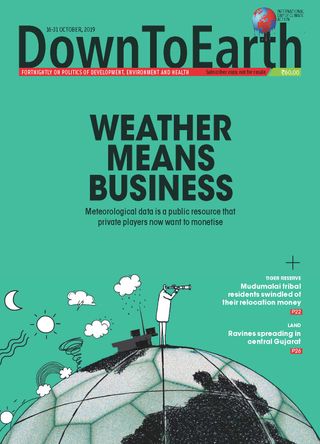
Towards Turbulence
Down To Earth
|October 16, 2019
As countries grapple with intense marine heat waves and stronger storms, the latest IPCC report says climate change has already altered our oceans, polar regions and high snowy mountains


THE TIMING could not have been more coincidental. As the ocean off the western coast of North America warms up at an unusually rapid pace, triggering fears of drought and warnings of harm to salmons, sea lions and other marine life, the Intergovernmental Panel on Climate Change (IPCC) has released a report that says marine heat waves have become twice more frequent in the past four decades and are lasting longer.
“The world’s ocean and cryosphere have been ‘taking the heat’ from climate change for decades, and consequences for nature and humanity are sweeping and severe,” Ko Barrett, vice-chair of IPCC, said while releasing the Special Report on the Ocean and Cryosphere in a Changing Climate (SROCCC). Prepared with reference to 7,000 scientific publications, SROCCC is the first such report to look into the impacts of climate change on the planet’s vast oceans and fragile ice sheets, which are home to some 1,500 million people and influence everything from climate and energy to trade, transport and culture worldwide. “The rapid changes to the ocean and the frozen parts of our planet are forcing people from coastal cities to remote Arctic communities to fundamentally alter their ways of life,” said Barrett.
The report finds that human activities are responsible for 84 to 90 per cent of the marine heat waves that occurred in the last one decade, and says the ocean will continue to warm throughout the 21 st century. By 2081, the frequency of marine heat waves could jump by 20 to 50 times.

Dit verhaal komt uit de October 16, 2019-editie van Down To Earth.
Abonneer u op Magzter GOLD voor toegang tot duizenden zorgvuldig samengestelde premiumverhalen en meer dan 9000 tijdschriften en kranten.
Bent u al abonnee? Aanmelden
MEER VERHALEN VAN Down To Earth
Down To Earth
Popular distrust
THE WORLD seems to be going through a period of stasis despite facing an unfathomable polycrisis.

2 mins
February 01, 2026
Down To Earth
CONSERVE OR PERISH
Periyar Tiger Reserve has rewritten Indian conservation by turning poachers into protectors and conflict into coexistence
5 mins
February 01, 2026

Down To Earth
'Rivers need to run free'
From Tibet to West Bengal, the Brahmaputra is the pulse of communities and ecosystems along its course. But what are the risks the river faces through human interventions, particularly dams, discusses journalist, author and filmmaker SANJOY HAZARIKA in his new book, River Traveller.
4 mins
February 01, 2026

Down To Earth
India is facing up to its innovation lag
There are signs now that India is acknowledging the superior strides made by China in a frontier technology like Al
4 mins
February 01, 2026

Down To Earth
Competing concerns
What are the repercussions of the EU-Mercosur pact that have made European farmers protest against the free trade agreement?
4 mins
February 01, 2026

Down To Earth
From fryer to flight
Sustainable fuel made from used cooking oil can play a pivotal role in helping India achieve its aviation emission reduction goals. Measures to collect this oil must be revamped
4 mins
February 01, 2026

Down To Earth
ACCESS OPEN
An amendment to India's nodal forest conservation law opens up forests across India to commercial exploitation by the paper industry
6 mins
February 01, 2026
Down To Earth
DRINK FROM TAP CAN BE A REALITY
As cities across India struggle to supply safe piped water, Odisha offers a success story
2 mins
February 01, 2026

Down To Earth
GREAT DRYING
The Earth is hotter than at any point in the past 100,000 years, with 2023-25 becoming the warmest three-year period on record and also breaching the 1.5°C threshold for the first time. One fallout is dwindling freshwater.
22 mins
February 01, 2026

Down To Earth
Green redemption
Restoration of grasslands of Kerala's Pampadum Shola National Park, once dominated by invasive Australian wattles, see a return of streams and native species
1 mins
February 01, 2026
Translate
Change font size