Poging GOUD - Vrij
Suffocating Tragedy
Down To Earth
|September 1, 2017
There is no scientific consensus on the cause of encephalitis that has been claiming lives every year in the Gorakhpur region since 1978. But an unprepared government along with medical mismanagement made matters worse this year.

MORE THAN 9,950 children have died of encephalitis in a single hospital in Gorakhpur in the past 40 years. But the health system continues to be unprepared to deal with the disease. On August 10 this year, a news portal ran a story about shortage of liquid oxygen in the Baba Raghav Das Medical College (BRD), and warned of an impending crisis. Since January, the disease had already claimed 160 lives. But oxygen was not made available and that night 23 children died. Children continued to die, and by August 21, the death toll rose to 260 for the year. Though it was clear that the children died due to lack of oxygen in BRD on August 10-11, the state government denied under-preparedness, even as it suspended the principal of the college and vowed to take action against the supplier.
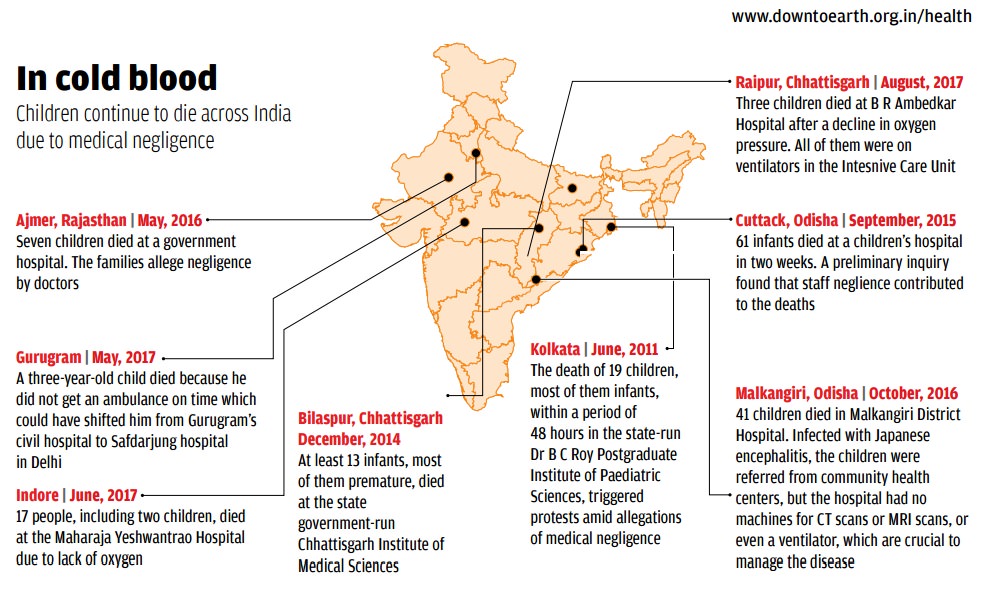
So was the hospital management aware about the shortage? The journalist who wrote the story, Manoj Kumar Singh, says everyone was aware about the looming crisis and the government is now just passing the buck. It seems Rajiv Mishra, the principal of BRD, reminded the authorities in several letters about sanctioning the pending payment to the supplier. According to media reports, Mishra wrote the first letter on March 22 to senior officials in the state’s health ministry. On August 1, Mishra copied this letter to the Medical Education Minister Ashutosh Tandon. Reports also suggest that the supplier too had informed the college and higher authorities that unless his dues of R68.65 lakh were cleared, the company would stop delivery.

Dit verhaal komt uit de September 1, 2017-editie van Down To Earth.
Abonneer u op Magzter GOLD voor toegang tot duizenden zorgvuldig samengestelde premiumverhalen en meer dan 9000 tijdschriften en kranten.
Bent u al abonnee? Aanmelden
MEER VERHALEN VAN Down To Earth

Down To Earth
THINK TWICE BEFORE FELLING SAL TREES
Many trees considered to be affected by sal borer in the 1990s are still alive today

1 mins
February 16, 2026

Down To Earth
EDGE OF SURVIVAL
Caste divides deny marginalised communities land, resources and essential aid, leaving them more vulnerable to climate disasters
6 mins
February 16, 2026

Down To Earth
A WISH LIST?
Union Budget for 2026-27 conveys the impression of a roll-call of intentions and ambitious proposals, with little detail on their formulation
6 mins
February 16, 2026
Down To Earth
Break down the gender wall
THE RULING National Democratic Alliance (NDA) government has been heavily invested in the goal to make India a developed economy by 2047.
2 mins
February 16, 2026

Down To Earth
MENSTRUAL HEALTH, NOW A FUNDAMENTAL RIGHT
In a landmark judgement, the Supreme Court has recognised menstrual health and hygiene as a fundamental right under Article 21 of the Constitution of India, which guarantees the right to life and dignity.
8 mins
February 16, 2026

Down To Earth
Of devolution and new disasters
The 16th Finance Commission pushes for changes in view of new fiscal and climatic conditions
11 mins
February 16, 2026
Down To Earth
Rising risks of plastics
NEGATIVE IMPACTS on human health due to emissions linked to the plastic lifecycle could double by 2040, according to a study published in The Lancet Planetary Health in January.
1 min
February 16, 2026

Down To Earth
GAP BETWEEN EPIDEMICS NARROWING
A watershed-based and landscape-level approach is needed to address forest degradation
2 mins
February 16, 2026
Down To Earth
WAITING TO STRIKE
Sal heartwood borer is considered the biggest threat to forestry in India, especially to the sal tree, where it lives and breeds.
11 mins
February 16, 2026

Down To Earth
A SPRING DELIGHT
Mustard flowers are not meant only for the eyes. Invite them to your plate once in a while
3 mins
February 16, 2026
Translate
Change font size