
Ga onbeperkt met Magzter GOLD
Krijg onbeperkte toegang tot meer dan 9000 tijdschriften, kranten en Premium-verhalen voor slechts
Poging GOUD - Vrij
Punjab's Contrarian Approach
Down To Earth
|November 01, 2017
Safe waste disposal is a big challenge for the national sanitation overdrive. Punjab has been experimenting with centralised systems to tackle this. Has it worked?

WHILE STATES in different ecological regions of the country are struggling to get suitable designs for systems to treat the solid and liquid wastes coming out of their toilets, Punjab has tried to tackle the problem in a different way. For over a decade, the state has been experimenting with both centralised and decentralised waste management systems to make access to sanitation tenable and safe. While the state’s 86 per cent households have access to toilets now, it inevitably emerges as the first port of call to check whether the challenge of safe waste disposal has been tackled effectively as envisioned.
The state government’s Department of Water Supply and Sanitation (DWSS) has been collaborating with the World Bank (WB) to set up a range of waste management systems to adequately meet the demand in face of fast increasing number of toilets. The centralised systems developed under this collaboration include conventional sewage treatment plants (stp), Waste Stabilisation Ponds (WSP) and Duckweed Ponds. The sewer connection to these treatment systems are conventional sewer and solid free sewer (also called small bore sewer) carrying the liquid waste under gravity. A district is allotted one of the above systems depending on local ecology and needs. For example in Muktsar district that has water logging problem, WSPs were suggested. “This is because enough land was available and it is a low cost-low energy system,” says Amrit Deep Singh, sub divisional officer, Public Health and Engineering Department, Muktsar. While districts like Ludhiana and Amritsar were suggested to set up stps because the socio-economic condition was favourable.
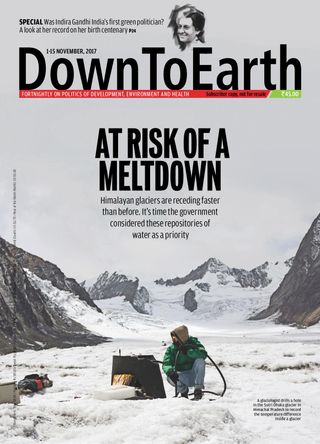

Dit verhaal komt uit de November 01, 2017-editie van Down To Earth.
Abonneer u op Magzter GOLD voor toegang tot duizenden zorgvuldig samengestelde premiumverhalen en meer dan 9000 tijdschriften en kranten.
Bent u al abonnee? Aanmelden
MEER VERHALEN VAN Down To Earth

Down To Earth
THINK TWICE BEFORE FELLING SAL TREES
Many trees considered to be affected by sal borer in the 1990s are still alive today

1 mins
February 16, 2026

Down To Earth
EDGE OF SURVIVAL
Caste divides deny marginalised communities land, resources and essential aid, leaving them more vulnerable to climate disasters
6 mins
February 16, 2026

Down To Earth
A WISH LIST?
Union Budget for 2026-27 conveys the impression of a roll-call of intentions and ambitious proposals, with little detail on their formulation
6 mins
February 16, 2026
Down To Earth
Break down the gender wall
THE RULING National Democratic Alliance (NDA) government has been heavily invested in the goal to make India a developed economy by 2047.
2 mins
February 16, 2026

Down To Earth
MENSTRUAL HEALTH, NOW A FUNDAMENTAL RIGHT
In a landmark judgement, the Supreme Court has recognised menstrual health and hygiene as a fundamental right under Article 21 of the Constitution of India, which guarantees the right to life and dignity.
8 mins
February 16, 2026

Down To Earth
Of devolution and new disasters
The 16th Finance Commission pushes for changes in view of new fiscal and climatic conditions
11 mins
February 16, 2026
Down To Earth
Rising risks of plastics
NEGATIVE IMPACTS on human health due to emissions linked to the plastic lifecycle could double by 2040, according to a study published in The Lancet Planetary Health in January.
1 min
February 16, 2026

Down To Earth
GAP BETWEEN EPIDEMICS NARROWING
A watershed-based and landscape-level approach is needed to address forest degradation
2 mins
February 16, 2026
Down To Earth
WAITING TO STRIKE
Sal heartwood borer is considered the biggest threat to forestry in India, especially to the sal tree, where it lives and breeds.
11 mins
February 16, 2026
Down To Earth
A SPRING DELIGHT
Mustard flowers are not meant only for the eyes. Invite them to your plate once in a while
3 mins
February 16, 2026
Translate
Change font size