Poging GOUD - Vrij
Patchy growth
Down To Earth
|February 01, 2022
Forests and trees now cover one-quarter of India's geography. But this is not necessarily good news

INDIA HAS increased its forest cover by an area roughly twice the size of Delhi in the past two years, suggests the India State of Forest Report 2021, released on January 13, 2022, by the Forest Survey of India (FSI). As a result the country’s forest and tree cover has risen to 809,537 sq km or 24.62 per cent of total land area. While releasing the report, Union Minister of Environment, Forest and Climate Change Bhupender Yadav claimed that his government has not only increased the forest cover but qualitatively enriched it. A closer look at the report’s findings, though, suggests that there is not much to celebrate.
First, this marginal increase still falls far short of what is needed to meet national and global targets. According to the National Forest Policy, 1988, the country must have 33 per cent of its geographical area under forest and tree cover. The same has been listed as an indicator under the UN’s Sustainable Development Goal 14 (Life on land) as well as the “Strategy for New India@75” released by government think tank NITI Aayog in December 2018, with 2030 as the deadline. In fact, an analysis of forest and tree cover trends from 1987, when the first FSI report was released, to 2021 shows that in 34 years, the cover as share of its geographical area has risen by just 5 percentage points.

Progress in 2011-21 has been awfully slow at just 0.81 percentage points (see 'Marginal rise'). As per the 2021 report, only 17 states and Union Territories have forests covering more than 33 per cent of their geographical area, of which five have over 75 per cent.
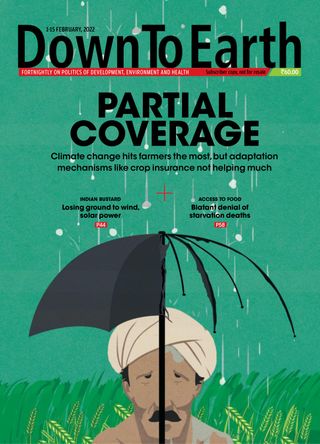

Dit verhaal komt uit de February 01, 2022-editie van Down To Earth.
Abonneer u op Magzter GOLD voor toegang tot duizenden zorgvuldig samengestelde premiumverhalen en meer dan 9000 tijdschriften en kranten.
Bent u al abonnee? Aanmelden
MEER VERHALEN VAN Down To Earth
Down To Earth
MAJESTIC SARUS STAGES COMEBACK
Involvement of farmers in conservation helps the sarus crane population soar in eastern Uttar Pradesh over the past decade

5 mins
June 16, 2026

Down To Earth
Global resistance to AI data centres hardens
India must learn how to regulate environmentally disastrous data centres that guzzle more water and power than entire nations
4 mins
June 16, 2026

Down To Earth
SUMMER SMOG
Ground-level ozone is one of the national capital's least appreciated public health threat
1 mins
June 16, 2026

Down To Earth
A FOREST IN WAIT
For five decades, Abujhmad in Chhattisgarh was closed to the country. Now, as the region opens up, ANIL ASHWANI SHARMA travels to villages in its dense forests to see how isolation has impacted the people and development
6 mins
June 16, 2026

Down To Earth
DON'T WASTE THE FUTURE
Policymakers may need to focus less on expanding programmes and more on improving their effectiveness and reach, suggests the latest NFHS-6 data
3 mins
June 16, 2026
Down To Earth
NEED A FOREST TRIBUNAL
A tribunal will provide people a dedicated independent forum where they will have a statutory right to approach
2 mins
June 16, 2026
Down To Earth
Moment or movement
ONE DEFINITION of the word metamorphosis in the dictionary is “a striking alteration in appearance, character, or circumstances”.
2 mins
June 16, 2026

Down To Earth
El Niño, amplified
As a possible super El Niño looms in 2026, scientists warn of devastations that may extend into 2027
6 mins
June 16, 2026

Down To Earth
A mindless denial
District level bodies are increasingly refusing tribal population's rights over resources guaranteed by the forest rights Act
5 mins
June 16, 2026

Down To Earth
TOOR TOUR
What makes pigeon pea so ubiquitous across cuisines in India
4 mins
June 16, 2026
Translate
Change font size