Poging GOUD - Vrij
NATURAL NUDGE
Down To Earth
|April 01, 2022
Employ beneficial and cost-effective microbes to improve crop yield

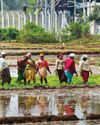
THE LIBERALISATION, privatisation and globalisation reforms of the 1990s disrupted the country's agrarian sector. Seeds, inputs and markets were out of reach for small farmers and agricultural workers, who fell in debt due to high production costs, credit rates, volatile market prices and fossil-fuel-based inputs. Hence, in the early 2000s India began promoting chemical-free organic farming and zero budget natural farming. These improve soil fertility, but there are conflicting views about their impact on yield.
To overcome this and boost productivity, the agriculture sector can tap into microorganisms. Scientific research shows constructive and cost-effective use of bacterial, fungal and algal microbes can also have positive results on crop yields.
Microbes can be used as biofertilisers, biostimulants and biopesticides, cultured in the laboratory. Nowadays, some varieties are also made by trained farmers.
Soil contains several natural microbes that help plants absorb nutrients. These can be cultured and modified into biofertilisers. They increase the availability of nutrients and boost yield by 10-25 per cent, says a 2018 Frontiers in Plant Science study.
Current estimated demand for biofertilisers in India is 18,500 tonnes per year, while production is 10,000 tonnes, as per data with Rama University, Noida.


Dit verhaal komt uit de April 01, 2022-editie van Down To Earth.
Abonneer u op Magzter GOLD voor toegang tot duizenden zorgvuldig samengestelde premiumverhalen en meer dan 9000 tijdschriften en kranten.
Bent u al abonnee? Aanmelden
MEER VERHALEN VAN Down To Earth

Down To Earth
Bitter pill
THE WEB SERIES PHARMA EXPOSES HARSH TRUTHS OF THE PHARMACEUTICAL INDUSTRY, WHERE PROFIT OFTEN BECOMES MORE IMPORTANT THAN HUMAN HEALTH

3 mins
January 16, 2026

Down To Earth
CHAOS IN-DEFINITION
The Aravallis are perhaps India's most litigated hill range. More than 4,000 court cases have failed to arrest their destruction. The latest dispute concerns a narrow legal definition of this geological antiquity, much of which has been obliterated by mining and urban sprawl. While the Supreme Court has stayed its own judgement accepting that definition, it must see the underlying reality and help reconcile development and national security with conservation.
19 mins
January 16, 2026

Down To Earth
BITS: INDIA
Indore has recorded 16 deaths and more than 1,600 hospitalisations between December 24 and January 6.
1 min
January 16, 2026

Down To Earth
GUARANTEE EXPIRES
India's rural employment guarantee law is replaced with a centrally controlled, budget-capped scheme. Is this an attack on the right to work?
3 mins
January 16, 2026

Down To Earth
BLOOM OR BANE
Surge of vibrant pink water lilies in Kuttanad, Kerala, provides socio-economic benefits, but the plant's ecological impacts must be understood
4 mins
January 16, 2026
Down To Earth
INVISIBLE EMPLOYER
Field and academic evidence shows sharp falls in casual agricultural employment at places where groundwater access declines
3 mins
January 16, 2026

Down To Earth
Schemed for erasure
Does the VB-G RAMG Act address structural weaknesses long observed in MGNREGA's implementation?
10 mins
January 16, 2026

Down To Earth
School of change
An open school in Panagar, Madhya Pradesh, aims to protect children of tribal settlements from falling into the trap of addiction
2 mins
January 16, 2026

Down To Earth
PULSE OF RESILIENCE
As a climate-ready crop, cowpea shows potential for widespread use in India
3 mins
January 16, 2026
Down To Earth
BITS GLOBAL
Britain recorded its hottest and sunniest year ever in 2025, the country's meteorological office said on January 2.
1 min
January 16, 2026
Translate
Change font size