
Ga onbeperkt met Magzter GOLD
Krijg onbeperkte toegang tot meer dan 9000 tijdschriften, kranten en Premium-verhalen voor slechts
Poging GOUD - Vrij
Clearing The Air
Down To Earth
|December 01, 2017
Science may have become our only crutch against bad air, but it is time we invented a new politics of space that privileges the walker and the cyclist

NOVEMBER IS here, and so is the familiar miasma that grips the city in a deadly embrace every winter. Equally banal is the tableau of events that this annual spectre triggers—outrage followed by much hand-wringing among the public and media, passing-the-buck among politicians, and, finally, as the danger level crosses the red mark, a crackdown by the courts. So schools are shut down, health advisories issued, construction works grounded, thermal power plants turned off, and thousands of commercial trucks halted at the city limits. Meanwhile, makers of masks and air purifiers are making a killing.
This time, though, there was some respite as the apex court, in a controversial juggling act, banned sale, but not bursting, of firecrackers 10 days before and after Diwali. Some people burst crackers regardless. While the pollution levels shot up to severe levels over the following fortnight, the general feeling is that were it not for the ban, the air would have been much fouler.
At any rate, the contribution of firecrackers to Delhi’s pollution budget is, to mutate an adage, a mere particle in the atmosphere, especially as it comes only once a year. The trouble is it becomes complicit in an annual, even if accidental, conspiracy of whammies, such as dipping mercury, lethargic winds, stubble burning, and dust-laden winds blowing in from the deserts of west Asia, all of which, in concert with history-sheeters like vehicular exhaust, road dust, and smoke from power plants, effectively turn Delhi into a deadly gas chamber, sending PM2.5 levels soaring to 6-13 times higher than what is considered kosher.
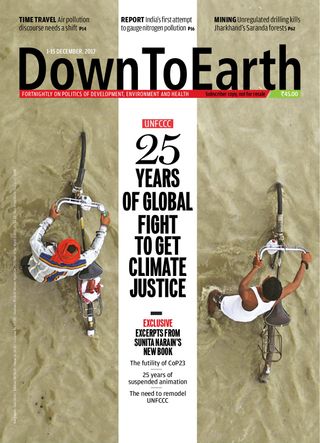

Dit verhaal komt uit de December 01, 2017-editie van Down To Earth.
Abonneer u op Magzter GOLD voor toegang tot duizenden zorgvuldig samengestelde premiumverhalen en meer dan 9000 tijdschriften en kranten.
Bent u al abonnee? Aanmelden
MEER VERHALEN VAN Down To Earth

Down To Earth
THINK TWICE BEFORE FELLING SAL TREES
Many trees considered to be affected by sal borer in the 1990s are still alive today

1 mins
February 16, 2026

Down To Earth
EDGE OF SURVIVAL
Caste divides deny marginalised communities land, resources and essential aid, leaving them more vulnerable to climate disasters
6 mins
February 16, 2026

Down To Earth
A WISH LIST?
Union Budget for 2026-27 conveys the impression of a roll-call of intentions and ambitious proposals, with little detail on their formulation
6 mins
February 16, 2026
Down To Earth
Break down the gender wall
THE RULING National Democratic Alliance (NDA) government has been heavily invested in the goal to make India a developed economy by 2047.
2 mins
February 16, 2026

Down To Earth
MENSTRUAL HEALTH, NOW A FUNDAMENTAL RIGHT
In a landmark judgement, the Supreme Court has recognised menstrual health and hygiene as a fundamental right under Article 21 of the Constitution of India, which guarantees the right to life and dignity.
8 mins
February 16, 2026

Down To Earth
Of devolution and new disasters
The 16th Finance Commission pushes for changes in view of new fiscal and climatic conditions
11 mins
February 16, 2026
Down To Earth
Rising risks of plastics
NEGATIVE IMPACTS on human health due to emissions linked to the plastic lifecycle could double by 2040, according to a study published in The Lancet Planetary Health in January.
1 min
February 16, 2026

Down To Earth
GAP BETWEEN EPIDEMICS NARROWING
A watershed-based and landscape-level approach is needed to address forest degradation
2 mins
February 16, 2026
Down To Earth
WAITING TO STRIKE
Sal heartwood borer is considered the biggest threat to forestry in India, especially to the sal tree, where it lives and breeds.
11 mins
February 16, 2026
Down To Earth
A SPRING DELIGHT
Mustard flowers are not meant only for the eyes. Invite them to your plate once in a while
3 mins
February 16, 2026
Translate
Change font size