Poging GOUD - Vrij
`Capital Lies With A Few, Power With The Masses'
Down To Earth
|January 16, 2019
Soon after Independence, a good 350 newspapers started as a cooperative venture. But only Janmorcha, published from Faizabad in Uttar Pradesh, has managed to survive. Its editor SHEETLA SINGH fearlessly wages a battle against the government which has made five attempts to shut the newspaper down. ANIL ASHWANI SHARMA spoke to the 87-year-old sentinel of cooperative journalism about the perils of newspaper publishing in the country
-

Why did you join journalism?
I entered journalism in 1958. The aim was to serve the masses and turn it into a vehicle of awareness and a means of protecting democracy.
How did you think of bringing out a newspaper as a cooperative?
In 1954, the Press Commission published a report which pointed at the threat capitalism posed to journalism and freedom of expression. It stated that cooperative newspapers could be the only solution. I was greatly influenced by it and started working in that direction.
Janmorcha will soon turn 60, but are there other newspapers that run on the cooperative model?
A survey was conducted in 1985 which found 247 newspapers in the country operating as cooperative. Sadly, none managed to survive. Other mediums are trying to use cooperative a profitmaking tool. Janmorcha has never taken money from the government, nor has any of its member taken shares worth more than ̀ 10,000. Journalists of this institution have the sole aim of working for the country. We have spread our reach to Bareilly, Prayagraj, Lucknow and Faizabad.
What is the biggest challenge for cooperative newspapers?
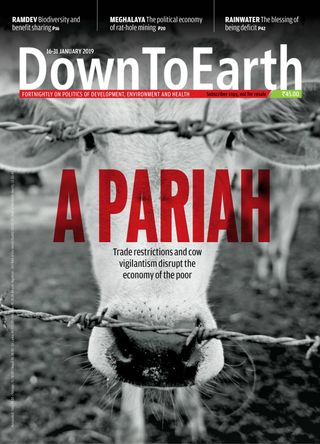

Dit verhaal komt uit de January 16, 2019-editie van Down To Earth.
Abonneer u op Magzter GOLD voor toegang tot duizenden zorgvuldig samengestelde premiumverhalen en meer dan 9000 tijdschriften en kranten.
Bent u al abonnee? Aanmelden
MEER VERHALEN VAN Down To Earth

Down To Earth
BEYOND COLLATERAL DAMAGE
Recent geopolitical conflicts are urging a reconsideration of what constitutes environmental harm in war and the limits of existing legal frameworks

3 mins
April 01, 2026
Down To Earth
Masterstroke
Residents of a small Kerala town reject an inadequate state-led development blueprint and create their own master plan that prioritises protection of historic water systems and urban commons
4 mins
April 01, 2026

Down To Earth
Rethinking E20
It is pertinent to explore potential of ethanol as high-value industrial feedstock
4 mins
April 01, 2026
Down To Earth
Food in the age of climate change
WHEN WE eat, we contribute to climate change. But food is also about livelihoods, about nutrition and about nature.
3 mins
April 01, 2026

Down To Earth
FADING WINTER
India's winters are warming, becoming shorter, shifting and spilling beyond their traditional bounds. The consequences are already evident in meltwater availability, forest-fire intensity and changes in flowering cycles and insect behaviour.
20 mins
April 01, 2026

Down To Earth
War on Iran strikes India's pharmaceuticals sector
Shortages of critical raw materials and rising input costs for the drug industry will have global consequences
4 mins
April 01, 2026

Down To Earth
POWER IN AN AGE OF INSECURITY
Energy transition is no longer solely about emission reduction but also about energy security
3 mins
April 01, 2026
Down To Earth
Re-discovery of fuelwood
THE WEST Asia conflict has made visible a multi-billion dollar energy market in India.
2 mins
April 01, 2026

Down To Earth
A CASE THAT RESHAPED INDIA'S ENVIRONMENT
The case of MC Mehta v Union of India stands as proof that a proactive judiciary can accelerate action even when the executive drags its feet
4 mins
April 01, 2026
Down To Earth
FOREVER DEPENDENT
India depends on global fertiliser supply chains for 70 per cent of its needs, leaving its food security exposed to geopolitical disruptions
6 mins
April 01, 2026
Translate
Change font size