
Ga onbeperkt met Magzter GOLD
Krijg onbeperkte toegang tot meer dan 9000 tijdschriften, kranten en Premium-verhalen voor slechts
From City Lights to Deep Space
BBC Sky at Night Magazine
|April 2022
In the first part of a series that looks at urban stargazing through the four seasons, Rod Mollise reveals the wonders you can discover in spring

Urban astronomy is not for the fainthearted, but persevere and you will find a wealth of celestial treasures that await discovery, even under bright night skies.
Many deep-sky objects are visible even in brightly lit urban areas. Take open clusters, nests of thousands of newborn suns, deep-sky objects which are the least harmed by light pollution. More tightly packed globular clusters are very old and light pollution takes its toll on them. While many are visible in the city with smaller aperture telescopes, most are just round smudges with no individual visible stars.
Galaxies can be challenging for urban observers to see. This doesn't mean you can't see them, you just won't see much detail. But diffuse nebulae are the objects most harmed by light pollution; even with a high-quality light-pollution reduction (LPR) filter screwed onto the eyepiece, dimmer emission nebulae can be a challenge to see. Planetary nebulae are not as harmed by light pollution. If they are tricky it's because they are difficult to distinguish from stars.
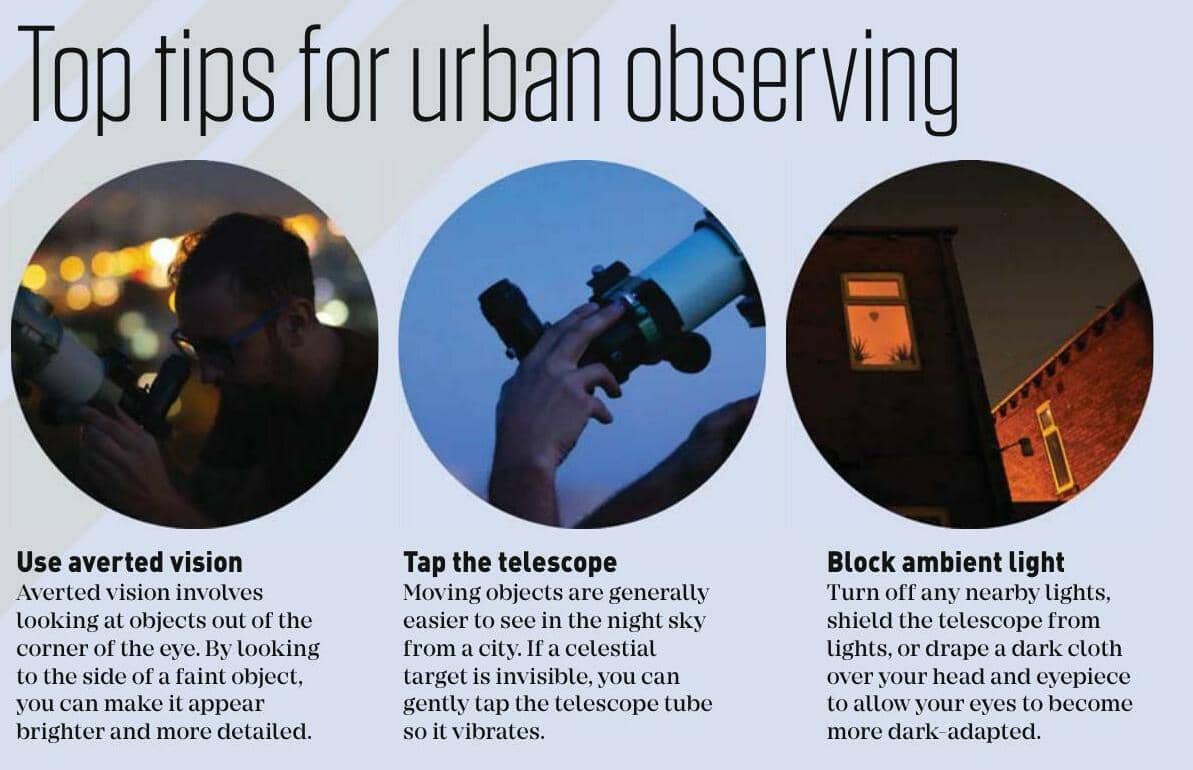
Key Kit
The most important characteristic of a telescope used for deep-sky observing from any site is aperture - the size of its light-collecting lens or mirror (the 'objective'). The superior light-gathering power of a larger telescope is even more important in the city. From a light-polluted area, you'll need one with a light-collecting lens or mirror with a diameter of at least 200mm. Inexpensive Dobsonian reflecting telescopes are a good balance between price, performance and portability. However, a 250mm Dobsonian is almost as affordable and portable, and the extra aperture makes a difference.
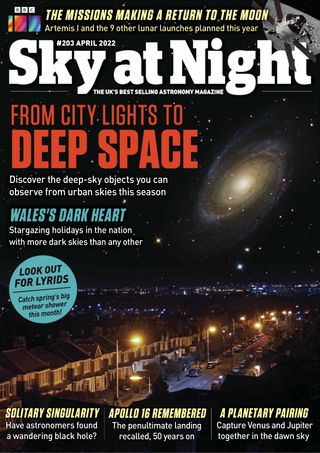

Dit verhaal komt uit de April 2022-editie van BBC Sky at Night Magazine.
Abonneer u op Magzter GOLD voor toegang tot duizenden zorgvuldig samengestelde premiumverhalen en meer dan 9000 tijdschriften en kranten.
Bent u al abonnee? Aanmelden
MEER VERHALEN VAN BBC Sky at Night Magazine
BBC Sky at Night Magazine
MOONWATCH
January's top lunar feature to observe

2 mins
January 2026
BBC Sky at Night Magazine
Speed up your processing workflow
How to use Photoshop's Actions tool to drastically cut your processing time
3 mins
January 2026
BBC Sky at Night Magazine
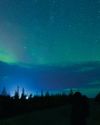
Chasing Canada's polar lights
With solar maximum peaking and a new Moon promising dark skies, Jamie Carter travels to Churchill, Manitoba to hunt the Northern Lights - and dodge polar bears – in Canada's far north
7 mins
January 2026
BBC Sky at Night Magazine
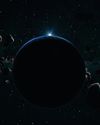
Beyond Pluto: The search for the hidden planets
Could one – or even two - undiscovered planets lurk at the edges of our Solar System? Nicky Jenner explores how close we are to finding the elusive 'Planet 9'
6 mins
January 2026
BBC Sky at Night Magazine
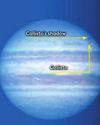
Jupiter moon events
Jupiter is a magnificent planet to observe.
2 mins
January 2026

BBC Sky at Night Magazine
What samples from space have taught us
Alastair Gunn explains what scientists have learnt in the 20 years since the first unmanned mission brought materials back from alien worlds
3 mins
January 2026
BBC Sky at Night Magazine
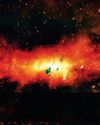
The Milky Way as you've never seen it before
This is the largest low-frequency radio colour image of our Galaxy ever assembled
1 min
January 2026
BBC Sky at Night Magazine
Merger of ‘impossibly' massive black holes explained
Scientists discover how enormous, fast-spinning black holes can exist after all
1 mins
January 2026
BBC Sky at Night Magazine
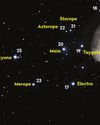
Lunar occultation of the Pleiades
BEST TIME TO SEE: 27 January from 20:30 UT
1 min
January 2026
BBC Sky at Night Magazine
The Universe's expansion may be slowing down
New study suggests current theories of dark energy could be wrong
1 mins
January 2026
Translate
Change font size