Poging GOUD - Vrij
IT'S TIME TO GET EXCITED ABOUT THE JAMES WEBB SPACE TELESCOPE
BBC Science Focus
|New Year 2022
NASA’s most ambitious project yet will peer deep into space looking for clues about the birth of planets, stars and the evolution of the Universe itself

You might be tempted to think of the James Webb Space Telescope (JWST) as just another hyped-up space mission. Resist that temptation. The JWST is the most ambitious space telescope ever launched.
It’s also the biggest gamble.
The JWST – or Webb, as NASA would like it to be known – is designed to reveal the evolution of the Universe, from its early phases to the modern era. It will do this by undertaking a thorough investigation of the Universe at infrared wavelengths.
To reveal the evolution of the Universe, Webb will target the origin of the various celestial objects that have emerged along the way. This begins in the distant, early Universe. Webb’s cameras and instruments will focus on the first galaxies and the first stars to light up the Universe.
Today, the evidence suggests that there’s probably a supermassive black hole at the centre of every galaxy. Yet how those black holes form is a mystery. Were they the gravitational seeds that catalysed galaxy formation, or did they form naturally at the centre of a gigantic gas cloud that was already coalescing to become a galaxy. Webb will investigate.
As for the first stars, no one knows what these were like, but theory suggests that they could be gigantic megastars, burning more brightly and hotter than anything in the Universe today. Webb will search for them.
It will also scrutinise the birth of stars and planets in the more recent Universe by peering inside the dusty nebulae that cocoon these nascent celestial objects.
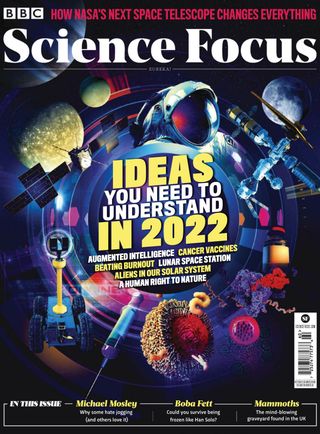

Dit verhaal komt uit de New Year 2022-editie van BBC Science Focus.
Abonneer u op Magzter GOLD voor toegang tot duizenden zorgvuldig samengestelde premiumverhalen en meer dan 9000 tijdschriften en kranten.
Bent u al abonnee? Aanmelden
MEER VERHALEN VAN BBC Science Focus

BBC Science Focus
DOES MY DOG HAVE ADHD?
Officially, Attention-Deficit Hyperactivity Disorder (ADHD) is a human condition. People are diagnosed with it. Dogs are not. Yet many of its core features, including hyperactivity, impulsivity and distractibility, can be found in dogs.

1 min
March 2026

BBC Science Focus
DOES MY BRAIN LIVE A LITTLE IN THE PAST?
Yes, your brain does live a little in the past. It can't help it. The information it receives via your senses is always a little out of date. Whether it's light entering the retinas in your eyes, or sounds vibrating the hairs in your ears, it not only takes time for the data to arrive, but your brain then has to process it.
2 mins
March 2026
BBC Science Focus
ASTRONOMY FOR BEGINNERS
RETURN OF THE EVENING STAR (VENUS)
1 mins
March 2026

BBC Science Focus
CAN YOU STOP YOUR SENSE OF TASTE DULLING AS YOU AGE?
Sometimes I hear people say that food just doesn't taste the same as they get older. It's tempting to blame this on age, but there are other factors at play, too.
1 mins
March 2026
BBC Science Focus
MICROBIOMES OF THE SUPERAGERS
BY STUDYING THE INCREASING NUMBER OF PEOPLE WHO ARE LIVING BEYOND THEIR 100TH BIRTHDAYS, SCIENTISTS ARE DISCOVERING THAT THE SECRET TO REACHING A RIPE OLD AGE IN RUDE HEALTH MIGHT LIE IN OUR GUTS
8 mins
March 2026

BBC Science Focus
HOW BIG WERE MEDIEVAL WAR HORSES?
You might picture knights charging into battle on towering steeds, but medieval horses were typically no bigger than modern-day ponies.
1 min
March 2026

BBC Science Focus
FORCES OF HABIT
Could new research on setting up healthy habits resuscitate those stuttering New Year resolutions?
3 mins
March 2026

BBC Science Focus
5 DANGERS HIDING IN YOUR PROCESSED FOOD
We all know that ultra-processed foods are bad for us, but what ingredients should we particularly try to avoid? And what are they doing to our bodies?
9 mins
March 2026

BBC Science Focus
Mosquitoes are becoming thirstier for human blood
Habitat loss may be pushing mosquitoes towards human hosts with deadly consequences
1 mins
March 2026

BBC Science Focus
HOW CAN I GET OVER MY EX?
Relationship breakups can be brutal, just look at the popularity of songs like 'Someone Like You' by Adele, or all the covers of 'Cry Me a River' by Julie London.
1 mins
March 2026
Translate
Change font size