Poging GOUD - Vrij
UNIVERSE, SAY CHEESE!
BBC Focus - Science & Technology
|December 2020
IN A CALIFORNIA LAB, SCIENTISTS AND ENGINEERS ARE PUTTING THE FINISHING TOUCHES TO A COLOSSAL CAMERA THAT COULD CHANGE THE WAY WE VIEW THE COSMOS

Pictures help us make sense of the world around us. From cave paintings, doodles and diagrams, to maps, sketches and photographs, as our tools for depicting the world have improved, so too has our understanding of it. And the device you see on these pages might be the most advanced picturing tool yet. It’s the focal plane of the Legacy Survey of Space and Time (LSST) Camera, and is the biggest and most sophisticated piece of photography equipment on – or off – the planet. It’s being developed at the SLAC National Accelerator Laboratory in California for one of the most ambitious astronomy surveys ever undertaken.
“It’s going to be a 10-year survey,” says Prof Aaron Roodman, the scientist in charge of the camera’s assembly. “We’re going to take images of every part of the southern hemisphere sky that’s visible from a mountaintop in Chile. And we’re doing that to enable a whole host of science projects.”
The LSST Camera won’t just be obtaining a handful of images, though. It’ll be taking around 1,000 every night. And the images will be big. The LSST Camera’s focal plane is 64 x 64cm, giving each image a 9.6 square degrees field of view – enough to contain 40 full moons. Each of the image sensors in the LSST Camera is 40 x 40mm and 189 of them have been tiled together to create the focal plane. To put that in perspective, a typical DSLR camera uses a single 36 x 24mm image sensor.
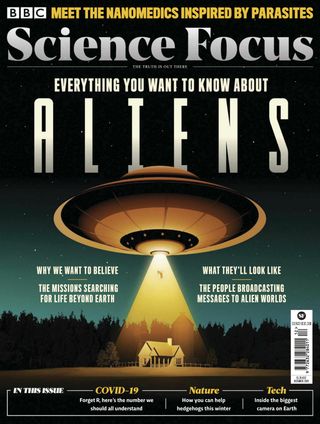

Dit verhaal komt uit de December 2020-editie van BBC Focus - Science & Technology.
Abonneer u op Magzter GOLD voor toegang tot duizenden zorgvuldig samengestelde premiumverhalen en meer dan 9000 tijdschriften en kranten.
Bent u al abonnee? Aanmelden
MEER VERHALEN VAN BBC Focus - Science & Technology

BBC Science Focus
DOES MY DOG HAVE ADHD?
Officially, Attention-Deficit Hyperactivity Disorder (ADHD) is a human condition. People are diagnosed with it. Dogs are not. Yet many of its core features, including hyperactivity, impulsivity and distractibility, can be found in dogs.

1 min
March 2026

BBC Science Focus
DOES MY BRAIN LIVE A LITTLE IN THE PAST?
Yes, your brain does live a little in the past. It can't help it. The information it receives via your senses is always a little out of date. Whether it's light entering the retinas in your eyes, or sounds vibrating the hairs in your ears, it not only takes time for the data to arrive, but your brain then has to process it.
2 mins
March 2026

BBC Science Focus
ASTRONOMY FOR BEGINNERS
RETURN OF THE EVENING STAR (VENUS)
1 mins
March 2026

BBC Science Focus
CAN YOU STOP YOUR SENSE OF TASTE DULLING AS YOU AGE?
Sometimes I hear people say that food just doesn't taste the same as they get older. It's tempting to blame this on age, but there are other factors at play, too.
1 mins
March 2026

BBC Science Focus
MICROBIOMES OF THE SUPERAGERS
BY STUDYING THE INCREASING NUMBER OF PEOPLE WHO ARE LIVING BEYOND THEIR 100TH BIRTHDAYS, SCIENTISTS ARE DISCOVERING THAT THE SECRET TO REACHING A RIPE OLD AGE IN RUDE HEALTH MIGHT LIE IN OUR GUTS
8 mins
March 2026

BBC Science Focus
HOW BIG WERE MEDIEVAL WAR HORSES?
You might picture knights charging into battle on towering steeds, but medieval horses were typically no bigger than modern-day ponies.
1 min
March 2026

BBC Science Focus
FORCES OF HABIT
Could new research on setting up healthy habits resuscitate those stuttering New Year resolutions?
3 mins
March 2026

BBC Science Focus
5 DANGERS HIDING IN YOUR PROCESSED FOOD
We all know that ultra-processed foods are bad for us, but what ingredients should we particularly try to avoid? And what are they doing to our bodies?
9 mins
March 2026

BBC Science Focus
Mosquitoes are becoming thirstier for human blood
Habitat loss may be pushing mosquitoes towards human hosts with deadly consequences
1 mins
March 2026

BBC Science Focus
HOW CAN I GET OVER MY EX?
Relationship breakups can be brutal, just look at the popularity of songs like 'Someone Like You' by Adele, or all the covers of 'Cry Me a River' by Julie London.
1 mins
March 2026
Translate
Change font size