Poging GOUD - Vrij
Scratching The Surface
The Caravan
|September 2019
How the Venice Biennale reveals problems with nationalist art patronage

Docked in the choppy waters of a Venetian canal, along the warehouse architecture of the Arsenale—one of two venues of the 2019 Venice Biennale—is the ruin of a 90-foot fishing boat. Titled “Barca Nostra”—Italian for “our boat”—it forms part of a project by the Swiss-Icelandic artist Christoph Büchel. On the night of 18 April 2015, in waters between Libya and the Mediterranean island of Lampedusa, this boat capsized, and nearly eight hundred passengers drowned or were lost at sea. Each passenger was a migrant fleeing war or famine, hoping to seek refuge in Europe. Onboard were people from Syria, Gambia, Somalia, Sierra Leone, Senegal, Mali, Libya, Eritrea and Bangladesh. Only 28 people survived.
A year after it was wrecked, the boat was brought back to Sicily, where forensic experts combed through its interiors to segregate and identify the body parts and belongings left behind. The boat’s passage from Libya was an operation spearheaded by Mohammed Ali Malek, a Tunisian smuggler. Malek was seen brandishing a long wooden pole to keep his passengers in line while ferrying them to the boat in a small wooden dinghy. He contacted the Italian coastguard in Rome as soon as they hit international waters, asking for help. The coastguard responded by signalling a nearby Portuguese container ship. Witnesses saw Malek grab the steering wheel and slam it into the oncoming vessel. He was found guilty of manslaughter, and sentenced to 18 years in prison and a ¤9 million fine.
Büchel’s project to bring the vessel to Venice cost a cool ¤33 million to complete, including the original ¤9.5 million the Italian navy spent on salvaging the boat. Venice is just the first port of call; the boat will later travel to the Sicilian town of Augusta, where it will be developed into a “garden of memory.”
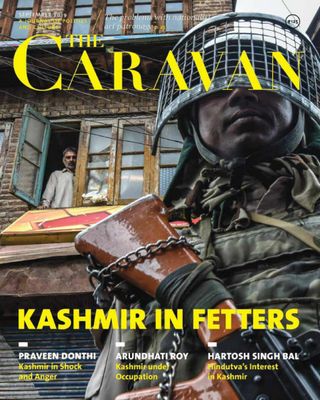

Dit verhaal komt uit de September 2019-editie van The Caravan.
Abonneer u op Magzter GOLD voor toegang tot duizenden zorgvuldig samengestelde premiumverhalen en meer dan 9000 tijdschriften en kranten.
Bent u al abonnee? Aanmelden
MEER VERHALEN VAN The Caravan
The Caravan
ANY RESEMBLANCE TO ACTUAL EVENTS IS NOT COINCIDENTAL
INTERFAITH ROMANCE FICTION IN THE ERA OF LOVE JIHAD

31 mins
December 2025
The Caravan
Manufacturing Legitimacy
How a Washington Post columnist laundered the Sangh's violent history
7 mins
December 2025

The Caravan
DEATH of REPORTAGE
THE DISMANTLING OF OUTLOOK'S LEGACY
32 mins
December 2025

The Caravan
FOG LIGHT
Samayantar's two-and-half-decade fight against the shrinking of Hindi's world
22 mins
December 2025
The Caravan
THE FINE PRINT
ON 19 MARCH 2005, thousands came out on the streets of Udupi, in coastal Karnataka, to protest a gruesome incident that had shaken the region a week earlier.
23 mins
December 2025
The Caravan
CHARACTER BUILDING
The enduring language of Indian streets
5 mins
December 2025

The Caravan
THE CONVENIENT EVASIONS OF RAJDEEP SARDESAI
DRESSED IN A turban and white kurta pyjama, Narendra Modi sat in the passenger seat of a van crossing the Patan district of Gujarat, in September 2012. Next to him sat Rajdeep Sardesai, the founder-editor of the news channel CNN-IBN.
63 mins
December 2025
The Caravan
Ahmed Kamal Junina: “Every class we hold is a defiant refusal to surrender”
A professor in Gaza on teaching during a genocide / Conflict
11 mins
December 2025

The Caravan
Bangla Pride, Urdu Prejudice
The language wars have primed West Bengal for the RSS
8 mins
November 2025

The Caravan
THE INTERVIEW
\"The people are naked before the government but the government is opaque to them\"
16 mins
November 2025
Translate
Change font size