Poging GOUD - Vrij
Regulation Risks Less Sustainable Alternatives to Plastic - Scenario in Europe
TerraGreen
|April 2020
Over the past couple of years plastics have become the public face of the waste pollution crisis, prompting an unprecedented consumer and regulatory backlash that shows no sign of stopping. The attached analysis from Mark Victory looks at how some narrowly focused regulation is shifting the problem to other sectors, doing little to improve end-of-life environmental impact or even intensifying the damage.

Over the past 2–3 years plastics have become the public face of the waste pollution crisis. Industry is responding by switching to other materials without considering their environmental impact relative to plastics, or whether sufficient local waste collection systems are in place, the Plastic Promises report launched by independent UK think tank the Green Alliance concludes.
Although its findings will come as little surprise to those involved in recycled plastics markets, and are mirrored across Europe, it once again highlights the gap in consumer understanding of the relative environmental impact of nonplastic alternatives and the unintended consequences this is having across the recycling industries. For example, nonplastic food-packaging alternatives – on average – increase energy use by 2.2 times, carbon dioxide (CO2 ) emissions by 2.7 per cent, and weight by 3.6 times, according to a UK parliamentary select committee report released in September 2019.
Indeed, the shift in things like bottled drinks from glass to materials such as polyethylene terephthalate (PET) that took place across recent decades was in part driven by its lower carbon usage and weight. Coupled with this, food-contact paper and cardboard packaging typically needs to be treated with a plastic barrier, making it more difficult to recycle and doing little to counterbalance the problem of microplastic ocean leakage. For consumers, plastic is a homogenized entity rather than a series of different materials with different degrees of sustainability, recyclability or local collection rates.
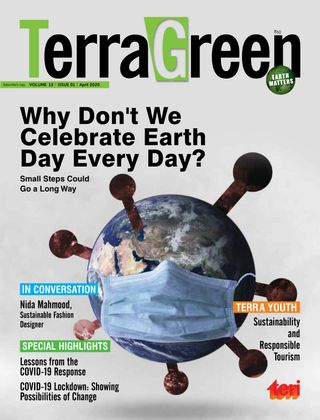

Dit verhaal komt uit de April 2020-editie van TerraGreen.
Abonneer u op Magzter GOLD voor toegang tot duizenden zorgvuldig samengestelde premiumverhalen en meer dan 9000 tijdschriften en kranten.
Bent u al abonnee? Aanmelden
MEER VERHALEN VAN TerraGreen

TerraGreen
Motor Efficiency
The Silent Catalyst of India's Green Industrial Revolution

4 mins
January 2026

TerraGreen
Beauty That Betrays!
The Quiet Invasion of An Ornamental Plant
3 mins
January 2026

TerraGreen
Farming Innovation Addresses Food Shortages
Also Halves Methane Emissions
4 mins
January 2026

TerraGreen
Aravalli on the Edge
Saving India's Ancient Green Shield from Collapse
3 mins
January 2026

TerraGreen
From Orchard to Table
Apple Picking, Family Time, and Fall Colours
4 mins
January 2026

TerraGreen
Coral Reefs Could Feed Millions
If We Let Them Rebuild
3 mins
January 2026

TerraGreen
Resting on Deodars
How Fallen Trees are Being Reimagined as Urban Assets in Shimla
3 mins
January 2026

TerraGreen
India's Clean-Air Innovation at Risk
Nationwide Assessment by WeNaturalists
2 mins
January 2026

TerraGreen
CNFF-25
Highlights Environmental Concern Amid India's Cultural Heritage
3 mins
January 2026
TerraGreen
Green Farming through Circular Economy
Sustainable Practices for Waste Reduction
8 mins
January 2026
Translate
Change font size