
Ga onbeperkt met Magzter GOLD
Krijg onbeperkte toegang tot meer dan 9000 tijdschriften, kranten en Premium-verhalen voor slechts
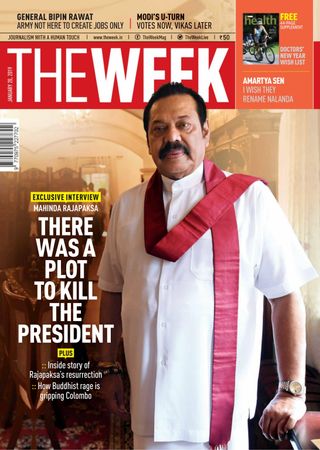
Mahinda Rajapaksa: There Was A Plot To Kill The President
THE WEEK
|January 20, 2019
There was a plot to assassinate not only the president but also my brother gotabaya. I cannot say anything about any involvement of the r&aw in that conspiracy, because I have not got any information to that effect.

The 278 km-long expressway connecting Colombo in the east with Kataragama in the south is lined by idyllic beaches and imposing mountains. It runs south from Colombo, tracing Sri Lanka’s southwestern coastline till it reaches Tangalle in Hambantota district, from where it arches inward to Kataragama, about 30km inland.
Tangalle is a small fishing port. A narrow road off the expressway takes you past posters of President Maithripala Sirisena and former president Mahinda Rajapaksa, to a bronze statue of Dudley Senanayake, Sri Lanka’s second prime minister and founder of the ruling United National Party. Senanayake stands tall on a pedestal, pointing at Carlton House, a manor house across the street painted forest green.
It is 8 am on a Sunday, and a crowd has gathered outside the Carlton House gates. As they wait to go in, people turn in their cellphones and take tokens, and are frisked by armed guards and policemen. The visitors do not seem to mind the security measures; they are here to see their favourite leader.
Carlton House has long been the seat of the Rajapaksas. Mahinda Rajapaksa’s grandfather, father and uncle were headmen and prominent politicians in Hambantota, but the former president towers over all of them in popularity and charisma.
Rajapaksa is all smiles as he enters the visitors hall at Carlton House. He is clad in a white dhoti and kurta, with his trademark brown shawl around his neck. The shawl is a legacy from his uncle. It was Don Mathew Rajapaksa, who was state councillor in the 1930s, who first took to wearing the shawl to represent the main crop of Hambantota—the earthy-brown finger millet.
Earthy, however, is not the word one would use to describe Mahinda Rajapaksa. He sits on a huge, burgundy sofa and greets visitors with clasped hands, showing the gold rings that adorn almost all his fingers. He smiles as young men pump their fists and cry, “Mahinda

Dit verhaal komt uit de January 20, 2019-editie van THE WEEK.
Abonneer u op Magzter GOLD voor toegang tot duizenden zorgvuldig samengestelde premiumverhalen en meer dan 9000 tijdschriften en kranten.
Bent u al abonnee? Aanmelden
MEER VERHALEN VAN THE WEEK
THE WEEK India
WHERE THE STORM NEVER REALLY PASSES
Guantánamo Bay, once a symbol of the ‘war on terror’, has emerged as a flashpoint in Donald Trump’s immigration battles, exposing deep tensions between America’s security, legality and moral commitments

10 mins
December 21, 2025

THE WEEK India
Moderation is the key
Most people do not believe me, but I am a moderate man.
3 mins
December 21, 2025
THE WEEK India
OCEAN THERAPY
The Modi-Putin summit unveils a cooperation strategy that will rewire sea trade routes and expand India's maritime connect to the Arctic
3 mins
December 21, 2025

THE WEEK India
Indian Army men fighting for the British against the Japanese were also patriots
Readers in India may be misled by the title of Gautam Hazarika's new book, The Forgotten Indian Prisoners of World War II: Surrender, Loyalty, Betrayal and Hell. It is not about the INA prisoners who were put on trial in the Red Fort by the British. This book is about those Indian soldiers who fought the Japanese in Singapore, Malaya and Burma alongside the British, and who had to surrender, were taken prisoner, put to torture and hard labour by the Japanese, refused to join the INA, and faced death or managed to escape. While recounting their stories, Hazarika also gives an insight into the INA movement. Edited excerpts from an interview with the author:
4 mins
December 21, 2025

THE WEEK India
CHAT WITH NEHRU, QUERY KALAM...
The Prime Ministers' Museum & Library showcases the life and contributions of prime ministers and nation-builders
3 mins
December 21, 2025

THE WEEK India
The art of shifting gears in investing
“Hope is not a strategy,” Hayes growls in one memorable scene, dismissing a teammate’s starry-eyed optimism.
3 mins
December 21, 2025

THE WEEK India
Trouble on the tarmac
It is not IndiGo but Indian aviation that has become too big to fail
4 mins
December 21, 2025

THE WEEK India
SHUX AND BLUE MARBLE
THE 18 DAYS IN SPACE MIGHT HAVE MADE HIM A HOUSEHOLD NAME, BUT GROUP CAPTAIN SHUBHANSHU SHUKLA IS AS GROUNDED AS EVER. AND BEFORE HE SUITS UP FOR HIS NEXT MISSION, THE WEEK'S MAN OF THE YEAR SHARES STORIES FROM HIS LIFE AND SPACE, INCLUDING HOW HE BECAME A 'WATER BENDER'
9 mins
December 21, 2025
THE WEEK India
The parietal lobe
If the frontal lobe is where we decide what to do, the parietal lobe is where we understand where we are. It is the brain's internal GPS, the quiet navigator that lets you put your hand exactly where your teacup is, find the edge of a staircase without staring at it, or scratch the correct side of your head when it itches. When it works well, we move through life gracefully. When it falters, life becomes slapstick comedy.
2 mins
December 21, 2025

THE WEEK India
Area of the globe? Pie is cubed
Floating in his private pool, China's helmsman Mao Zedong shared his strategic vision with visiting Soviet strongman Nikita Khrushchev in 1958: \"You look after Europe, and leave Asia to us.\" Obviously, he expected the US to withdraw into its prewar Monroe world of the Americas, thus making the world tripolar.
2 mins
December 21, 2025
Translate
Change font size