Poging GOUD - Vrij
Road To Khalsa
Outlook
|November 18, 2019
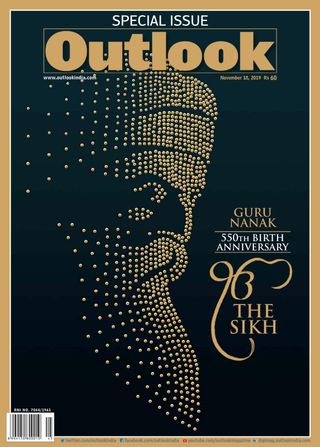
Talk of a ‘pacifist’ Gurunanak and ‘militant’ Gobind Singh oversimplifies Sikh history

In the late 18th century, the East India Company began to take interest in the affairs of the Sikhs, who had emerged as a political power. Advised by Warren Hastings, James Browne collected information on the Sikhs and published his History of the Origin and Progress of Sicks. He made a general statement that the Sikhs were at first quiet, inoffensive and unarmed, but persecution by Aurangzeb made them take up arms against the Mughal empire under the leadership of Guru Gobind Singh, whose militancy presented a contrast to Gurunanak’s pacifism. A dichotomy between the first and the 10th Gurus became a stereotype in later British historical writing.
Meanwhile, the idea of the unity of Guruship was developing among Sikhs. They saw no difference between Guru Nanak and his successors. In the early 17th century, Bhai Gurdas projected Guru Nanak and his five successors as one. In the Sri Gur Sobha, written soon after the death of Guru Gobind Singh, all the 10 Gurus are projected as one. In the early 18th century, in the inscriptions on the seal of Banda Singh and the coin stuck in his time, Guru Nanak is regarded as the source of inspiration and power. Ratan Singh Bhangu, writing in the early decades of the 19th century, records that when Captain Murray, the British political agent at Ludhiana, asked him who gave sovereignty to the Khalsa, Bhangu’s reply was “Guru Nanak”. Teja Singh and Ganda Singh suggested in 1950 that Guru Nanak would have done something similar to what Guru Gobind Singh did if he had the same resources. It has been argued that the Sikh panth developed steadily from the time of Guru Nanak to the institution of the Khalsa as a culmination of the movement started by him.

Dit verhaal komt uit de November 18, 2019-editie van Outlook.
Abonneer u op Magzter GOLD voor toegang tot duizenden zorgvuldig samengestelde premiumverhalen en meer dan 9000 tijdschriften en kranten.
Bent u al abonnee? Aanmelden
MEER VERHALEN VAN Outlook

Outlook
The Spectacle of the Woman Accused
Media narratives—especially when women are involved—can end up amplifying suspicion and weaponising gender

7 mins
March 11, 2026

Outlook
The Stink of Epstein
Why are the rich and powerful of the world scared of what lies buried in the Jeffrey Epstein files?
6 mins
March 11, 2026

Outlook
Passing the Watermelon
Narendra Modi's presence in Israel is being read not just as a bilateral engagement, but as an endorsement of Israeli action in Gaza and the West Bank
5 mins
March 11, 2026
Outlook
For Phoolan, Who Wasn't a Devi
“Whether or not it is the Truth is no longer relevant. The point is that it will, (if it hasn’t already) - become the Truth. Phoolan Devi, the woman has ceased to be important. (Yes of course she exists. She has eyes, ears, limbs, hair etc. Even an address now) But she is suffering from a case of Legenditis. She’s only a version of herself. There are other versions of her that are jostling for attention. Particularly Shekhar Kapur’s “Truthful” one, which we are currently being bludgeoned into believing.”–Arundhati Roy in ‘The Great Indian Rape-Trick I’, on the film Bandit Queen by Shekhar Kapur based on Phoolan, whom he never met because he didn’t think he needed to meet her. The film was based on journalist Mala Sen’s book India’s Bandit Queen: The True Story of Phoolan Devi.
5 mins
March 11, 2026

Outlook
The Chic Cartel
Women are not just victims or side characters in recent crime-and-power OTT dramas. They are complex forces-capable of empathy, strategy and ruthlessness-whose narratives demand both recognition and reckoning
5 mins
March 11, 2026

Outlook
The Hierarchy of Sympathy
In crimes against women, justice is shaped not only in courtrooms but in newsrooms where narrative determines whose suffering becomes national conscience and whose fades into procedural silence
5 mins
March 11, 2026

Outlook
Dasyu Sundari
Media accounts simultaneously cast her as victim and avenger, until a life shaped by caste violence and gendered oppression was repackaged into a consumable myth of dishonour and revenge
8 mins
March 11, 2026

Outlook
Prince Pervert
Are rumours of the death of the rule of law vastly exaggerated?
4 mins
March 11, 2026
Outlook
Together, Apart
Poonam Saxena's translations of Mannu Bhandari and Rajendra Yadav's memoirs present a portrait of the trailblazing Hindi writer-couple's marriage and of newly independent India
3 mins
March 11, 2026

Outlook
The Great Indian Rape Trick'
The trope of transforming sexual violence against women into a springboard for rage that can only be channelled through counter-violence has long served as a popular framework in cinema, both globally and in India
6 mins
March 11, 2026
Translate
Change font size