
Ga onbeperkt met Magzter GOLD
Krijg onbeperkte toegang tot meer dan 9000 tijdschriften, kranten en Premium-verhalen voor slechts
Poging GOUD - Vrij
Reforms in DRDO Should Continue for Better Results
Geopolitics
|March 2017
DRDO needs to be attentive to the criticism and take up the good suggestions that come its way in the interest of the nation. But that criticism can not be a sweeping statement. DRDO has delivered to the armed forces. The government need to think truly innovatively in enabling DRDO to achieve its stated mission
-

The mission statement of India's Defence Research and Development Organisation (DRDO) has clearly laid out its tasks and responsibilities. DRDO is meant to design, develop and lead to production of state-of-the-art sensors, weapon systems, platforms and allied equipment for India's defence forces. It must provide technological solutions to the services to optimise combat effectiveness and to promote well-being of the troops. It should also develop infrastructure and committed quality manpower and build a strong indigenous technology base.
If DRDO completes these responsibilities that have been entrusted to it, India and its armed forces would not have to go around the world looking for equipment and weapons that are suitable to modern warfare. This is the premise under which the institution for defence innovations have been formed in the country.
The DRDO is for the armed forces and that's its sole purpose. DRDO gets nearly Rs 13,000 crore annually from the Indian defence budget in the recent years to ensure it delivers on these mission statement. There is clearly a supplier and customer relations between the DRDO and the armed forces. But it is not just confined to that binary. The relation is also enmeshed with the two sides becoming collaborators.
There exists criticism of the DRDO from the armed forces community that it hasn't performed up to the mark. But that criticism can not be a sweeping statement. For, DRDO has delivered to the armed forces on several areas, that too remarkable products that are, in fact, critical for national security.
Take for example the strategic weapons. The Agni series and Prithvi series strategic ballistic missiles developed by DRDO scientists has led to a credible deterrent capability for the armed forces, even with adversaries such as China. Agni-V missile, with over 5,500km range has the capability to strike deep inside Chinese territory.
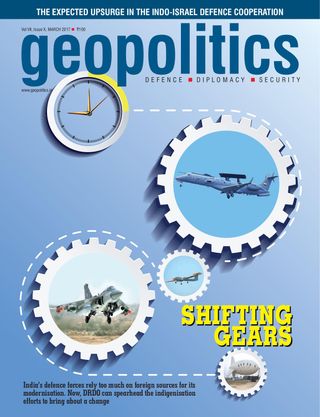

Dit verhaal komt uit de March 2017-editie van Geopolitics.
Abonneer u op Magzter GOLD voor toegang tot duizenden zorgvuldig samengestelde premiumverhalen en meer dan 9000 tijdschriften en kranten.
Bent u al abonnee? Aanmelden
MEER VERHALEN VAN Geopolitics
Geopolitics
Navy Flags Critical Engine Dependency Gap
Despite significant advances in indigenous warship construction, India's continued reliance on foreign marine propulsion systems remains a critical vulnerability in its defence framework.

1 mins
April 2026

Geopolitics
GTRE Advances Engine Testing With Su-30
India's aero-engine development programme is set to accelerate as GTRE proceeds to convert two Su-30 MKI fighters into dedicated flying testbeds, enabling real-time validation of indigenous propulsion technologies.
1 mins
April 2026
Geopolitics
Indigenous Anti-Tank Missile Nears Production Clearance
India's indigenous man-portable anti-tank guided missile is approaching final clearance for mass production following successful validation trials against moving targets.
1 min
April 2026
Geopolitics
A RE-LOOK AT INDIAN MILITARY LOGISTICS & THEATRE COMMANDS
JOSEPH P CHACKO explains why logistics systems must be integrated to be capable of seamlessly supporting modern warfare operations, which necessitate rapid, coordinated responses across multiple domains
14 mins
April 2026
Geopolitics
Defence Spending Drives Acquisition Surge
India's defence modernisation programme has entered a phase of rapid implementation, with FY 2025-26 seeing full utilisation of capital expenditure and a clear focus on addressing critical capability gaps across the armed forces.
3 mins
April 2026

Geopolitics
K9 Vajra Hits mega Indigenisation
India's India's flagship tracked artillery programme has reached a crucial turning point, with the K9 Vajra-T now achieving over 82 per cent indigenous content at the work package level, marking a fundamental shift in domestic defence manufacturing capability.
1 min
April 2026

Geopolitics
NUCLEAR SHARKS OF STEEL!
India’s third Arihant-class submarine, INS Aridhaman, was commissioned into the Indian Navy on April 3, 2026, at Visakhapatnam by Defence Minister Rajnath Singh.
2 mins
April 2026

Geopolitics
Army Eyes Tank-Launched Drone Strikes
The Indian Army is advancing a new concept to equip its main battle tanks with indigenous loitering munitions that can be deployed directly from existing 81mm smoke grenade launchers.
1 min
April 2026

Geopolitics
THE ANATOMY OF A POLARISED FRONTIER
West Bengal has changed from a longtime “Red Bastion” to one of the most hotly contested states in Indian politics.
2 mins
April 2026

Geopolitics
Navy Advances Drone-Ready Amphibious Carriers
India's next-generation amphibious warfare programme has entered a crucial -phase as the Navy advances its evaluation of four large-deck platforms designed to revolutionise expeditionary operations.
1 mins
April 2026
Translate
Change font size