Poging GOUD - Vrij
ASAT SYSTEMS INDIA'S REQUIREMENTS
Geopolitics
|March 2020
While satellites are an important aspect of the application of space technology to military needs, it is also important to recognise the increasing possibility of the deployment of anti-satellite weapons and possibly space-based weapons in the medium to long-term future. SANJAY BADRI MAHARAJ spells out India’s ASAT journey

On March 29, 2019, India successfully intercepted a satellite in Low Earth Orbit at an altitude of 300 km. This intercept, using the Microsat-R as a target, established a capability that had previously been only theoretical.
This system – designated the PDV Mk.2 – draws heavily from the Indian Ballistic Missile Defence System in respect of its exo-atmospheric interceptor (the PDV) and as such we must factor in the capability conferred by the BMD system as it has evolved.
Current ASAT systems are reliant on kinetic energy weapons in the form of ground-based/ ship-based missiles often derived from BMD systems. In addition, the United States and Russia have tested air-launched kinetic weapons from versions of their manned interceptors. However, increasingly new technologies, such as directed energy weapons or even electromagnetic weapons are being tested and these will have implications for future ASAT systems. In addition, Directed Energy Weapon (DEW) systems may be used to disable satellites. Moreover, some tests are being conducted using other satellites to destroy or disable other satellites with DEW systems being considered for such employment.
Military Use of Space
The use of satellites for military purposes began in 1958 when the United States launched the communications satellite SCORE which transmitted a pre-recorded message from space. Since then, more than 2000 military satellites, the first of which were experimental and others later operational, have been launched by the USA and USSR, and its successor states.
As of 2016, the United States has the largest fleet of satellites in orbit with 589, followed by China with 181 and Russia with 141. India currently stands in seventh place with some 42 satellites in orbit. While the numbers of satellites may be of importance in and of themselves, the challenge of making effective use of the data obtained therefrom by the military is critical.
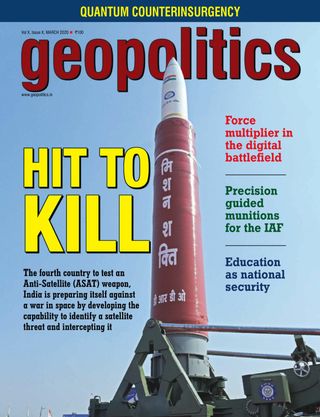

Dit verhaal komt uit de March 2020-editie van Geopolitics.
Abonneer u op Magzter GOLD voor toegang tot duizenden zorgvuldig samengestelde premiumverhalen en meer dan 9000 tijdschriften en kranten.
Bent u al abonnee? Aanmelden
MEER VERHALEN VAN Geopolitics
Geopolitics
IAF seeks Ecuador Jaquar airframes
The Indian Air Force has initiated discussions with the Ecuadorian Air Force to acquire its remaining grounded SEPECAT Jaguar airframes, as part of a broader effort to extend the service life of India's Jaguar strike fleet through 2035.

1 min
January 2026
Geopolitics
INDIA TO LAUNCH INDIGENOUS 6-TONNE HALE UAV
India's effort to build an indigenous High Altitude Long Endurance (HALE) unmanned aerial vehicle has moved into a critical transition stage. The Aeronautical Development Establishment has issued an Expression of Interest to identify a Development-cum-Production Partner for the proposed six-tonne class HALE UAV, while simultaneously preparing to seek cabinet committee on Security approval to formally initiate the development phase.
2 mins
January 2026

Geopolitics
IAF evaluates SPICE 250 for precision strikes
The Indian Air Force is evaluating the SPICE 250 precision-guided munition as part of its effort to strengthen standoff strike capabilities against a wide range of targets in contested environments.
1 min
January 2026
Geopolitics
Russia offers S-350 Vityaz with full tech transfer to India
Russia has renewed its offer to supply the Rundian Armed Forces with the S-350 Vityaz air defence system, positioning it as a complementary layer to India's existing S-400 Triumf regiments.
1 min
January 2026

Geopolitics
India inducts first indigenous Pollution Control Vessel
Defence Minister Rajnath Singh recently commissioned Indian Coast Guard Ship Samudra Pratap, the first of two Pollution Control Vessels, calling it a reflection of India's increasingly mature and capable defence industrial ecosystem.
1 min
January 2026
Geopolitics
DAC clears indigenous EW suite for IAF's Mi-17 V5 fleet
The Defence Acquisition Council has accorded Acceptance of Necessity (AON) for multiple DRDO-developed systems, including an advanced Electronic Warfare (EW) Suite for the Indian Air Force's Mi17 V5 helicopter fleet.
1 min
January 2026
Geopolitics
WHY PSLV-C62 FAILURE WILL BADLY HURT INDIA
In space research, satellite launch failures are not uncommon. Yet the failure of ISRO's PSLV-C62 will hurt India, its space ambitions, and its military capabilities for years to come
5 mins
January 2026
Geopolitics
Prime Toolings targets 10 kN thrust milestone by March
Prime Toolings has reiterated its confidence in achieving a 10 kN thrust benchmark by March 2026, even after recent propulsion trials initially fell short of expectations. The company said the development effort was originally structured around an 8 kN thrust objective, but early test runs stabilised at approximately 6 kN. Rather than treating this outcome as a setback, the company views it as a valuable learning phase inherent to complex propulsion development.
1 min
January 2026
Geopolitics
IRRELEVANT UNITED NATIONS
If anything, the U.S. invasion of Venezuela and the capture of its President Nicolás Maduro, or, for that matter, President Donald Trump's habit of imposing economic sanctions on countries effortlessly, constitute a trend that makes the existence of the United Nations (U.N.) irrelevant in its present form. It is an affront to the world body by undermining the principles of collective security and multilateralism.
4 mins
January 2026

Geopolitics
Indian startup Carbine Systems tests first private DEW prototype
Belgaum-based Carbine Systems has testing of its first directed-energy weapon prototype, H.A.R.A. Mk 1 (Hyper Amplification Radiant Array),. marking a notable milestone for India's indigenous laser-weapons ecosystem.
1 min
January 2026
Translate
Change font size