
Ga onbeperkt met Magzter GOLD
Krijg onbeperkte toegang tot meer dan 9000 tijdschriften, kranten en Premium-verhalen voor slechts
Poging GOUD - Vrij
Preparing For The Unthinkable
Asian Military Review
|October 2019
Tackling any type of CBRN attack demands the proper equipment. Some Asian-Pacific countries have the capability to react if the worst should happen.
-

The threat of biological and chemical warfare in the Asia Pacific remains low with a firm commitment by the 10 member countries of the Association of Southeast Asian Nations (ASEAN) – comprising Brunei, Cambodia, Indonesia, Laos, Malaysia, Myanmar, Philippines, Singapore, Thailand, and Vietnam – along with other regional countries and stakeholders: Australia, China, India, Japan, Republic of Korea, New Zealand, Russia, and the United States, who have all principally committed to the nonproliferation and use of these deadly weapons.
“We recognise the need to address ongoing chemical weapons challenges, to speak with one voice against the use of chemical weapons anywhere, by anyone, and under any circumstances,” the leaders of these countries asserted in their joint statement on chemical weapons during the 12th East Asia Summit (EAS) in Manila in November 2017 .
Despite this assurance, the risk of a biological or chemical attack is not non-existent. The Democratic People’s Republic of Korea (DPRK, or North Korea) continues to pursue weapons of mass destruction and is believed to maintain a stockpile of between 2,500 and 5,000 tonnes of mustard, phosgene, sarin, and V-series nerve agents.
The threat has also been broadened with the rising tide of transnational terrorism in the region, largely stemming from returning Daesh foreign fighters from Iraq and Syria. In the latter half of 2015 and early 2016, these fighters were recorded employing in multiple instances deploying mustard gas and chlorine via improvised explosive devices (IEDs) and mortar bombs, mainly in Iraq.
In its latest worldwide Threat Assessment Report released in January 2019, the US intelligence community warned that the overall threat from weapons of mass destruction (WMDs) will continue to grow during the year, noting “the most significant and sustained use” of such weapons in decades.
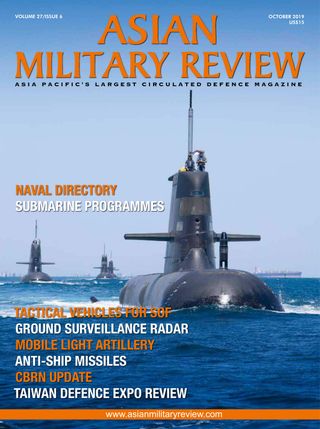

Dit verhaal komt uit de October 2019-editie van Asian Military Review.
Abonneer u op Magzter GOLD voor toegang tot duizenden zorgvuldig samengestelde premiumverhalen en meer dan 9000 tijdschriften en kranten.
Bent u al abonnee? Aanmelden
MEER VERHALEN VAN Asian Military Review

Asian Military Review
SMART MUNITIONS INCREASE MARKET SHARE
Top attack munitions are now widely developed for different artillery calibers with varied ranges.

10 mins
June/July 2021

Asian Military Review
NEXT GEN NVGS - A CLEAR IMPROVEMENT
Fused and enhanced night-vision technology will make the difference to soldiers fighting at night.
8 mins
June/July 2021

Asian Military Review
MILITARY ROTORCRAFT DEVELOPMENT - NO MORE ‘STOVEPIPES'
New rotorcraft are going to come with new abilities founded on open systems that provide easier upgrade paths and cheaper through life costs.
8 mins
June/July 2021

Asian Military Review
INDO PACIFIC UAV DIRECTORY 2021
The development of unmanned aerial vehicles is growing apace, especially in China. New longer range ISR platforms are also on the procurement list of several nations.
27 mins
June/July 2021

Asian Military Review
TIME TO RESET TRILATERAL RELATIONS
United States President Joe Biden has made it a top priority of his Administration to repair and re-energize global alliances during its first year in power. This is a necessary strategic and political calculus made in light of growing global security, public health, and environmental challenges that will require cooperation and multilateral contributions. President Trump’s ‘America first’ policy did much to undermine confidence in such relationships over his time in office.
3 mins
June/July 2021

Asian Military Review
SOCPAC KEEN TO SHARE JOINT DOCTRINE AND TRAINING
The return of Great Power competition means that US SOCPAC is more than ever seeking joint training opportunities with regional special forces.
9 mins
June/July 2021

Asian Military Review
MARINE ENGINE POWER - NOT JUST ABOUT KNOTS
Navies not only want more engine power, there are also coming under increasing pressure to become environmentally conscious.
9 mins
June/July 2021

Asian Military Review
AMPHIBIOUS FORCES
New amphibious concepts are re-shaping marine forces to break the A2AD defensive line.
9 mins
June/July 2021

Asian Military Review
SPACE V AIRBORNE ISR OR MIX AND MATCH
Owning satellite based ISR for military use is still an exclusive ‘club’, but airborne ISR still provides that most countries need.
9 mins
April/May 2021

Asian Military Review
SHIPBUILDING - A NUMBERS GAME
While experience grows among Indo-Pacific naval designers, order numbers remain crucial to keeping costs down and yards in business.
11 mins
April/May 2021
Translate
Change font size