Poging GOUD - Vrij
reclaiming the attic
Old House Journal
|January - February 2022
Is your house bursting at the seams? Do you long for private office space, a guest retreat, or a kids’ bonus room? The solution might be right over your head: no need to leave the neighborhood, or even put on an addition.

The conversion of unfinished attics to year-round living space has been a constant in American homes for centuries. Fitting out an attic, however, comes with its own set of constraints and a checklist of dos and don’ts. The first constraint is that attic walls typically slant at sharp angles, cutting down the amount of usable space. You may find a lack of headroom, most notably in low-pitched or gable-ended attics. An attic remodel usually will require flooring, sheathing for walls and ceilings, stair access, and dormers or windows. Then come such big-ticket items as structural support, insulation and venting, plumbing for a bathroom, heating and air conditioning, and electrical service. In essence, you’ll be building a little house in the attic. A good candidate for an attic conversion should be space free of obstructions with a ceiling height of at least 7' over much of the space.
A complex job is defined by what’s missing: adequate headroom in most of the space, say, or lack of a staircase (or limited room to add one on the floor below). The older the house, the more likely that renovation will require increased structural support. You may even need to raise the roof.

The simplest conversions are those where the attic already has adequate headroom, a floor (or subfloor), adequate light and window space, and access by way of a fixed stair. Chances are the joists under the floor will need reinforcement, the stair may not meet modern building codes, and livability will demand more windows than the required minimum. If walls and ceilings are clad in beadboard— a common treatment in the attics of many early-20th-century houses—that will need to be removed so that insulation and wiring can go in.


Dit verhaal komt uit de January - February 2022-editie van Old House Journal.
Abonneer u op Magzter GOLD voor toegang tot duizenden zorgvuldig samengestelde premiumverhalen en meer dan 9000 tijdschriften en kranten.
Bent u al abonnee? Aanmelden
MEER VERHALEN VAN Old House Journal

Old House Journal
Un-muddling!
MAKING IT WRIGHT The Ross Home was completed in 1916 as part of a small subdivision called Ravine Bluffs, in Glencoe, Illinois, designed by Frank Lloyd Wright.

1 min
May - June 2026

Old House Journal
Vintage, Retro, Wow
For their own house, this artistic pair created an eclectic farmhouse kitchen.
3 mins
May - June 2026

Old House Journal
New Window in a Brick House
Redundant flashings and attention to detail keep out air and water.
6 mins
May - June 2026

Old House Journal
Interpreting MCM, outdoors
ADOPTING A MID-CENTURY HOUSE, A GARDENER IS INSPIRED BY THE EXPANSIVE VIEWS FROM INSIDE TO CREATE AN INTERPRETIVE LANDSCAPE—THINKING OUTSIDE THE (GLASS) BOX.
4 mins
May - June 2026

Old House Journal
stewards of home PAST & FUTURE
In Milwaukee, a striking limestone Tudor retains its history as it gains luxury and function through a deft renovation.
3 mins
May - June 2026

Old House Journal
Eichlers get an upgrade
Performance improvements for the prized homes of an influential developer who wanted us all to be able to own one.
7 mins
May - June 2026

Old House Journal
Houses Before 1800
These are survivors in styles ancient and vernacular.
1 min
May - June 2026

Old House Journal
Weaving Sidewall Shingle Corners
Some house styles and shingle applications don't rely on corner boards. Here's how to make an attractive, waterproof corner.
2 mins
May - June 2026

Old House Journal
serenity IN A LANDMARK HOUSE
In Berkeley, a preservation-minded couple reinvigorate a picturesque 1914 house designed by famed California architect Julia Morgan.
4 mins
May - June 2026
Old House Journal
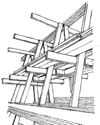
SITE-BUILT TRIM RACK
I built this trim rack because I wanted our job sites to be more efficient and organized.
1 min
May - June 2026
Translate
Change font size