Poging GOUD - Vrij
Lacing in New Boards
Old House Journal
|July - August 2021
Plank and strip flooring with isolated areas of damage can be saved with careful patching.

Flooring made of old-growth wood is beautiful, but sometimes the floor comes with an undesirable history. Termite damage, burn marks, pet stains, and signs of other mistreatment can so disfigure sections of wood that the only alternative is replacement.
Fortunately, ripping out the entire floor isn’t necessary. A bit of skillful patching can heal ancient wounds. There are two main challenges: matching the wood in all of its specifics, and “lacing in” or staggering the repair so that the patch blends with the rest of the floor.
Finding a source of replacement wood may be as simple as salvaging a few boards from the attic floor—or as time consuming as seeking out the right stock from reclaimed-lumber dealers scattered across the country. Obviously, the wood should be of the same species, be it heart pine, oak, or chestnut, and milled the same way (i.e., tongue-and-groove strip vs. shiplapped wide plank), and to the same dimensions. The cut is important too: for example, flat-sawn oak can look remarkably different from quartersawn oak once the floor is laid.
The growth rings on flat-sawn boards appear as a tangential grain—curved lines running up and down the boards, a pattern some call “cathedral arches.” Quarter-sawn wood produces boards with a vertical grain like pinstriping. The denser the original wood, the tighter the pinstriping. Less obvious but just as essential is the age of the wood. If your house was built in 1910, you want wood milled from roughly the same era.


Dit verhaal komt uit de July - August 2021-editie van Old House Journal.
Abonneer u op Magzter GOLD voor toegang tot duizenden zorgvuldig samengestelde premiumverhalen en meer dan 9000 tijdschriften en kranten.
Bent u al abonnee? Aanmelden
MEER VERHALEN VAN Old House Journal
Old House Journal
Un-muddling!
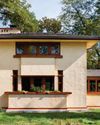
MAKING IT WRIGHT The Ross Home was completed in 1916 as part of a small subdivision called Ravine Bluffs, in Glencoe, Illinois, designed by Frank Lloyd Wright.

1 min
May - June 2026

Old House Journal
Vintage, Retro, Wow
For their own house, this artistic pair created an eclectic farmhouse kitchen.
3 mins
May - June 2026

Old House Journal
New Window in a Brick House
Redundant flashings and attention to detail keep out air and water.
6 mins
May - June 2026

Old House Journal
Interpreting MCM, outdoors
ADOPTING A MID-CENTURY HOUSE, A GARDENER IS INSPIRED BY THE EXPANSIVE VIEWS FROM INSIDE TO CREATE AN INTERPRETIVE LANDSCAPE—THINKING OUTSIDE THE (GLASS) BOX.
4 mins
May - June 2026

Old House Journal
stewards of home PAST & FUTURE
In Milwaukee, a striking limestone Tudor retains its history as it gains luxury and function through a deft renovation.
3 mins
May - June 2026

Old House Journal
Eichlers get an upgrade
Performance improvements for the prized homes of an influential developer who wanted us all to be able to own one.
7 mins
May - June 2026

Old House Journal
Houses Before 1800
These are survivors in styles ancient and vernacular.
1 min
May - June 2026
Old House Journal
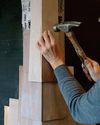
Weaving Sidewall Shingle Corners
Some house styles and shingle applications don't rely on corner boards. Here's how to make an attractive, waterproof corner.
2 mins
May - June 2026

Old House Journal
serenity IN A LANDMARK HOUSE
In Berkeley, a preservation-minded couple reinvigorate a picturesque 1914 house designed by famed California architect Julia Morgan.
4 mins
May - June 2026
Old House Journal
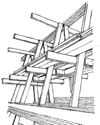
SITE-BUILT TRIM RACK
I built this trim rack because I wanted our job sites to be more efficient and organized.
1 min
May - June 2026
Translate
Change font size