Poging GOUD - Vrij
Sunspots and Activity Under Mauna Kea Volcano Keep Scientists Busy
Rock&Gem Magazine
|August 2020
Sunspots and Activity Under Mauna Kea Volcano Keep Scientists Busy

The sun at the center of our solar system goes through an 11-year solar cycle during which magnetic fields emerge, forming sunspots. At maximum points in the solar cycle, hundreds of such sunspots emerge. At a minimum, sunspots are almost altogether absent.
What difference does it make? At solar-cycle maximums, those sunspots are indicative of solar flares that release storms of magnetized solar plasma. These, in turn, produce not only beautiful northern and southern lights (the Aurora Borealis and Aurora Australis) here on Earth, they also can wreak havoc on satellites, power lines, and Earth’s climate. In fact, at the extreme end of the scale, high stellar activity can sweep away an orbiting planet’s atmosphere!
Scientists had thought our sun was stemming its magnetic activity cycle and heading toward a less active state, but, per a recent report in the journal Science, studies of other stars indicate that our sun may be just warming up. Our sun’s magnetic activity level would seem to be lower than comparable stars out there in the universe. Could this mean our sun might reach higher activity levels? And if so, what would be the consequences to our power grids, astronauts circling in space, and the atmosphere enveloping and protecting us all?
Scientists are turning ever more eyes on both our own sun and other stars, striving to resolve such questions for those of us down here on Earth.

Dit verhaal komt uit de August 2020-editie van Rock&Gem Magazine.
Abonneer u op Magzter GOLD voor toegang tot duizenden zorgvuldig samengestelde premiumverhalen en meer dan 9000 tijdschriften en kranten.
Bent u al abonnee? Aanmelden
MEER VERHALEN VAN Rock&Gem Magazine
Rock&Gem Magazine
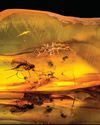
A New Amber Locality Fills a Gap
A sandstone quarry in central Ecuador has yielded the first significant deposit of Mesozoic amber from South America.

1 min
January / February 2026
Rock&Gem Magazine
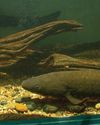
Did "Left-Handed" Fish Leave Water Earlier than Thought?
Fossil evidence suggests that fish (or \"fishapods\") dragged themselves onto land during the middle Devonian Period.
1 min
January / February 2026
Rock&Gem Magazine
"Lab Quakes” Produce Surprising Results
When faults let loose and earthquakes result, the main effect we mortals experience is the violent shaking.
1 min
January / February 2026
Rock&Gem Magazine
This Egg is No Spring Chicken
How to date a dino egg
1 min
January / February 2026
Rock&Gem Magazine
Have we Already Mined the Critical Minerals We Need
Then why are we throwing them away?!
1 min
January / February 2026
Rock&Gem Magazine
One Toxic Worm
A critter that creates & tolerates orpiment!
1 min
January / February 2026
Rock&Gem Magazine
ROCK & GEM FIELD GUIDE: Silver
Silver (Ag) is a native element and one of Earth's most prized precious metals.
2 mins
January / February 2026
Rock&Gem Magazine
DINOSAURS OF THE HELL CREEK MUSEUM
In the Badlands of South Dakota, just outside the small town of Belle Fourche—pronounced “Bell Foosh”—a new attraction has taken shape that every dinosaur enthusiast should see. The Dinosaurs of the Hell Creek Museum is part hands-on exhibit, part science center and part active research lab.
3 mins
January / February 2026
Rock&Gem Magazine
The Lost Twins of Kongsberg
A Silver Story Resurfaced
3 mins
January / February 2026
Rock&Gem Magazine
Switzerland's ICE PALACE
Walk Inside a Glacier at The Top of Europe
7 mins
January / February 2026
Translate
Change font size