
Ga onbeperkt met Magzter GOLD
Krijg onbeperkte toegang tot meer dan 9000 tijdschriften, kranten en Premium-verhalen voor slechts
ICELAND SPAR: THROUGH THE LOOKING-GLASS
Rock&Gem Magazine
|April 2023
In Through the Looking-Glass, the sequel to Alice's Adventures in Wonderland, author Lewis Carroll used the title phrase as a metaphor for peering into a world where nothing was quite what it seemed. When it came to understanding the mysterious nature of light, the "looking glass" for early scientists was optical calcite or Iceland spar.

Specimens of the Iceland spar variety of calcite are popular items in rock shops and at gem-and-mineral shows. Looking like miniature ice cubes, these colorless, transparent, cleaved rhombohedrons sell for only a few dollars each. But the commonplaceness of these little rhombohedrons belies a fascinating history that has a profound impact on science and technology.
Calcite (calcium carbonate, CaCO3) crystallizes in the trigonal system and is slightly denser than quartz. Pure calcite is colorless, but impurities impart a range of soft colors. With its weak ionic bonding, calcite is rather soft (Mohs 3.0) and cleaves easily into rhombohedrons.
Birefringence is calcite's most notable property. This ability to polarize light and refract it in two slightly different directions creates the double images seen when objects are viewed through Iceland spar crystals.
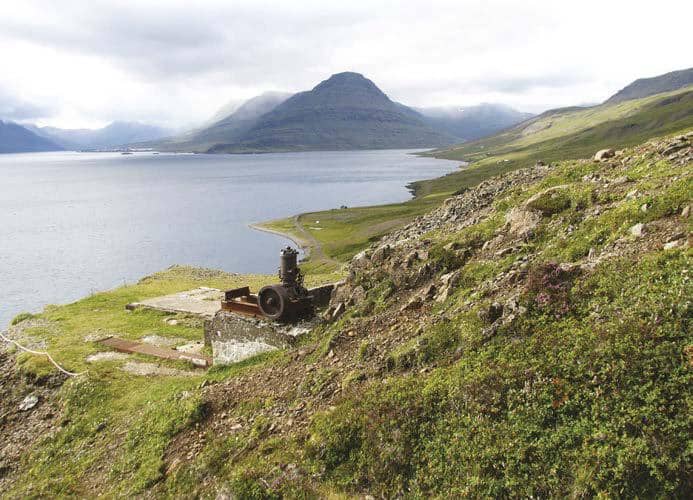
SUN STONE
Centuries before the magnetic compass was introduced to Europe, Viking mariners were demonstrating an uncanny ability to navigate the northern seas, even when cloudiness and fog obscured the sun or when the sun was below the horizon.
Icelandic monastery texts dating to 1250 mention a sólarsteinn (sun stone) that the Vikings used to determine the sun's position without direct solar sightings. When a sun stone was held against the eye while scanning the horizon, polarized light cast two shadowy images upon the retina. The horizontal deflection at which their darkness equalized accurately indicated the position of the unseen sun.

Dit verhaal komt uit de April 2023-editie van Rock&Gem Magazine.
Abonneer u op Magzter GOLD voor toegang tot duizenden zorgvuldig samengestelde premiumverhalen en meer dan 9000 tijdschriften en kranten.
Bent u al abonnee? Aanmelden
MEER VERHALEN VAN Rock&Gem Magazine
Rock&Gem Magazine
A New Amber Locality Fills a Gap
A sandstone quarry in central Ecuador has yielded the first significant deposit of Mesozoic amber from South America.

1 min
January / February 2026
Rock&Gem Magazine
Did "Left-Handed" Fish Leave Water Earlier than Thought?
Fossil evidence suggests that fish (or \"fishapods\") dragged themselves onto land during the middle Devonian Period.
1 min
January / February 2026
Rock&Gem Magazine
"Lab Quakes” Produce Surprising Results
When faults let loose and earthquakes result, the main effect we mortals experience is the violent shaking.
1 min
January / February 2026
Rock&Gem Magazine
This Egg is No Spring Chicken
How to date a dino egg
1 min
January / February 2026
Rock&Gem Magazine
Have we Already Mined the Critical Minerals We Need
Then why are we throwing them away?!
1 min
January / February 2026
Rock&Gem Magazine
One Toxic Worm
A critter that creates & tolerates orpiment!
1 min
January / February 2026
Rock&Gem Magazine
ROCK & GEM FIELD GUIDE: Silver
Silver (Ag) is a native element and one of Earth's most prized precious metals.
2 mins
January / February 2026
Rock&Gem Magazine
DINOSAURS OF THE HELL CREEK MUSEUM
In the Badlands of South Dakota, just outside the small town of Belle Fourche—pronounced “Bell Foosh”—a new attraction has taken shape that every dinosaur enthusiast should see. The Dinosaurs of the Hell Creek Museum is part hands-on exhibit, part science center and part active research lab.
3 mins
January / February 2026
Rock&Gem Magazine
The Lost Twins of Kongsberg
A Silver Story Resurfaced
3 mins
January / February 2026
Rock&Gem Magazine
Switzerland's ICE PALACE
Walk Inside a Glacier at The Top of Europe
7 mins
January / February 2026
Translate
Change font size