
Ga onbeperkt met Magzter GOLD
Krijg onbeperkte toegang tot meer dan 9000 tijdschriften, kranten en Premium-verhalen voor slechts
Poging GOUD - Vrij
SISAL FIBRE SPINNING
Textile Value Chain
|July 2020
Highlight of the article:Sisal fiber obtained from the plant Agave Sisalana, yields a stifffibre, traditionally used in making twine, rope and also dartboards. Today Brazil is major world producer of sisal.The first commercial plantings in Brazil were made in late 1930’s and the first sisal fibre exports from there were made in 1946. Sisal plants consists of a rosette of sword-shaped leaves about 1.5 to 2 meters long.Young leaves may have a few minute thin along their margins, but lose them as they mature. The sisal plant has a 7-10 years life time and typically produces 200-250 commercially usable leaves. Traditionally, sisal has been the leading material for agricultural twin (binder twin and baler twin) because of its strength, durability to stretches, affinity for certain dyestuffs, and resistance to deteriorstion in salt water.But the importance of this traditional use is diminishing with competition from polypropylene and the development of other haymaking techniques, while new higher-valued sisal has been developed.

Natural fibres are fibres that are produced by plants, animals, and geological processes. One of the most widely used natural fibers is Sisal fiber. It is also very easily cultivated. You can obtain Sisal fiber from Sisal plant. The plant, was formally known as Agave Sisalana. These plants produce rosettes of sword-shaped leaves which start out toothed, and gradually lose their teeth with maturity. Decortication is a process in which every leaf loses its long, straight fibers. During decortication, the leaves are beaten down to remove the pulp and plant material, leaving the tough fibers behind.
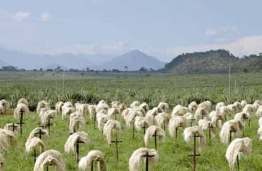
Sisal fiber is a high renewable source of energy , also it is fully biodegradable. Green composites were fabricated with soy protein resin which were modified with gelatin. Sisal fiber, modified soy protein resins, and composites were characterized for their mechanical and thermal properties. Sisal fibre is low maintenance with minimal wear and tear, and exceptionally durable. It is not suitable for a smooth wall finish and also not recommended for wet areas, because it is too tough for textiles and fabrics.

Dit verhaal komt uit de July 2020-editie van Textile Value Chain.
Abonneer u op Magzter GOLD voor toegang tot duizenden zorgvuldig samengestelde premiumverhalen en meer dan 9000 tijdschriften en kranten.
Bent u al abonnee? Aanmelden
MEER VERHALEN VAN Textile Value Chain

Textile Value Chain
The New Age of Men's Tailoring: From Bespoke to Hybrid Models
Part 1 of the Series: The Evolving World of Men's Tailored Wear

4 mins
January 2026

Textile Value Chain
The Textile Landscape of 2025: A Year of Transformation
Navigating Policy Reforms, Trade Agreements, and Global Events
5 mins
January 2026
Textile Value Chain
Recycled Fibres vs Virgin Fibres: The Real Cost, Footprint & Business Opportunity
For decades, the textile industry asked only one question when choosing raw material:
3 mins
January 2026

Textile Value Chain
2025 in Perspective: A Stronger, Cleaner, Smarter Future for Textiles
The year 2025 reminded the textile and apparel sector that resilience now matters more than pace.
5 mins
January 2026
Textile Value Chain
Heimtextil as a Working lab for Sutlej and its Customers
When the global home textiles industry gathers in Frankfurt this January, Sutlej Textiles is approaching Heimtextil with a clear intent: to treat the fair less as a product parade and more as a live development lab with its buyers and partners.
4 mins
January 2026

Textile Value Chain
Weaving Heritage into Future: A Conversation with Ms Roop Rashi Mahapatra
In an era where fast fashion dominates the global textile landscape, Khadi stands as a timeless symbol of India's heritage, sustainability, and self-reliance.
11 mins
January 2026

Textile Value Chain
Home Textiles: Ever-growing Market to Evergreen Product Source
Indian Home textiles have always enjoyed a special market position, and demand continues to increase, capturing a premium to the budgeted market across different markets, but with one constant hunger for extraordinary design, a super comfortable feel, and the appeal of sophistication, along with changing market dynamics.
4 mins
January 2026

Textile Value Chain
The Velvet Revolution: How This Timeless Fabric is Redefining Modern Textiles
When you run your hand across velvet, something happens.
3 mins
January 2026

Textile Value Chain
SPGPrints Achieves Landmark Success at ITMA ASIA 2025 With Transformative Textile Printing Technology and Key Order Closures
SPGPrints, the global leader in innovative textile printing solutions, announced an overwhelmingly successful participation in ITMA ASIA 2025 at the Singapore Expo.
2 mins
January 2026

Textile Value Chain
Development of Home Textile Products from Post-Consumer Textile Waste
With the growing concern over textile waste and its environmental impact, sustainable approaches for fabric reuse are urgently needed.
5 mins
January 2026
Translate
Change font size