Poging GOUD - Vrij
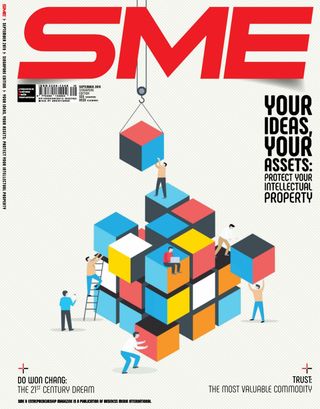
Trust: The Most Valuable Commodity
SME Magazine Singapore
|September 2019
Buffett’s observation about trust in business has only become more important in today’s interconnected world. In an age where information (and misinformation) travels at the speed of social media, trust is more important than ever to business success and sustainability over the long term. More than ever, integrity is the ultimate brand attribute.

Companies build trust on a daily basis in routine interactions with customers, consistently delivering on their promises or going to great lengths to rectify the situation when they cannot. They behave as if their customers’ satisfaction and wellbeing are their most important considerations, leaving customers with a feeling of partnership rather than adversity. Or so the idea goes.
However, many organisational cultures encourage opportunistic behaviour, whether purposely or inadvertently. Poor moral leadership, performance incentives that lead employees to be single-mindedly hypercompetitive, lack of open and frequent discussion of ethical implications—such attributes make it more likely that employees will view relationships with customers and even fellow employees with a zero-sum mentality.
Across the world, trust in established institutions has been falling—whether it’s in government, non-governmental organizations, or business. According to the long-running Edelman Trust Barometer, businesses, government, and media have all seen a drop in trust over the past decade. In addition, Gallup research also show that worldwide, two-thirds of adults say corruption is widespread in business.
Consequently, businesses worldwide are suffering from a trust deficit. Even for well-managed companies, establishing a reputation for integrity can be a challenge in the modern era, as employees, customers and investors in most countries start from a point of scepticism.
Does this matter? Yes, for two reasons. One is that the evaporation of trust in some key institutions is directly damaging for economic growth. The general distrust of business, not only banks but also spreading to energy companies, retailers, food producers and others, will tend to encourage unnecessary (as well as necessary) regulation and contribute to the climate of uncertainty holding back investment.

Dit verhaal komt uit de September 2019-editie van SME Magazine Singapore.
Abonneer u op Magzter GOLD voor toegang tot duizenden zorgvuldig samengestelde premiumverhalen en meer dan 9000 tijdschriften en kranten.
Bent u al abonnee? Aanmelden
MEER VERHALEN VAN SME Magazine Singapore

SME Magazine Singapore
Cloud- Driven Recovery
With digital transformation being an important catalyst for Malaysia’s inclusive economic recovery, cloud computing plays an important role that enables . the country to acquire the advantages that technology offers.

5 mins
Issue 40, 2021
SME Magazine Singapore
Live Werkz: Venturing Beyond Southeast Asia
Being forward-looking in its approach has enabled LiveWerkz Pte Ltd to survive the Covid-19 pandemic, says vice president Tricia Ng. Despite being a Singaporean company, the company does not focus its efforts in the Southeast Asia region. Instead, Greater China and the Middle East become the foundation for its businesses. Ng tells SME the company’s strategies in facing a challenging future.
2 mins
Issue 42, 2021
SME Magazine Singapore
Singapore's Go Digital Well Received
More than 78,000 of Singapore’s SMEs have participated in the country’s Go Digital programme since its 2017 launch, with more about 40,000 becoming participants last year, including 30,000 that received Covid-19 incentives from the government.
2 mins
Issue 42, 2021

SME Magazine Singapore
Accountants And SMEs: Creating A Sustainable World
For SME finance professionals, ‘sustainability’ is about achieving longevity. However, there is a confusion over different definitions of sustainability. They recognise the growing importance of tackling sustainability issues but lack the understanding of how doing this can be integrated into day-to-day practices within the finance function.
5 mins
Issue 42, 2021

SME Magazine Singapore
Rebuilding Our Mental Well-Being In Sales
Sue Barrett is a writer, training provider and entrepreneur who founded Barrett in 1995 to positively transform the culture, capability and continuous learning of leaders, teams and businesses.
2 mins
Issue 42, 2021

SME Magazine Singapore
Omicron: A Test Of Resilence
Global manufacturers have been facing a supply chain crisis since the start of the year. Just as it appeared that the situation was beginning to stabilise, the Omicron Covid variant reared its ugly head.
6 mins
Issue 42, 2021

SME Magazine Singapore
Silver Lining In The Cloud
Although RAS Security Pte Ltd’s business was adversely affected by the pandemic, there’s a silver lining in the cloud. The occurrence has necessitated the company to innovate its business model to remain viable and led to the discovery of new areas of security service provision. Managing director Tejdeep Singh shares his journey.
2 mins
Issue 40, 2021
SME Magazine Singapore
Accelerating Artificial Intelligence
Singapore is introducing two new public artificial intelligence (AI) programmes as part of the strategy to use technology for social and economic good, involving a total allocation of S$680 million to accelerate AI research. The latest initiatives require a funding of S$180 million.
2 mins
Issue 40, 2021

SME Magazine Singapore
Three Tips For Hiring Top Talents
BIG EGOS LOSE TALENTS First up, when it comes to hiring, you must put aside your ego.
2 mins
Issue 40, 2021

SME Magazine Singapore
The Economy Is Recovering, But What About People?
All signs are pointing towards a speedy recovery. Contrary to what this writer initially predicted, the economy seems to be genuinely recovering.
3 mins
Issue 40, 2021
Translate
Change font size