Poging GOUD - Vrij
Building Resilience
Indian Management
|April 2017
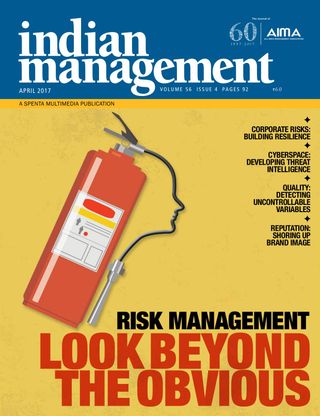
A structured approach that merely complies with regulations is not enough to manage risks. Unconventional thinking is the need of the hour.

I am a preferred flyer with Emirates and choose the airline for all my flights to the US and select parts of Europe. March 22, 2017, the UK and US governments imposed a ban on passengers carrying laptops in the cabin from six airports around the world. Dubai is one of them. This is an external risk. I will now fly through a ‘US and UK friendly’ airport. However, Emirates will be directly impacted. They have deployed their best assets on those sectors. If Emirates has not factored this risk, given its business model they will find it difficult to mitigate it. The impact will touch every bit of Emirates—financials, brand image, fleet management, customer loyalty programmes, employees, investors, and many more. This development is a clear indicator of how risk has changed in the last two decades and the speed of its change in the last five years.
The ‘risk mix’ is changing at a pace of knots. ‘Risk mutation’ like virus mutation is the new phenomenon that is developing. Most conventional risks have now become ‘hygiene’ checks for businesses. Companies are redrawing their risk management plans and reviewing it at a higher frequency. It is not being managed in operational silos anymore. Risk management is a high weightage item on the boards’ agenda. It sometimes matters a lot more than growth plans. This is primarily because the danger may be in the blind spots caused by the lack of an integrated view of operational activities or in areas not considered to be at risk. The Emirates example is a case in point.

Dit verhaal komt uit de April 2017-editie van Indian Management.
Abonneer u op Magzter GOLD voor toegang tot duizenden zorgvuldig samengestelde premiumverhalen en meer dan 9000 tijdschriften en kranten.
Bent u al abonnee? Aanmelden
MEER VERHALEN VAN Indian Management

Indian Management
The 'BHAG' Imperative
From George P. Mitchell's shale breakthrough to ISRO's space success, bold national goals show how vision and persistence can drive India toward energy independence.

3 mins
May 2026

Indian Management
Grassroots governance
Economic growth alone will not make India developed-strong grassroots governance, accountability, and respect for the rule of law must lead the way.
4 mins
May 2026

Indian Management
The power of purpose
When purpose is clear, authentic storytelling turns it into real impact.
4 mins
May 2026

Indian Management
The vanishing middle
In an age where AI is reshaping the role of middle management, what must leaders do to remain relevant?
4 mins
May 2026

Indian Management
The real innovation risk
Innovation thrives not in limitless freedom, but within clearly defined boundaries that focus creativity and drive meaningful progress, opines Sheri Jacobs, FASAE, CAE, President and CEO, Avenue M Group and author, Unexpected Power of Boundaries.
5 mins
May 2026

Indian Management
Discomfort drives inclusion
When it comes to both work and life, none of us enjoys discomfort.
5 mins
May 2026
Indian Management
Purpose and authentic storytelling together drive organisational success
The most enduring organisations are remembered for more than their products, profits or scale.
2 mins
May 2026

Indian Management
Humanity over automation
When leaders start acting like machines, machines start acting like leaders
5 mins
April 2026

Indian Management
The focus advantage
Startups fail for many reasons: teams break apart, funding runs out, markets shift.
5 mins
April 2026
Indian Management
Human-Centred Leadership in the Age of AI
Artificial Intelligence (AI) is rapidly redefining the operational and competitive landscape across industries.
3 mins
April 2026
Translate
Change font size