
Ga onbeperkt met Magzter GOLD
Krijg onbeperkte toegang tot meer dan 9000 tijdschriften, kranten en Premium-verhalen voor slechts
Poging GOUD - Vrij
Hungry? Grub's Up!
Farmer's Weekly
|January 17, 2020
As the popularity of alternative protein sources rises, the idea of consuming insects has become more palatable to the general population. While insect farming is still a long way from being commercialised on a mass scale, opportunities for both human and animal consumption are set to increase. Lindi Botha spoke to Prof Margaret Matanda from the University of Sydney Business School, Australia, about research being conducted on the feasibility of the industry.

What is the value of the edible insects industry?
Insects are consumed by over two billion people worldwide. The UN estimates that the global edible insect market will be worth $8 billion [about R115 billion] in 10 years.
According to the UN, the world’s population is expected to increase to nine billion by 2040. To provide this number with nutritionally balanced meals that are economically feasible, food production has to increase by 40%.
With insect farming, less space, and fewer agricultural chemical inputs, energy and fuel are required, which means that insects have a much smaller carbon footprint than cattle or poultry. This also makes insect production more sustainable than other forms of protein, so its value in terms of benefits to the environment and global food chains is also noteworthy.
What type of insects are edible and suitable for commercialisation?
Edible insects vary a lot across countries. What is ultimately consumed is influenced by cultural factors as well as religious beliefs. However, in East and Southern Africa there’s a higher acceptance and consumption of edible insects than in other parts of the world.
Research and development efforts are already underway to consolidate the role of edible insects in boosting food and nutritional security in the region. In most Southern African countries, edible insects include mopane worms (the larvae of the emperor moth
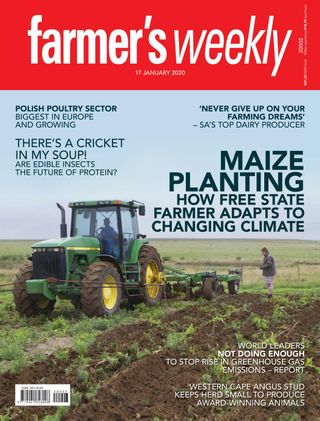

Dit verhaal komt uit de January 17, 2020-editie van Farmer's Weekly.
Abonneer u op Magzter GOLD voor toegang tot duizenden zorgvuldig samengestelde premiumverhalen en meer dan 9000 tijdschriften en kranten.
Bent u al abonnee? Aanmelden
MEER VERHALEN VAN Farmer's Weekly
Farmer's Weekly
Cash flow budgets: keeping farmers in control of liquidity, risk, and their survival
Profit doesn't guarantee a farm's survival - cash does. Cobus du Plessis explains why cash flow budgets are one of the most important yet underused financial tools on South African farms.

5 mins
February 27 - March 06, 2026

Farmer's Weekly
The toast of the Navy
The incredible story of the World War II-era Great Dane dog Nuisance being enlisted in the Royal Navy is well documented. Graham Jooste shared some entertaining anecdotes involving the canine shipmate.
6 mins
February 27 - March 06, 2026
Farmer's Weekly
Healthier soils deter destructive locusts
Locust swarms remain a serious global threat, capable of devastating crops, livelihoods and local economies across vast regions.
1 min
February 27 - March 06, 2026
Farmer's Weekly
Wheat crisis dominates Grain SA regional meetings
As the ongoing wheat crisis continues to erode producers' margins, emotions ran high at Grain SA's regional meeting in Moorreesburg in the Western Cape.
2 mins
February 27 - March 06, 2026

Farmer's Weekly
A FARMER'S EXPERIENCE
Street Wallet has been a game-changer for Mario Athanasopoulos, hydroponic production consultant and owner of Green City Farms.
1 mins
February 27 - March 06, 2026
Farmer's Weekly
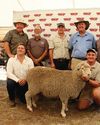
Kesieberg Merino Stud Production Sale
The Kesieberg Merino Stud Production Sale was held on the farm Leeuwfontein on 4 February on behalf of Willie and Herman Henning.
1 min
February 27 - March 06, 2026

Farmer's Weekly
Not cheaper, just different: what you should know about farming in Mozambique
Although Mozambique is often viewed as a cheaper, easier farming location than South Africa, cost comparisons tell a more complex story. But while cross-border production presents real challenges, it also offers opportunities for complementary trade, diversification and regional food security, particularly when it comes to subtropical crops such as bananas.
10 mins
February 27 - March 06, 2026

Farmer's Weekly
The all-rounder anchoring South Africa's beef value chain
Louis Steyl, CEO of the Bonsmara Cattle Breeders' Society of South Africa, spoke to Octavia Avesca Spandiel about how the versatile Bonsmara breed anchors the country's beef value chain, delivering balanced performance, reproductive and feed efficiency, and carcass traits across extensive and intensive systems.
6 mins
February 27 - March 06, 2026

Farmer's Weekly
THE HITCHING POST
I'm a 60-year-old white woman who loves camping, animals, the outdoors, and watching sport.
2 mins
February 27 - March 06, 2026
Farmer's Weekly
Foot-and-mouth disease in pigs
Recently, the radio news mentioned an outbreak of foot-and-mouth disease (FMD) in pigs in South Africa.
2 mins
February 27 - March 06, 2026
Translate
Change font size