
Ga onbeperkt met Magzter GOLD
Krijg onbeperkte toegang tot meer dan 9000 tijdschriften, kranten en Premium-verhalen voor slechts
Poging GOUD - Vrij
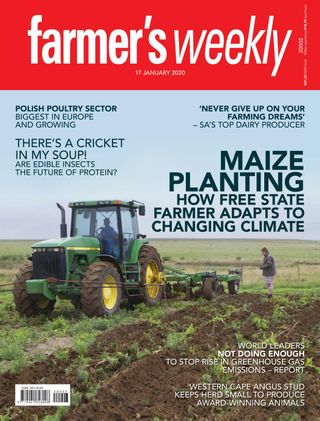
Greenhouse Gas Emissions Continue To Rise
Farmer's Weekly
|January 17, 2020
Despite calls for governments and policymakers to take an active approach to the issue of global warming, a new report by the World Meteorological Organization shows that the rate of increase of greenhouse gas emissions is still above average. If urgent steps are not taken to reduce these emissions, the world will suffer catastrophic consequences, the report warns.
-

Levels of heat-trapping greenhouse gases in the atmosphere have reached a record high. This continuing long-term trend means that future generations will be confronted with increasingly severe impacts of climate change, including rising temperatures, more extreme weather, water stress, sea-level rise, and disruption to marine and land ecosystems.
The World Meteorological Organization (WMO) Greenhouse Gas Bulletin shows that globally averaged concentrations of carbon dioxide (CO2) reached 407,8 parts per million (ppm) in 2018, up from 405,5 ppm in 2017.
The increase in CO2 was very close to that observed from 2016 to 2017, and just above the average over the last decade. Global levels of CO2 crossed the symbolic and significant 400 ppm benchmark in 2015. Carbon dioxide remains in the atmosphere for centuries, and in the oceans for even longer.
Concentrations of methane and nitrous oxide also surged by higher amounts than during the past decade, according to the Global Atmosphere Watch network, which has stations in the remote Arctic, mountain areas and tropical islands.
Since 1990, there has been a 43% increase in total radiative forcing (the warming effect on the climate) by longlived greenhouse gases. Carbon dioxide accounts for about 80% of this, according to figures from the US National Oceanic and Atmospheric Administration.
The last time the Earth experienced a comparable concentration of CO2 was three to five million years ago. At this time, temperatures were 2°C to 3°C warmer, and the sea level was 10m to 20m higher.
Emissions gap

Dit verhaal komt uit de January 17, 2020-editie van Farmer's Weekly.
Abonneer u op Magzter GOLD voor toegang tot duizenden zorgvuldig samengestelde premiumverhalen en meer dan 9000 tijdschriften en kranten.
Bent u al abonnee? Aanmelden
MEER VERHALEN VAN Farmer's Weekly
Farmer's Weekly
Cash flow budgets: keeping farmers in control of liquidity, risk, and their survival
Profit doesn't guarantee a farm's survival - cash does. Cobus du Plessis explains why cash flow budgets are one of the most important yet underused financial tools on South African farms.

5 mins
February 27 - March 06, 2026

Farmer's Weekly
The toast of the Navy
The incredible story of the World War II-era Great Dane dog Nuisance being enlisted in the Royal Navy is well documented. Graham Jooste shared some entertaining anecdotes involving the canine shipmate.
6 mins
February 27 - March 06, 2026
Farmer's Weekly
Healthier soils deter destructive locusts
Locust swarms remain a serious global threat, capable of devastating crops, livelihoods and local economies across vast regions.
1 min
February 27 - March 06, 2026
Farmer's Weekly
Wheat crisis dominates Grain SA regional meetings
As the ongoing wheat crisis continues to erode producers' margins, emotions ran high at Grain SA's regional meeting in Moorreesburg in the Western Cape.
2 mins
February 27 - March 06, 2026

Farmer's Weekly
A FARMER'S EXPERIENCE
Street Wallet has been a game-changer for Mario Athanasopoulos, hydroponic production consultant and owner of Green City Farms.
1 mins
February 27 - March 06, 2026

Farmer's Weekly
Kesieberg Merino Stud Production Sale
The Kesieberg Merino Stud Production Sale was held on the farm Leeuwfontein on 4 February on behalf of Willie and Herman Henning.
1 min
February 27 - March 06, 2026
Farmer's Weekly
Not cheaper, just different: what you should know about farming in Mozambique
Although Mozambique is often viewed as a cheaper, easier farming location than South Africa, cost comparisons tell a more complex story. But while cross-border production presents real challenges, it also offers opportunities for complementary trade, diversification and regional food security, particularly when it comes to subtropical crops such as bananas.
10 mins
February 27 - March 06, 2026
Farmer's Weekly
The all-rounder anchoring South Africa's beef value chain
Louis Steyl, CEO of the Bonsmara Cattle Breeders' Society of South Africa, spoke to Octavia Avesca Spandiel about how the versatile Bonsmara breed anchors the country's beef value chain, delivering balanced performance, reproductive and feed efficiency, and carcass traits across extensive and intensive systems.
6 mins
February 27 - March 06, 2026

Farmer's Weekly
THE HITCHING POST
I'm a 60-year-old white woman who loves camping, animals, the outdoors, and watching sport.
2 mins
February 27 - March 06, 2026
Farmer's Weekly
Foot-and-mouth disease in pigs
Recently, the radio news mentioned an outbreak of foot-and-mouth disease (FMD) in pigs in South Africa.
2 mins
February 27 - March 06, 2026
Translate
Change font size