Poging GOUD - Vrij
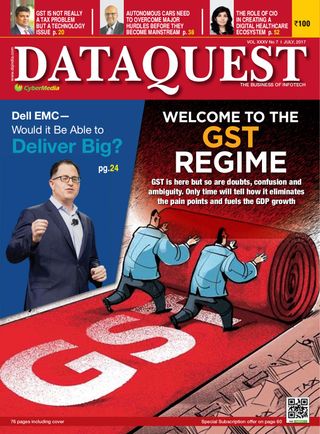
GST Is Not Really A Tax Problem But A Technology Issue
DataQuest
|July 2017
GST compliance is the hot issue with most organizations in India. And SAP has a major role to help organizations become GST-ready as most of them use SAP ERP or other applications. To understand how SAP is helping customers adopt GST-ready applications, Dataquest had a tetea-tete with Deb Deep Sengupta, President and Managing Director, SAP India

As digital India has become a buzzword presently in India, how do you see transformation in various industries?
The digital transformation is now opening up to a lot more industries in the ecosystem. We are hearing quite a bit about security from some time now. So therefore, security is going to be very critical; especially for a country like India where the mindset is not process and policy oriented. Other than that, the new tax regime is giving a huge push to the Government’s Digital India campaign. Micro, small and medium enterprises will all have to digitise their processes. More taxpayers are to come into the fold of the formal economy and move on to digital modes of payment.
We are seeing a lot of action in the market from large established and well-known technology companies to SMEs due to GST. how do you think it will impact everybody?
I think everybody knows the long-term impact of GST because it is going to increase India’s tax net. Secondly, it will make systems more transparent. As new policies that come up, there will be a lot of operatives involved. Companies that have a consistent strategy and which can support their clients and customers on a consistent basis will only be able to survive. Otherwise, they’ll just wither away. I guess it is good in a way - at least it creates awareness. Then it is for these organizations to be able to figure out whether they can sustain and whether it’s an opportunity they would want to pursue. In my opinion, whenever one market policy such as GST is rolled out, most companies aim to become compliant. The biggest advantage of GST, other than at a macro level, even at an organizational level is that it will give companies the opportunity to redesign their supply chain.

Dit verhaal komt uit de July 2017-editie van DataQuest.
Abonneer u op Magzter GOLD voor toegang tot duizenden zorgvuldig samengestelde premiumverhalen en meer dan 9000 tijdschriften en kranten.
Bent u al abonnee? Aanmelden
MEER VERHALEN VAN DataQuest

DataQuest
Engineering India's Al-First Data Centres at Hyperscale
Rohan Sheth explains how AI and HPC are reshaping India's data centres, from density and cooling to power economics, sustainability, and hyperscale decision criteria.

4 mins
February 2026

DataQuest
From copilots to colleagues: Why agentic AI is forcing enterprises to rethink control, trust, and culture
As AI agents shift from assisting to acting, enterprises must redesign governance, data controls, and security guardrails so autonomy stays auditable, reversible, and trusted.
2 mins
February 2026

DataQuest
Reclaiming Control in the AI Era: A Conversation with Kalyan Kumar, CPO, HCLSoftware
Enterprises are reassessing cloud-first strategies as AI becomes core to operations. HCLSoftware's Kalyan Kumar explains why sovereignty, choice and control now shape decisions.
5 mins
February 2026

DataQuest
When infrastructure learns: The rise of the Al-native core
AI-native infrastructure is moving from concept to operational reality, reshaping how organisations build, govern, and scale intelligence across their digital core.
6 mins
February 2026

DataQuest
Bridging the gap between connectivity and compute at scale
As AI scales in India, data centres are evolving into high-density, low-latency platforms that unify connectivity, compute, and sustainability at national scale.
4 mins
February 2026

DataQuest
PUE is not a grapefruit metric, anymore
So what are the new high-hanging fruits for data centre strategists today? And are players going after them?
4 mins
February 2026

DataQuest
Even if Al demand fades, India need not worry - about data centres
For every megawatt (MW) of installed colocation capacity, users here generate approximately 13.2 PB of data monthly- compared to 0.3 PB for Australia and just 0.01 PB for Singapore. India's data centre growth is not dependent on one tech lever. Plus, it is phased and modular and not kneejerk. Manoj Paul explains these contours in detail.
7 mins
February 2026

DataQuest
AI infrastructure and systemic risk
What has been the biggest change in data centre industry-specially after AI workloads? Is Al-bubble a big risk for data centre infra- how much will it affect data centres if something cracks?
1 min
February 2026

DataQuest
Inside the Shift to High-Density, Al-Ready Data Centres
CtrlS' Vipin Jain discusses what it truly takes to build AI-ready data centres in India, balancing high density, liquid-ready cooling, resilience, and ESG accountability.
4 mins
February 2026

DataQuest
Sustainability is now the headline, not a footnote
Sanjay Agrawal, Head Presales and CTO at Hitachi Vantara India and SAARC opines that the conversation is moving beyond headline metrics like PUE toward a broader view of how data lifecycle management and infrastructure efficiency reduce the overall environmental footprint. Let's see why and how- while also touching upon adjacent (or not-so-adjacent) factors like redundancies, availability and AI-readiness
3 mins
February 2026
Translate
Change font size